By
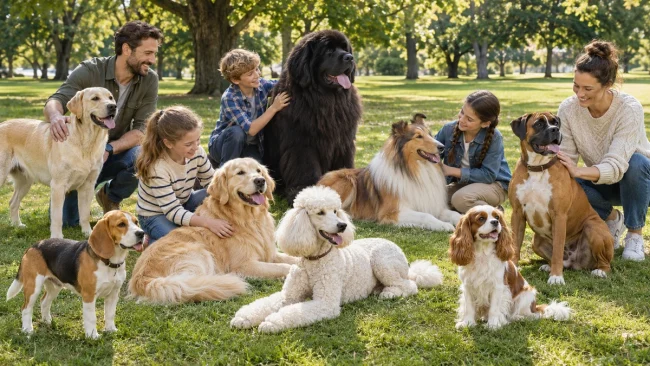
The best dog breeds for kids are not simply the cutest, smallest or most popular dogs. A good family match depends on the dog’s temperament, adult size, exercise needs, trainability and the ages and behavior of the children in the home.
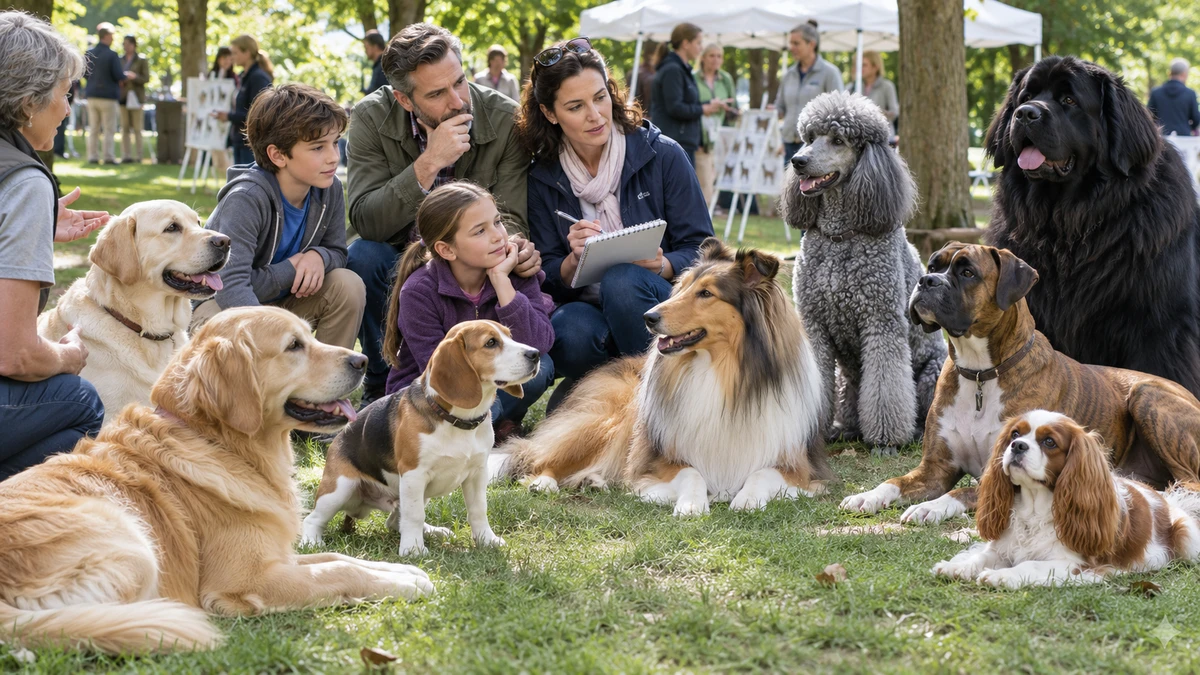
Labrador Retrievers, Golden Retrievers, Beagles, Collies, Poodles, Newfoundlands, Boxers and Cavalier King Charles Spaniels are all breeds families commonly research. Each offers different advantages, and each also comes with practical trade-offs.
A Labrador may be patient and playful but energetic enough to knock over a toddler. A Newfoundland may have an exceptionally gentle temperament but can weigh more than 100 pounds. A Beagle is compact and cheerful but may follow its nose instead of your instructions. A Standard Poodle can be highly trainable and lower shedding but needs considerable exercise and grooming.
Most importantly, no breed should be treated as automatically safe with children.
Dogs and young children should be supervised, and children need to learn how to respect the dog’s body, food, sleep and personal space.
This guide focuses specifically on children and dog compatibility. For a broader comparison of household temperament, size and lifestyle, visit our Family Dog Breeds guide.
Below, we compare popular family-friendly breeds by child age, size, activity and temperament so you can look for a dog that fits your household rather than relying on a generic “best dog for kids” ranking.
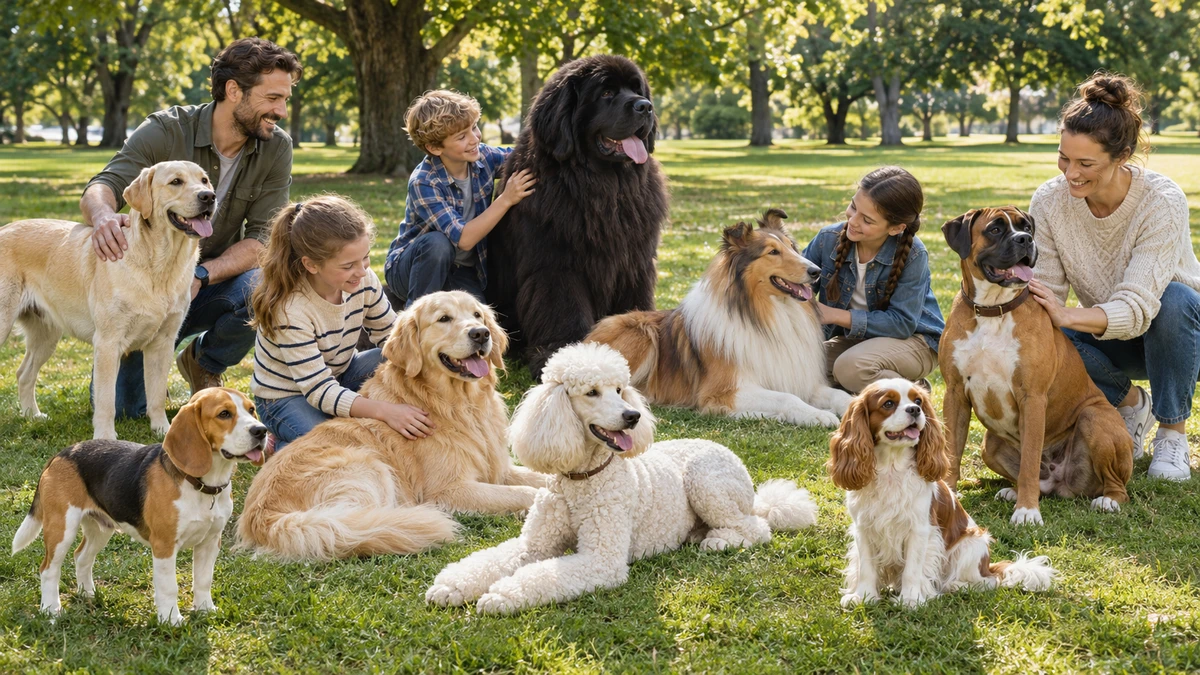
What Makes a Dog Breed Good for Kids?
A family dog does not need to tolerate anything a child might do.
Instead, useful traits can include:
- Stable temperament
- Good recovery after normal household excitement
- Trainability
- Appropriate play style
- Comfort around people
- Adult size your family can physically manage
- Exercise needs that match your routine
The dog’s individual temperament matters just as much as breed tendencies.
A responsible breeder or rescue organization should help you evaluate a particular dog’s behavior rather than promising that every member of a breed will behave identically.
If a steady, less excitable temperament is especially important in your household, our guide to calm dog breeds can help you compare temperament separately from child compatibility.
Child Age Matters
The ideal dog for a family with teenagers may be different from the ideal dog for a family with a toddler.
Babies and Toddlers
Very young children move unpredictably, make sudden noises and do not yet understand canine body language.
Adult supervision is essential.
A tiny dog can be accidentally injured, while a large enthusiastic dog can accidentally knock the child over.
School-Age Children
Older children can begin learning appropriate dog handling, participate in training and help with age-appropriate care under adult responsibility.
Teenagers
Active breeds may work particularly well when older children genuinely participate in walking, training and structured activities.
The adults in the household should still assume final responsibility for the dog.
Quick Comparison of Good Dog Breeds for Kids
| Breed | General Family Strength | Adult Size | Main Trade-Off |
|---|---|---|---|
| Labrador Retriever | Friendly, trainable, playful | 55–80 lb | High activity and youthful enthusiasm |
| Golden Retriever | Gentle, social, trainable | 55–75 lb | Exercise and shedding |
| Beagle | Cheerful, compact, social | Under 20–30 lb | Scent drive and vocalization |
| Collie | Devoted, responsive, family-oriented | 50–75 lb | Exercise and coat care |
| Standard Poodle | Highly intelligent and trainable | 40–70 lb | Exercise and grooming |
| Newfoundland | Sweet, patient temperament | 100–150 lb | Giant size, grooming and cost |
| Boxer | Playful, affectionate, protective | Large | Bouncy energy |
| Cavalier King Charles Spaniel | Gentle, affectionate, adaptable | 13–18 lb | Physical delicacy and health research |
1. Labrador Retriever
Labrador Retrievers are among the most familiar family dogs for good reason.
They are generally friendly, outgoing and highly trainable.
Adults weigh approximately 55 to 80 pounds, giving them a sturdy body that can suit active households with children.
Labs often enjoy:
- Fetch
- Swimming
- Hiking
- Training
- Family outings
That makes them especially attractive for families that want the dog actively involved in daily life.
The main trade-off is energy.
Young Labs can be extremely enthusiastic and may jump, run or play with enough force to knock over very small children unintentionally.
Training and daily exercise are therefore essential.
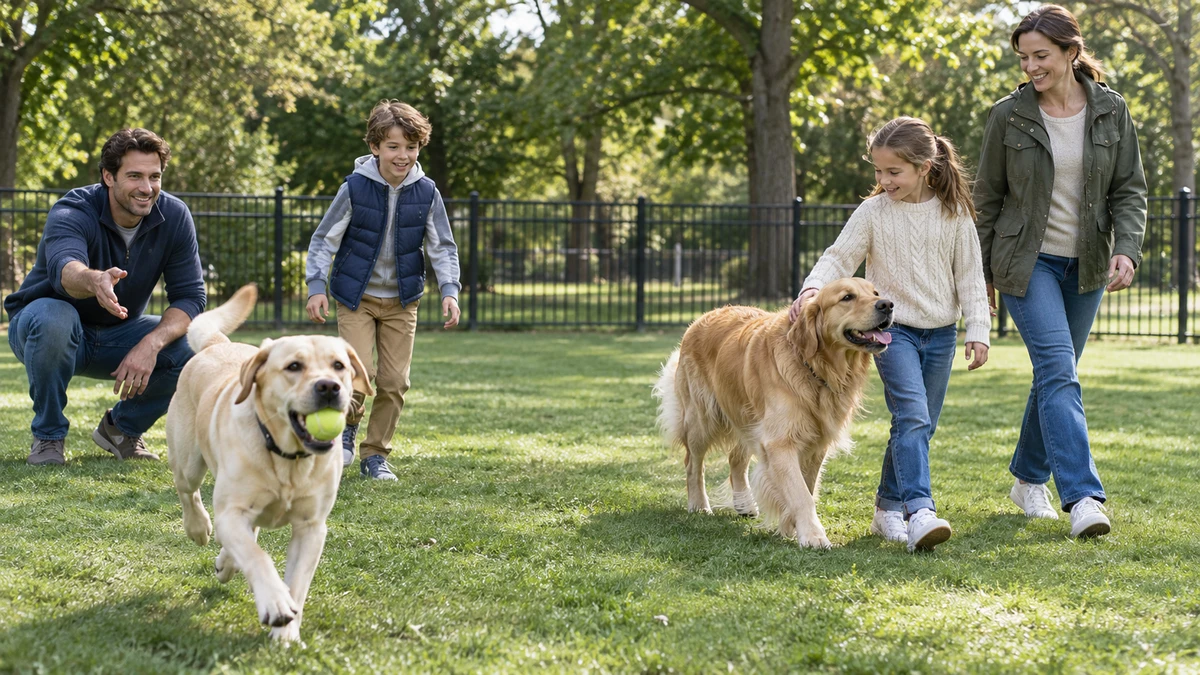
2. Golden Retriever
Golden Retrievers are another classic choice for families with children.
They are known for friendly, affectionate and generally patient temperaments.
Goldens typically weigh approximately 55 to 75 pounds and have enough physical substance for active family life.
They are highly social and usually enjoy being involved in household activities.
Like Labradors, they need substantial daily exercise.
Families should also be comfortable with:
- Regular brushing
- Seasonal shedding
- Training an energetic young dog
- Providing mental stimulation
For an active family wanting a dog that can participate in walks, games and outings, both retriever breeds are strong candidates.
3. Beagle
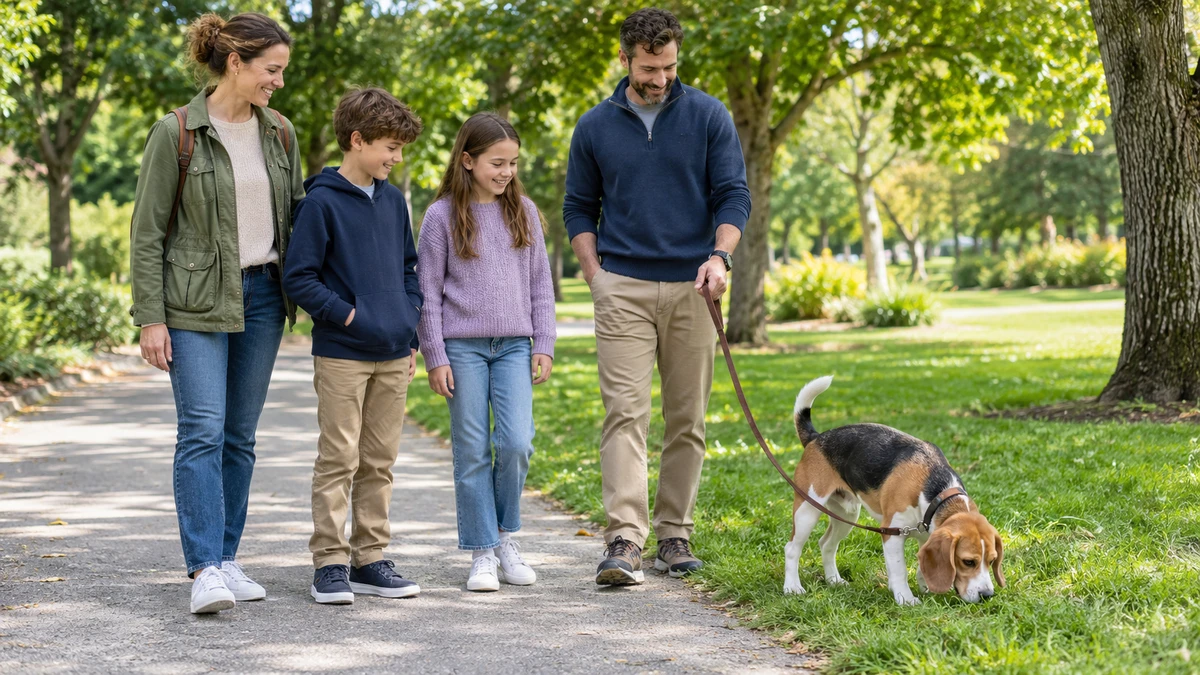
Beagles provide a more compact family-dog option.
AKC recognizes two size varieties: dogs 13 inches and under generally weigh under 20 pounds, while those between 13 and 15 inches commonly weigh about 20 to 30 pounds.
They are generally cheerful, social dogs that enjoy being part of family activity.
Their smaller size makes them physically easier to transport and manage than a Labrador or Newfoundland.
But Beagles are scent hounds.
Expect:
- Strong interest in smells
- Need for secure leash or fenced management
- Independent decision-making
- Potential vocalization
- Regular exercise
A Beagle may be wonderful with a child and still completely ignore a recall cue when an exciting scent appears.
4. Collie
Collies have a long reputation as family-oriented dogs.
They are famously associated with children, intelligence and responsiveness to gentle training.
Adults generally weigh approximately 50 to 75 pounds.
Both Rough and Smooth Collies share the same breed temperament, although their grooming requirements differ substantially.
Collies generally benefit from:
- Regular exercise
- Training
- Time with their family
- Mental activity
Their herding background can sometimes influence behavior around moving children, so appropriate training remains important.
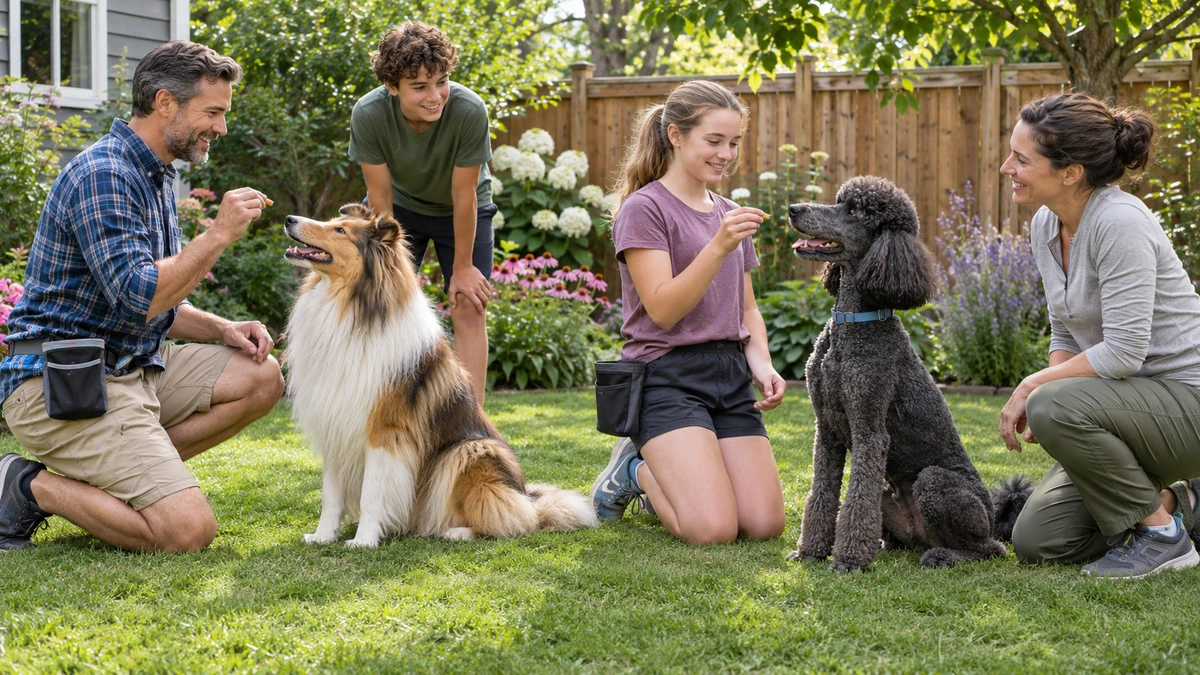
5. Standard Poodle
The Standard Poodle can be an excellent family dog for households that want an intelligent, athletic and highly trainable companion.
Standard Poodles weigh roughly 40 to 70 pounds depending on sex.
They are active dogs that can enjoy:
- Swimming
- Fetch
- Hiking
- Obedience
- Dog sports
- Interactive games
Their curly coat releases relatively little loose hair, but that advantage comes with regular grooming and clipping.
A Poodle is therefore not automatically an easy-care family dog simply because it sheds less.
The breed tends to work best in families prepared to provide both physical activity and mental engagement.
6. Newfoundland
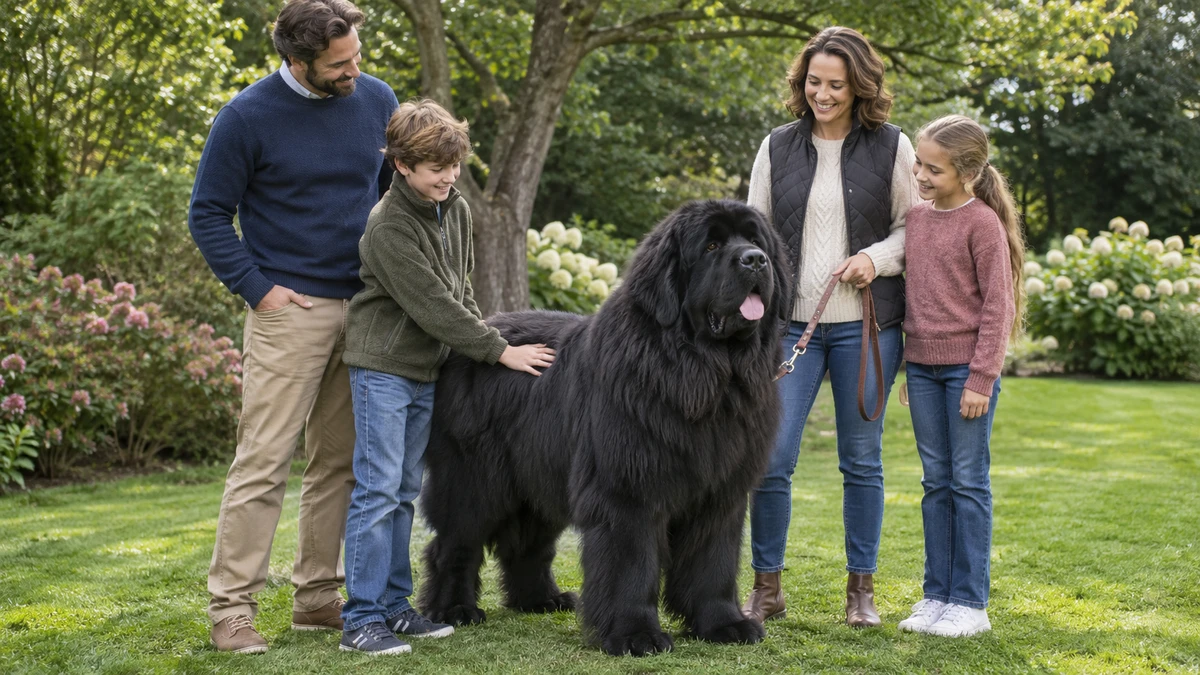
The Newfoundland is famous for a sweet, patient temperament and strong attachment to people.
But families should look beyond the gentle reputation and understand the enormous adult size.
Adult females commonly weigh about 100 to 120 pounds, while males may reach approximately 130 to 150 pounds.
That creates practical considerations around:
- Training
- Transport
- Food
- Grooming
- Floor space
- Veterinary handling
A calm Newfoundland can still accidentally knock over a small child.
Early leash manners and household training are especially important because of the breed’s strength.
The heavy coat also requires regular maintenance.
7. Boxer
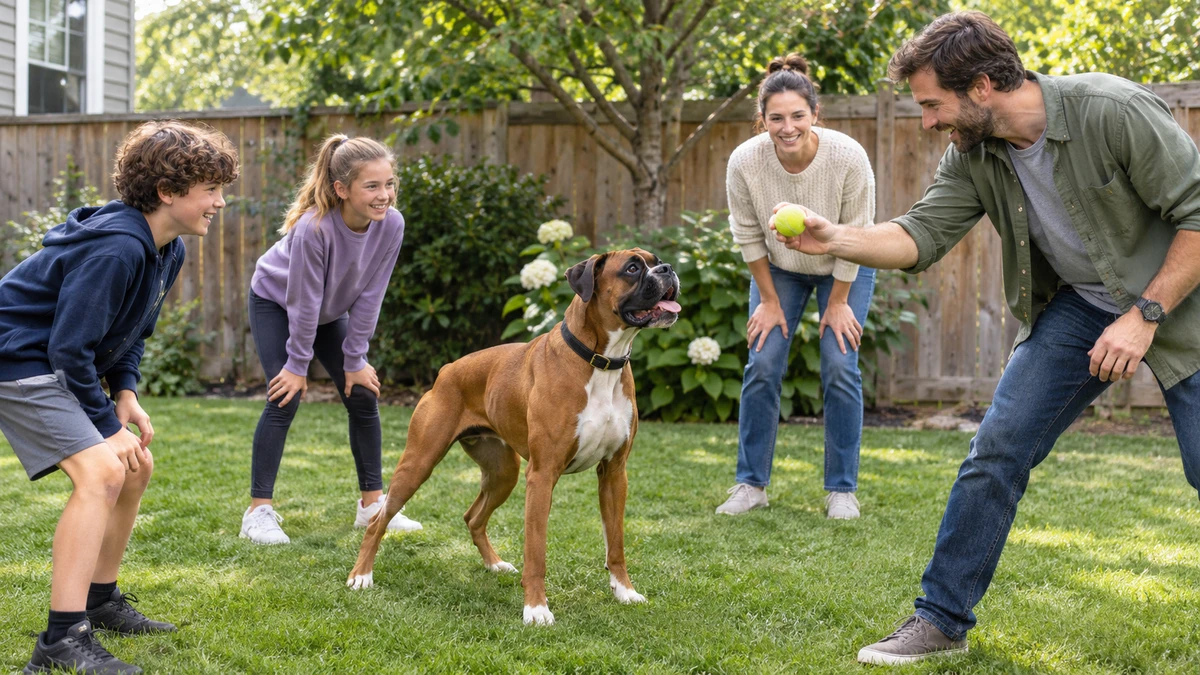
Boxers are affectionate, playful and strongly attached to their families.
They are also energetic.
Boxers can be good with children but may be less practical around very small children because their excited, bouncy play can be physically overwhelming.
This can make them a particularly interesting choice for families with older children who want an active dog.
Boxers require:
- Daily exercise
- Training
- Structured play
- Socialization
Their short coat is relatively simple to maintain.
However, simple grooming should not be confused with low total maintenance because their activity level can be substantial.
8. Cavalier King Charles Spaniel
Families wanting a smaller dog may consider the Cavalier King Charles Spaniel.
Adults generally weigh approximately 13 to 18 pounds.
Cavaliers are affectionate, gentle and adaptable companion dogs that often enjoy both relaxed household time and moderate outdoor activity.
Their size can be convenient in smaller homes, but it also means they are physically more delicate than a Labrador or Golden Retriever.
Children need to understand gentle handling.
Prospective owners should also review current breed-club health-testing recommendations before choosing a breeder.
Small Dog Breeds That Can Be Good With Kids
A common mistake is assuming every small dog is automatically better for children.
Small dogs require less floor space, but very tiny dogs can be vulnerable to accidental injury.
Smaller breeds families may research include:
- Cavalier King Charles Spaniel
- Beagle
- Some Poodles
- Havanese
- Bichon Frise
The child’s age and behavior matter.
A gentle teenager can live successfully with a very small dog, while a rough toddler may be safer around neither a tiny dog nor a very large enthusiastic puppy without careful management.
If compact adult size is one of your main requirements, compare these options with our broader Best Small Dog Breeds guide.
Large Dog Breeds That Can Be Good With Kids
Larger breeds can offer physical sturdiness, but body size creates different risks.
Examples families often research include:
- Labrador Retriever
- Golden Retriever
- Collie
- Standard Poodle
- Newfoundland
- Boxer
The key question is whether the adults can control, train and physically manage the dog at full adult size.
You can compare their size, working history and general care requirements further in our Large Dog Breeds guide.
Is a Bigger Dog Safer for Children?
Not automatically.
A sturdier dog may be less vulnerable to accidental rough handling than a five-pound toy breed.
But large dogs introduce other risks:
- Knocking children over
- Strong leash pulling
- Heavy paws during play
- Larger mouths and greater physical power
Temperament, training and supervision matter more than simply choosing the biggest dog available.
Is a Small Dog Easier for Kids?
Again, not necessarily.
Small dogs are easier to transport and may consume less food, but they can also be:
- Physically fragile
- Fast underfoot
- More difficult for young children to handle gently
- Just as demanding to train
Children should not routinely carry a small dog simply because they can lift it.
Active Families Need Active Dogs
If your family regularly hikes, walks, plays outdoors or participates in dog sports, a Labrador, Golden Retriever, Standard Poodle or Boxer may fit well.
These breeds often enjoy being involved in active routines.
A mismatch occurs when a high-energy breed enters a home that expects the dog to entertain itself for most of the day.
Less Active Families Should Look Beyond Popularity
A Labrador may be famous as a family dog, but that does not mean it fits every family.
If your household prefers shorter walks and a slower routine, an extremely active young retriever may become frustrating.
Breed popularity should never override lifestyle fit.
Training Matters More Than Many Families Expect
Even a naturally friendly breed needs training.
Useful family-dog skills include:
- Loose-leash walking
- Recall
- Leave it
- Drop it
- Waiting at doors
- Settling on a mat
- Calm greetings
These skills reduce conflict and make everyday life easier for both children and adults.
Children Need Training Too
It is unfair to expect the dog to tolerate inappropriate handling simply because the breed is known for patience.
Children should learn not to:
- Ride dogs
- Pull tails or ears
- Grab collars unexpectedly
- Hug tightly around the neck
- Put their face directly in the dog’s face
- Disturb a sleeping dog
- Take food or chews away
- Climb into the dog’s bed or crate
How to Teach Kids to Behave Around Dogs
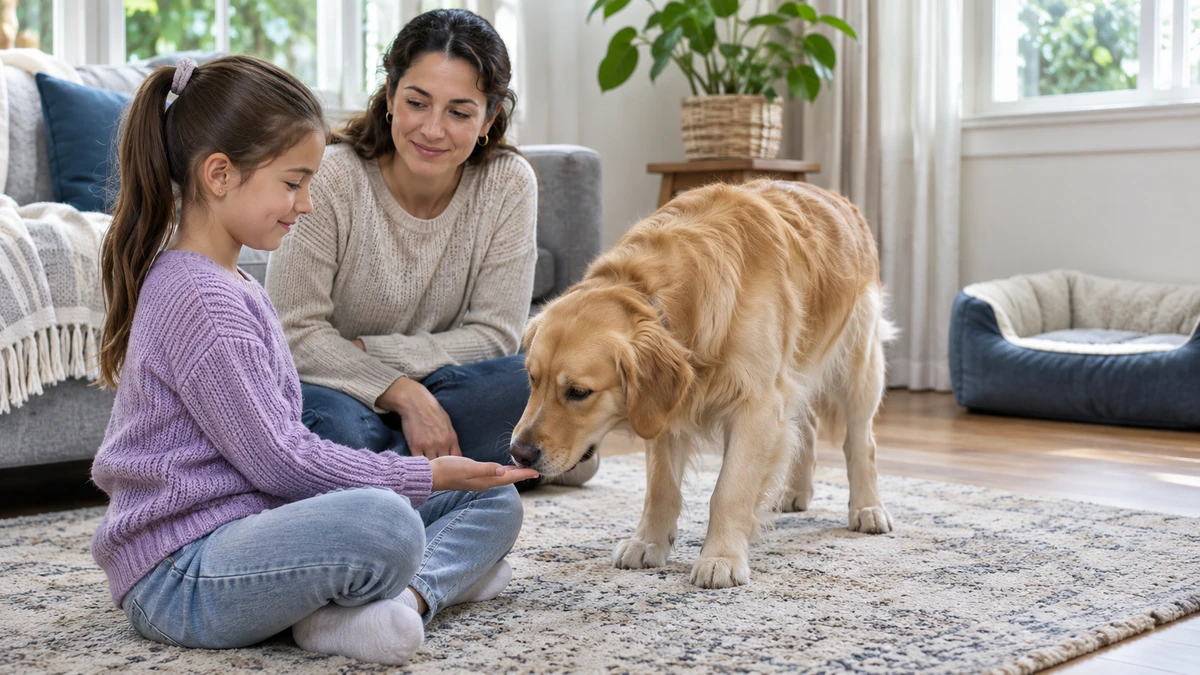
Teach children to let the dog approach rather than forcing contact.
Calm interaction is better than constant hugging.
Children can participate in positive activities such as:
- Tossing treats during training under adult guidance
- Helping fill a water bowl
- Playing structured fetch
- Walking with an adult
- Learning simple training cues
The dog should always have a resting space that children understand is off-limits.
Never Leave Young Children Unsupervised With a Dog
This rule applies even to famously gentle family breeds.
A dog may become uncomfortable because of pain, food, sleep, fear or rough interaction.
A child may unintentionally create a situation the dog cannot comfortably tolerate.
Adult supervision allows someone to intervene before either child or dog becomes overwhelmed.
Learn Basic Canine Body Language
Adults and older children should learn to recognize when a dog wants more space.
Possible signals can include:
- Turning the head away
- Moving away
- Lip licking
- Yawning outside normal tiredness
- Body stiffness
- Trying to hide
- Growling
Do not punish a dog for communicating discomfort. Increase distance and address the situation safely.
Should You Get a Puppy or an Adult Dog for Kids?
Puppies are appealing but require substantial work.
Young puppies commonly:
- Bite during play
- Jump
- Chew household items
- Need frequent bathroom breaks
- Require socialization and training
An adult dog with a known temperament can sometimes be easier for families because actual size, energy and household behavior are already visible.
If this will also be your first dog, compare puppy and breed difficulty with our guide to the best dog breeds for first-time owners.
Family Dog Size vs Home Size
A large yard is useful but does not replace exercise or interaction.
Likewise, a family living in a smaller home does not automatically need a tiny dog.
Consider:
- Indoor floor space
- Outdoor access
- Walking routine
- Vehicle size
- Stairs
- Dog bed and crate space
What About Shedding?
Family-friendly breeds can have very different coats.
Labradors and Golden Retrievers shed substantially.
Collies require regular coat care.
Standard Poodles shed relatively little but need clipping.
Newfoundlands combine giant size with a heavy coat.
If coat management matters to your household, choose separately for shedding and grooming rather than assuming “family dog” describes coat maintenance.
Dog Allergies and Families With Children
No breed can guarantee an allergy-free home.
If someone in your family has known dog allergies, spend time around adult dogs of the breed before making a commitment and seek appropriate medical guidance when needed.
Low-shedding breeds such as Poodles may spread less loose hair around the home, but allergens are not limited to visible fur.
Which Dog Breed Is Right for Your Kids?
| Your Family Priority | Breeds Worth Researching |
|---|---|
| Active family + highly social dog | Labrador Retriever |
| Gentle active family companion | Golden Retriever |
| Compact cheerful hound | Beagle |
| Responsive herding-family dog | Collie |
| Trainable lower-shedding family dog | Standard Poodle |
| Giant gentle companion | Newfoundland |
| Energetic dog for older active children | Boxer |
| Small gentle companion | Cavalier King Charles Spaniel |
10 Questions to Ask Before Getting a Dog for Your Kids
- How old are the children?
- How gently can they interact with animals?
- How much daily exercise can the adults realistically provide?
- Who will be responsible for training?
- What adult dog size can the family physically manage?
- How much shedding and grooming can you tolerate?
- How much barking can your home tolerate?
- Are there other pets?
- Will the dog spend long periods alone?
- Would an adult dog with known behavior fit better than a puppy?
The Dog Should Be an Adult Responsibility
A child can help with a family dog, but the adults should assume that they are ultimately responsible for the animal.
Children’s interests, school schedules and maturity change over time.
Adults need to be prepared to provide:
- Exercise
- Food
- Training
- Grooming
- Veterinary care
- Supervision
throughout the dog’s life.
Final Thoughts
The best dog breeds for kids include a wide range of sizes and personalities.
Labrador and Golden Retrievers can be outstanding choices for active households. Beagles provide a more compact, cheerful family dog. Collies combine devotion with trainability, while Standard Poodles offer intelligence and lower shedding for families prepared for grooming and exercise.
Newfoundlands are known for sweet, patient temperaments but require families capable of managing giant size. Boxers can be enthusiastic playmates for active families, especially with older children. Cavaliers provide a smaller, gentler companion option.
None of these breeds is automatically safe, easy or appropriate for every child.
Choose according to the ages of your children, adult dog size, exercise, temperament, grooming, training and the amount of adult supervision your household can provide.
And remember that successful family-dog relationships are two-sided: the dog needs training and socialization, while children need to learn how to respect the dog’s space and body.
For a wider comparison that is not limited specifically to children, continue with our Family Dog Breeds guide.
The best family dog is not simply the breed with the strongest reputation around children. It is the individual dog whose normal needs and temperament fit the entire family.