By
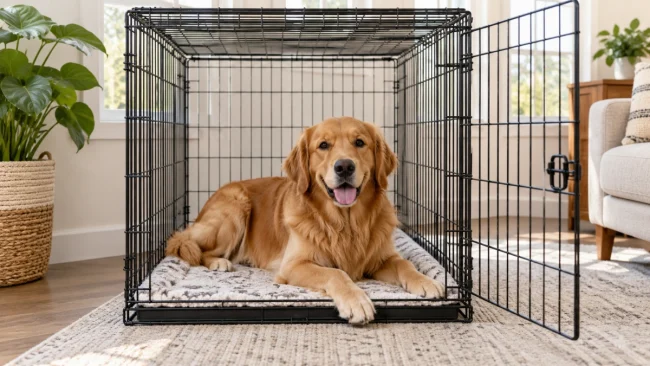
Dog blankets for crates can add a familiar, washable sleeping surface without requiring a bulky bed. A lightweight blanket can provide moderate warmth, collect hair and dirt, and give some dogs a soft surface to settle on.
But a crate is a confined space, so blanket size and construction matter more than they do on an open dog bed or couch. Too much fabric can bunch into the usable floor area, loose threads can create chewing hazards, and a blanket used outside a wire crate can reduce ventilation if it covers too much of the structure.
The best crate blanket is therefore not simply the softest one. It should fit the interior space, remain easy for your dog to move around, match your dog’s chewing and toileting habits, and be simple enough to wash frequently.
For broader guidance on blanket materials and everyday uses, visit our Dog Blankets topic hub.
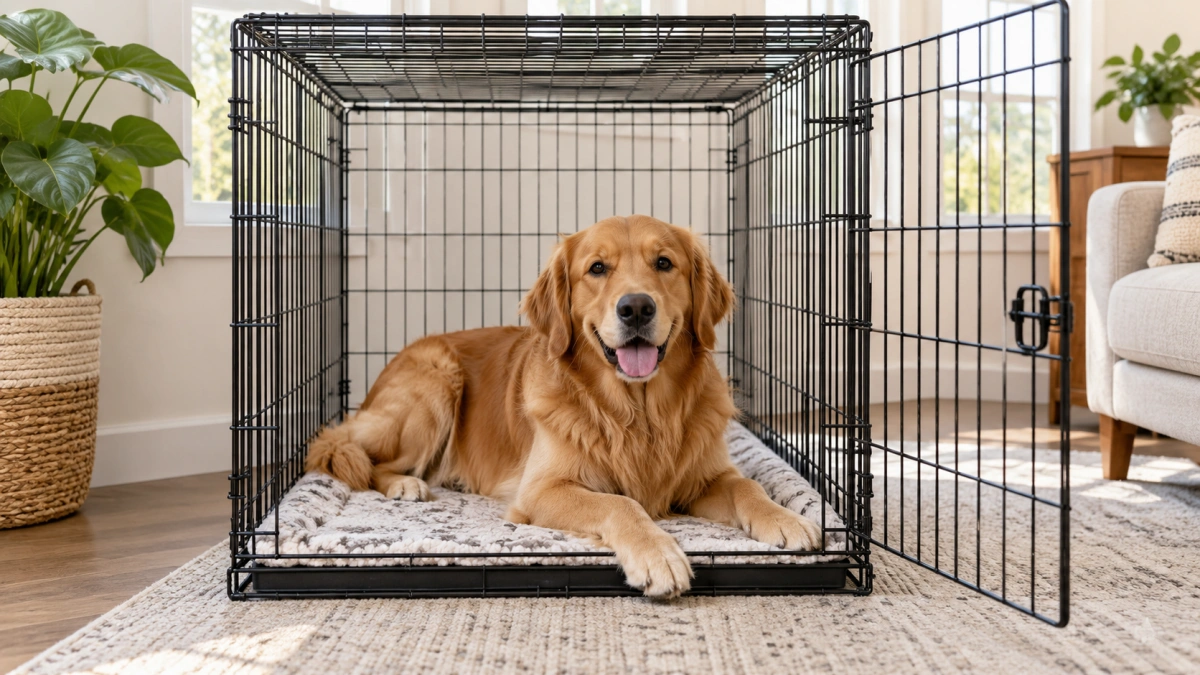
Quick Comparison: Which Crate Blanket Setup Works Best?
| Setup | Best For | Main Advantage | Main Concern |
|---|---|---|---|
| Thin flat fleece blanket | Everyday crate bedding | Soft, washable and low bulk | Some dogs may chew it |
| Loose nesting blanket | Dogs that gently rearrange bedding | Allows natural nesting behavior | Can bunch and reduce floor space |
| Waterproof-backed blanket | Accident or wet-dog protection | Helps protect crate tray | May be warmer or slower to dry |
| Washable crate mat plus thin blanket | Dogs that need more cushioning | Separates support from removable top layer | Takes up more vertical and floor space |
| No loose blanket | Persistent fabric chewers or shredders | Removes ingestion and entanglement risk | Provides less soft bedding |
Not every dog needs a loose blanket in a crate. Your dog’s behavior should determine whether soft fabric is appropriate at all.
Should You Put a Blanket Inside a Dog Crate?
For many dogs, yes, provided the blanket is safe for that individual dog.
A blanket can help by:
- Creating a softer contact surface
- Adding moderate warmth
- Collecting loose hair
- Providing familiar bedding
- Making routine cleaning easier
However, some dogs are better without loose bedding.
Avoid or postpone a loose blanket if your dog:
- Repeatedly tears fabric
- Swallows blanket pieces
- Gets tangled in bedding
- Regularly urinates on soft bedding during early housetraining
- Becomes excessively hot
Comfort does not require adding fabric when the fabric itself creates a new problem.
The Crate Must Fit the Dog Before the Blanket Fits the Crate
Before choosing bedding, make sure the crate itself allows your dog to:
- Stand comfortably
- Turn around
- Lie down
- Stretch into a normal resting position
Then account for the space bedding occupies.
A thick pad plus several folded blankets can make a correctly sized empty crate much smaller in actual use.
Do not solve an undersized crate by choosing a thinner blanket. Fix the crate size first.
How to Measure a Crate for a Blanket
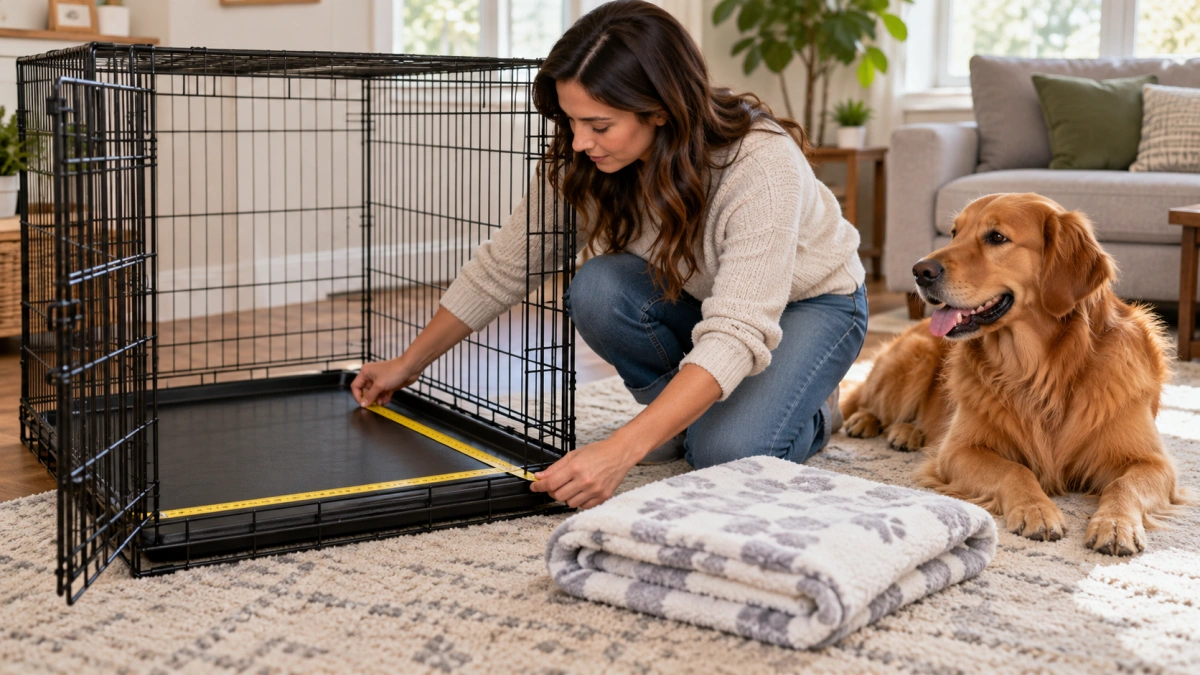
Measure the actual interior floor rather than relying only on the crate’s advertised external dimensions.
Record:
- Interior floor length
- Interior floor width
- Available height after any mat or bed is installed
If a plastic tray has raised edges, measure the flat usable area inside those edges as well.
For a simple floor-covering blanket, dimensions close to the usable interior floor are often easier to manage than a very oversized throw.
Should a Crate Blanket Cover the Whole Floor?
It can, but it does not have to.
Full-floor coverage is useful when you want:
- A consistent sleeping surface
- Hair collection
- Moderate insulation from a plastic or metal tray
Partial coverage can work for dogs that prefer having both a soft and a cooler bare surface available.
The most important issue is that the blanket remains manageable rather than forming a large unstable pile.
Can a Crate Blanket Be Too Large?
Yes.
A blanket that is much larger than the crate may create:
- Thick folds
- Reduced floor space
- Extra heat
- More fabric to chew
- Places where legs can become tangled
Oversized fabric is especially unnecessary when your goal is simply to cover the crate tray.
If your dog enjoys light nesting, some extra fabric may be appropriate, but the blanket should not dominate the entire interior.
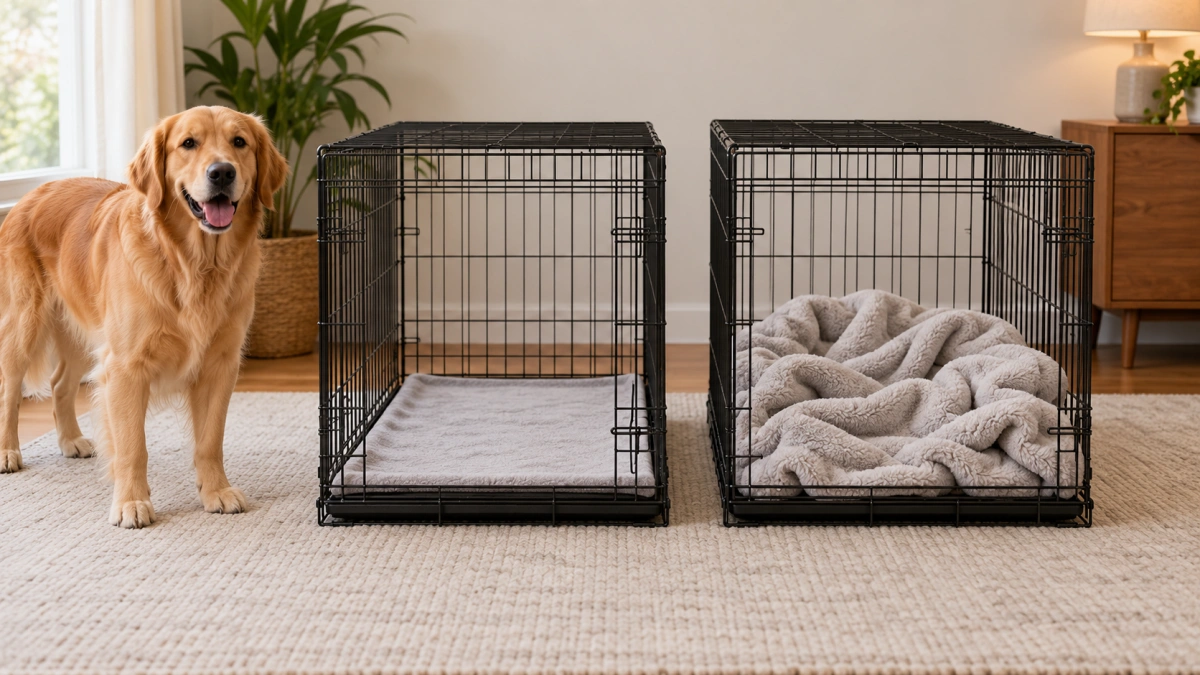
Flat Blanket vs Loose Nesting Blanket
Flat Setup
A mostly flat blanket is easier to inspect and usually works best for:
- Puppies
- Senior dogs
- Small crates
- Dogs that do not rearrange bedding
- Dogs with reduced mobility
Loose Nesting Setup
A small amount of loose material may suit a dog that naturally circles, paws, and rearranges bedding before settling.
However, nesting material should remain:
- Lightweight
- Intact
- Free of loose strings
- Small enough not to overwhelm the crate
Which Material Works Best in a Dog Crate?
Short Fleece
Short fleece is a practical general-purpose choice because it combines softness, moderate warmth, low weight, and common machine-washable construction.
Low-Pile Microfiber
A smooth low-pile fabric may be useful when easy hair cleanup and lower insulation are priorities.
Plush or Sherpa
These materials provide more warmth and deeper softness but add bulk and may hold more dog hair.
Use them more cautiously in small crates or warm rooms.
Waterproof Multi-Layer Fabric
A waterproof layer can help with occasional accidents or wet coats, but it is not automatically necessary for every dog.
If liquid protection is your primary concern, see our guide to waterproof dog blankets.
Do Not Use Material That Snags or Shreds Easily
Crates can increase the consequences of damaged bedding because the dog has less room to move away from loose material.
Avoid or replace blankets with:
- Large holes
- Loose loops
- Tassels
- Long fringe
- Exposed stuffing
- Long pulled threads
A dog may catch a paw in a hole or swallow loose fabric after chewing.
Simple finished edges and tightly constructed fabrics are easier to inspect.
Chewers and Blanket Shredders Need Extra Caution
A blanket that is safe for one dog may be unsuitable for another.
If your dog repeatedly shreds bedding, the problem is not solved by repeatedly replacing soft blankets.
Fabric ingestion can create choking or gastrointestinal obstruction risks.
For persistent chewers, the safer crate setup may involve no loose blanket until you find bedding that the dog does not destroy.
Inspect crate bedding regularly for:
- Bite marks
- Missing corners
- Torn seams
- Pulled fibers
- Holes

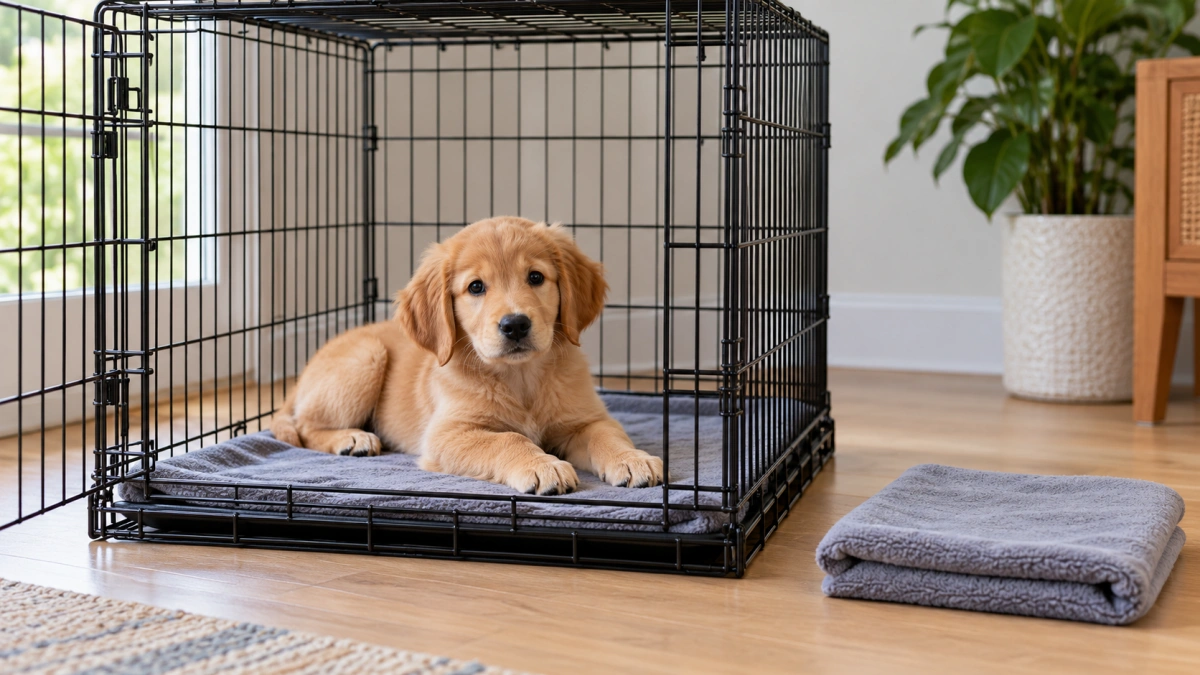
Crate Blankets for Puppies
Puppies need extra consideration because soft bedding can interact with both housetraining and chewing.
Early puppies may:
- Urinate on absorbent bedding
- Chew corners
- Pull threads
- Drag bedding around
- Swallow fabric pieces
If a puppy repeatedly soils or destroys a blanket, temporarily simplifying the crate setup may be more practical than adding more bedding.
Once the puppy consistently keeps the crate clean and leaves bedding intact, a lightweight washable blanket can be introduced or reintroduced.
Crate Blankets for Senior Dogs
Older dogs may appreciate a warmer or softer crate surface, but do not fill the crate with deep loose folds.
For reduced mobility, prioritize:
- A stable floor
- Flat bedding
- Easy turning
- No raised fabric near the entrance
- Enough room to stretch
A supportive mat underneath a removable thin blanket may work better than several thick folded blankets.
If an older dog suddenly struggles to rise, turn, or settle comfortably, veterinary assessment is more appropriate than simply adding more cushioning.
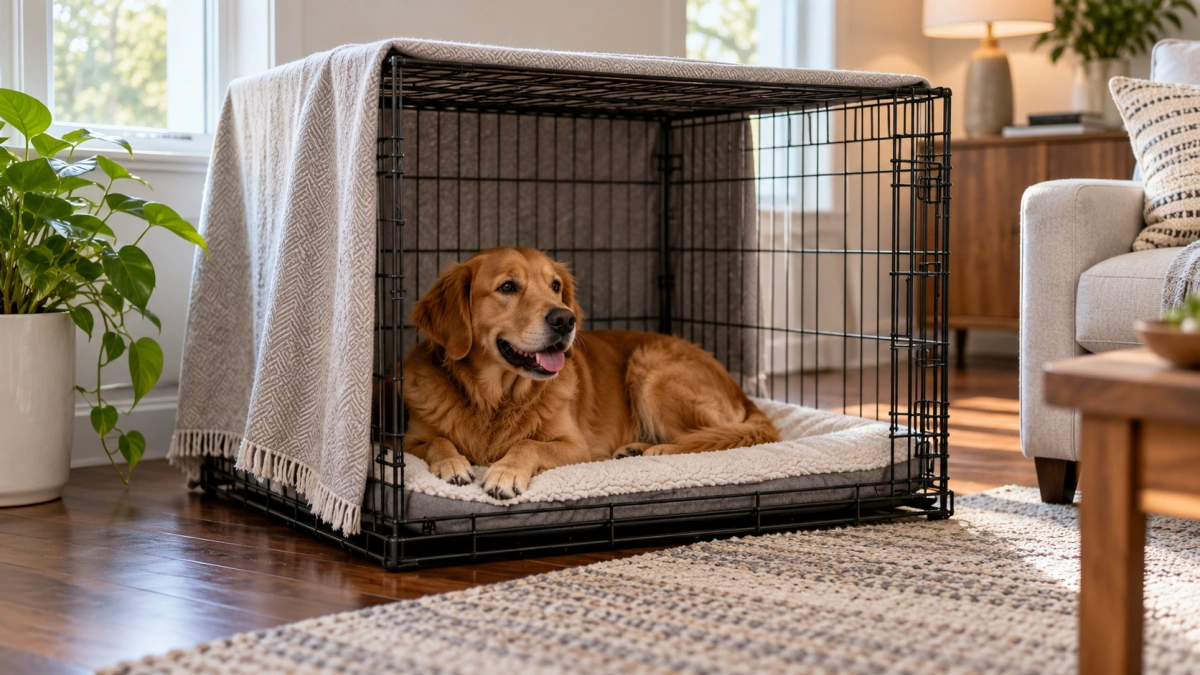
Using a Blanket Over the Outside of a Crate
A blanket over a wire crate serves a different purpose from bedding inside it.
An external cover may reduce visual stimulation and create more privacy for some dogs.
However, do not completely seal a wire crate in thick fabric.
Keep ventilation and airflow available.
A practical setup may cover:
- The top
- The back
- Part of one side
while leaving the entrance and additional ventilation open.
Cornell specifically recommends that when a wire kennel is covered, one or two sides remain open.
Make Sure Your Dog Cannot Pull the Cover Through the Bars
Some dogs grab an external blanket through wire crate openings.
They may then:
- Pull fabric into the crate
- Shred it
- Swallow pieces
- Create a large pile of fabric inside
If your dog does this, a fitted purpose-designed crate cover that remains outside reach may be more appropriate than a loose household blanket.
Should You Cover the Crate at Night?
Some dogs settle well with partial visual coverage, while others become warmer, more restless, or try to pull the cover inside.
The correct setup depends on the dog.
If you use an external blanket at night:
- Keep ventilation open
- Use breathable material
- Keep fabric out of chewing reach
- Monitor room temperature
- Stop if the dog appears uncomfortable
A blanket should not be used to make a dog tolerate a crate when the dog is showing intense confinement distress.
Watch for Signs the Crate Setup Is Not Comfortable
Crate bedding is not the solution for every confinement problem.
Pay attention if your dog repeatedly shows:
- Persistent panting
- Excessive drooling
- Repeated escape attempts
- Frantic scratching
- Continuous vocalizing
- Inability to settle
These behaviors may indicate stress rather than a blanket preference.
A veterinarian or qualified trainer can help when crate distress persists.
Do Not Overheat the Crate
A confined space with thick bedding and an external cover can retain more heat than an open dog bed.
Be particularly cautious with:
- Thick fleece
- Sherpa
- Multiple folded blankets
- Full external covers
- Warm rooms
During warmer conditions, a lightweight blanket or bare washable crate mat may be more appropriate.
Should You Use a Heated Blanket in a Crate?
A standard heated or electric blanket should not be treated as ordinary unsupervised crate bedding.
Electrical cords create chewing hazards, and confined dogs cannot always move as freely as they can in an open room.
If your dog needs additional warmth, first consider passive options such as an appropriately warm ordinary blanket and a comfortable room temperature.
For detailed active-heat safety, see our guide to heated and warm dog blankets.
Do Not Put a Weighted Blanket in a Crate
A crate already limits movement.
Adding intentional blanket weight can make it more difficult for a dog to reposition or move away.
For ordinary crate bedding, use lightweight material rather than a human or pet weighted blanket.
Do You Need a Waterproof Crate Blanket?
Waterproofing can be useful for:
- Puppy accidents
- Senior-dog accidents
- Wet coats
- Drool
But waterproofing is not automatically better.
A multi-layer waterproof blanket may be:
- Warmer
- Heavier
- Slower to dry
If accidents are no longer an issue, a simpler washable blanket can be easier to manage.
Crate Blanket vs Crate Mat
| Feature | Loose Blanket | Crate Mat |
|---|---|---|
| Easy to wash | Usually very easy | Depends on construction |
| Provides structure | Low | Higher |
| Allows nesting | Yes | Limited |
| Can bunch | Yes | Less likely |
| Chew edges accessible | Often | Depends on design |
| Easy laundry rotation | Excellent | Moderate |
Many dogs can use both: a correctly sized crate mat for the primary surface and a thin removable blanket on top.
However, adding both reduces available interior space, so make sure the crate remains properly sized after bedding is installed.
Dog Crate Blanket vs Dog Bed Blanket
An open dog bed gives a dog far more space to push bedding away.
Inside a crate, dimensions and loose fabric require more attention.
A dog blanket for a bed can be oversized for nesting or mattress coverage, while a crate blanket should generally be more controlled in size and bulk.
Dog Kennel Blankets
“Dog kennel” can refer to indoor crates, boarding kennels, shelter runs, or larger enclosed sleeping spaces.
For an indoor kennel-style enclosure, the same basic principles apply:
- Correct size
- Washable material
- No dangerous loose threads
- Adequate ventilation
- Appropriate warmth
For outdoor kennels, ordinary indoor blankets may not be appropriate because damp fabric can become cold, dirty, and difficult to dry.
Outdoor bedding deserves separate weather and moisture considerations.
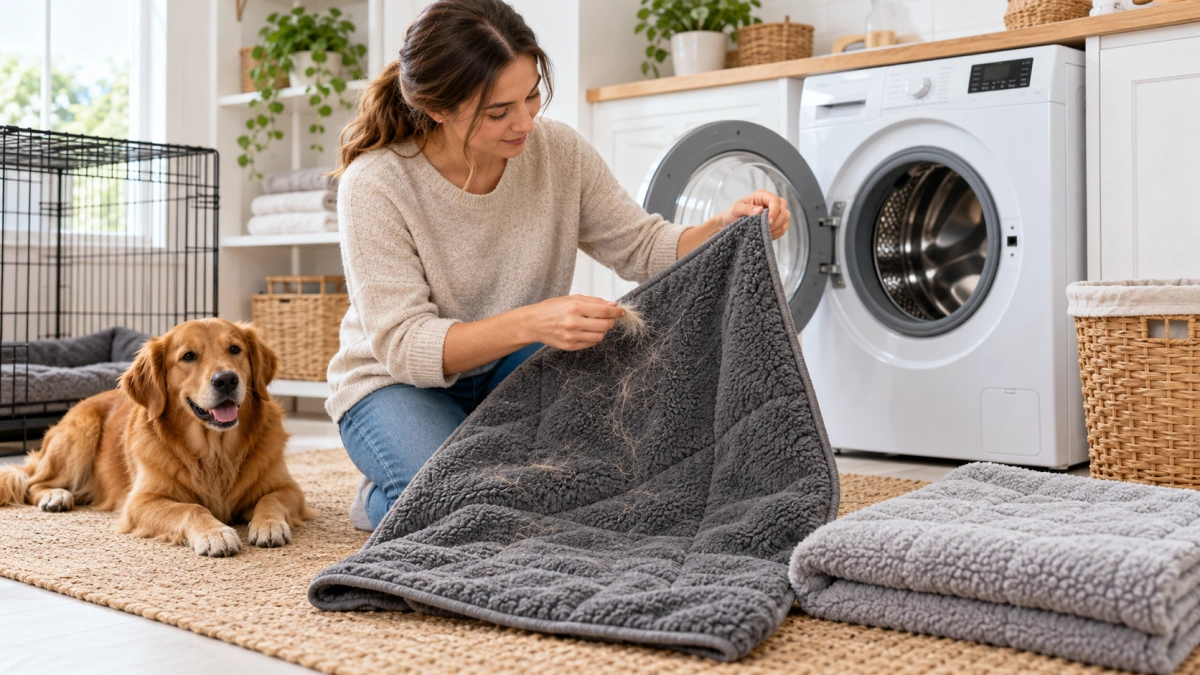
How to Wash Dog Crate Blankets
Crate blankets should be simple enough to clean frequently.
A practical routine is:
- Remove the blanket from the crate.
- Shake off loose hair and dry debris.
- Inspect for chewing, holes, and pulled threads.
- Pre-treat appropriate stains if permitted.
- Wash according to the care label.
- Dry completely.
- Clean the crate tray before replacing the blanket.
Do not place a damp blanket back into a confined crate.
Warm, damp bedding is harder to keep clean and comfortable.
How Often Should You Wash a Crate Blanket?
There is no single schedule for every dog.
Wash frequency depends on:
- Shedding
- Outdoor dirt
- Drool
- Accidents
- Odor
- How many hours the dog spends resting there
Wash immediately after significant urine, feces, vomit, or other contamination.
For ordinary use, clean the blanket whenever hair, dirt, moisture, or odor builds up.
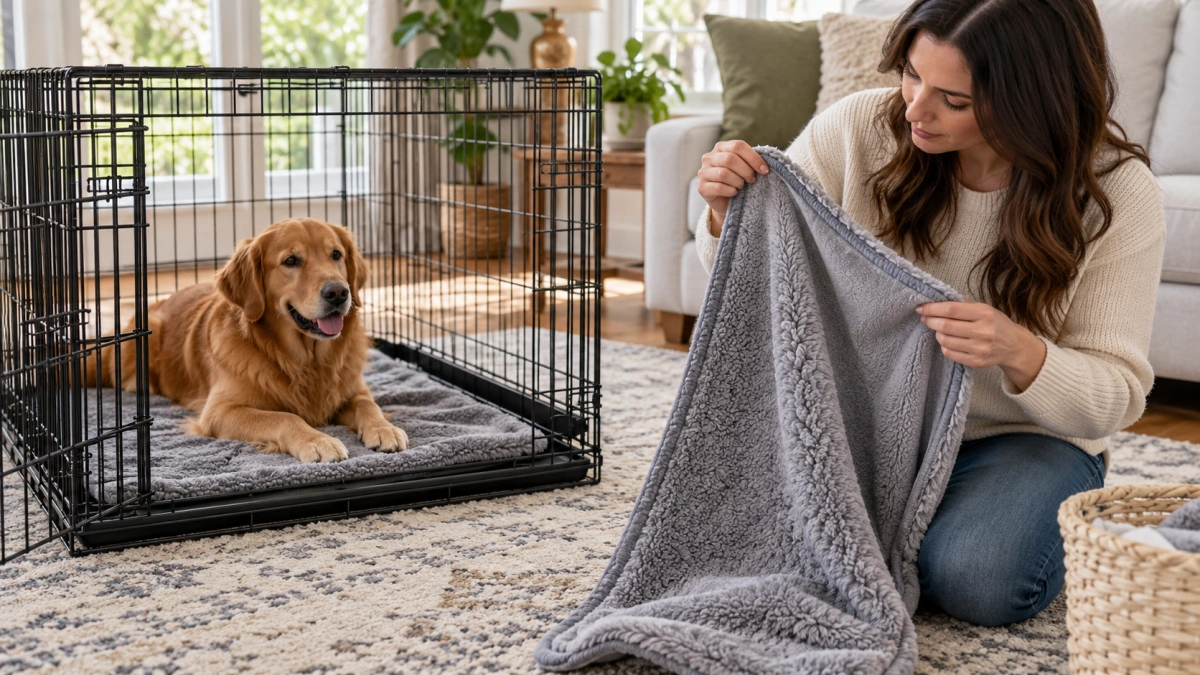
Why Two Crate Blankets Work Better Than One
A spare blanket makes crate cleaning easier.
Use:
- One blanket in the crate
- One clean replacement
When the first blanket needs washing, the clean one can be installed immediately.
This is especially useful for puppies, heavy shedders, senior dogs, and dogs that come indoors with wet paws.
Our 9-Point Dog Crate Blanket Check
Use this framework before putting any blanket into a crate or kennel.
1. Crate Size
Can the dog still stand, turn, lie down, and stretch after bedding is installed?
2. Blanket Dimensions
Does the blanket fit the usable interior without excessive bunching?
3. Weight
Is the blanket lightweight enough for the dog to move and rearrange safely?
4. Breathability
Does the material avoid unnecessary heat buildup?
5. Fabric Condition
Are seams, edges, and fibers intact?
6. Chewing Behavior
Does your dog leave fabric alone, or does it shred and swallow bedding?
7. Toileting
Is the dog reliably clean in the crate, or is soft bedding encouraging repeated accidents?
8. Laundry
Can you wash and fully dry the blanket as often as needed?
9. Ventilation
If you also cover the outside of a wire crate, are adequate sides still open for airflow?
A crate blanket that passes these nine checks is more useful than one selected only because it looks thick and cozy.
Common Dog Crate Blanket Mistakes
- Choosing a blanket before checking crate size
- Using external crate dimensions instead of interior space
- Folding an oversized blanket into a large pile
- Using thick plush in a warm confined area
- Giving loose blankets to a persistent fabric chewer
- Ignoring torn seams and holes
- Adding bedding while a puppy still regularly soils or shreds it
- Covering every side of a wire crate with a heavy blanket
- Allowing a dog to pull an external cover through the bars
- Blocking ventilation
- Using heated bedding without considering electrical and heat risks
- Using a weighted blanket inside the crate
- Returning damp bedding to the crate
- Assuming a blanket is necessary for every dog
- Using crate blankets to manage severe confinement distress instead of addressing the underlying problem
Dog Crate Blanket Buying Checklist
- What are the actual interior crate dimensions?
- Can my dog stand, turn, lie down, and stretch comfortably?
- Will a mat or bed already take up part of the interior?
- Do I want full-floor or partial blanket coverage?
- Does my dog nest or prefer flat bedding?
- Is the blanket lightweight?
- Is the material breathable?
- Is the pile appropriate for the room temperature?
- Are the edges securely stitched?
- Are there loose loops, tassels, or fringe?
- Does my dog chew blankets?
- Does my puppy soil soft bedding?
- Do I need waterproof protection?
- Is the blanket machine washable?
- Can it dry quickly and completely?
- Should I keep a second blanket for laundry rotation?
- If used outside the crate, will ventilation remain open?
- Can my dog reach and pull the outside blanket through the bars?
Final Thoughts
The best dog blanket for a crate is usually simpler than the bedding you might use on an open dog bed.
Start with the crate itself. Your dog must still have enough usable space to stand, turn, lie down, and stretch after every mat and blanket has been added.
Then choose a lightweight, washable blanket that fits the interior without creating excessive folds. Short fleece and other stable low- to medium-pile fabrics work well for many dogs because they provide softness without excessive bulk.
Your dog’s behavior matters just as much as the material. Puppies that soil soft bedding and dogs that shred or swallow fabric may be safer with a simpler setup until those behaviors improve.
If you cover the outside of a wire crate, treat that as a separate decision. Keep adequate ventilation open and make sure your dog cannot pull the covering through the bars.
Finally, make cleaning easy. A correctly sized blanket that can be removed, inspected, washed, dried completely, and swapped with a clean spare will usually provide more practical value than a large fluffy blanket that overwhelms the crate.