By
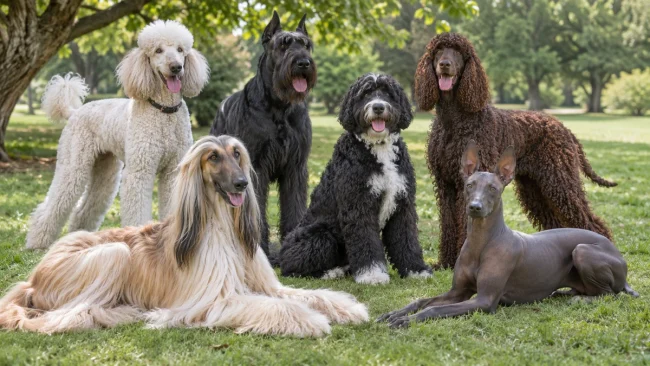
Large dog breeds that don’t shed much are less common than small low-shedding companion breeds, but several excellent options exist for people who want a bigger dog without the heavy seasonal coat loss associated with breeds such as Golden Retrievers, German Shepherd Dogs, Great Pyrenees, or Samoyeds.
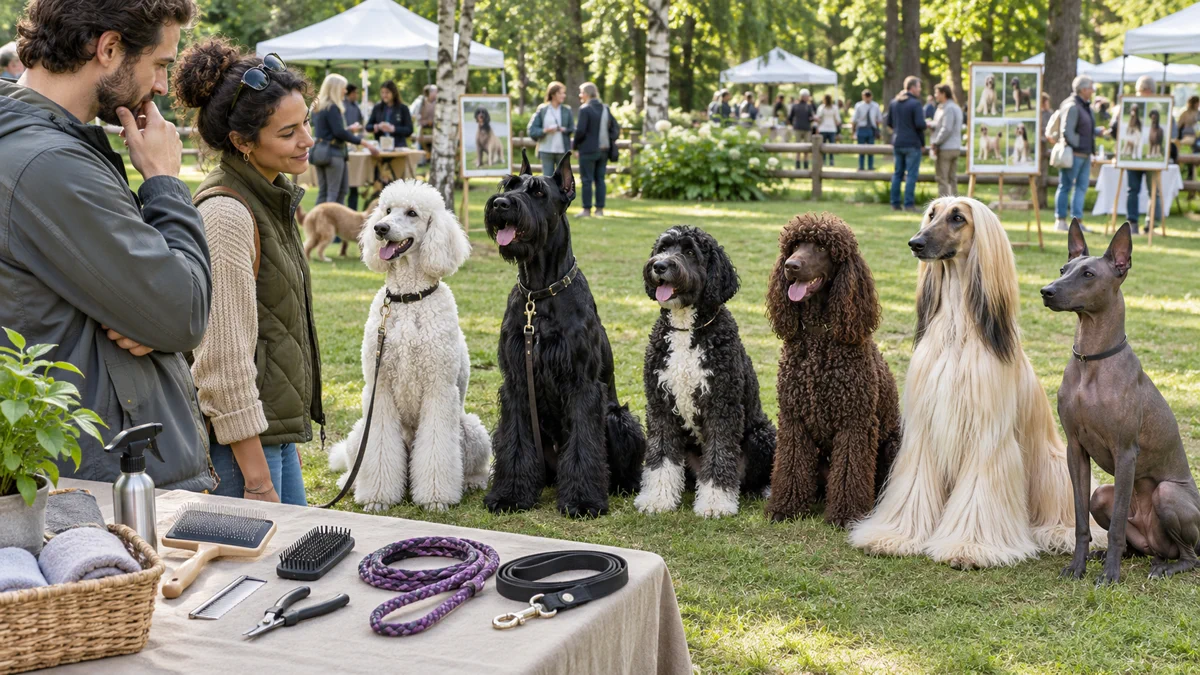
Standard Poodles, Giant Schnauzers, Portuguese Water Dogs, Irish Water Spaniels, Afghan Hounds, and some larger hairless breeds can all produce substantially less loose hair around the home than typical heavy-shedding large dogs.
However, low shedding creates an important trade-off. Many of these dogs require frequent brushing, clipping, coat trimming, or professional grooming because hair that does not fall out easily continues growing or remains trapped within the coat.
They are also not automatically hypoallergenic. Every dog produces allergens through skin, dander, saliva, and other biological material. A low-shedding coat may reduce how much allergen-carrying hair spreads around the home, but no breed can guarantee an allergy-free household.
If you want a smaller companion with similar coat characteristics, compare our small low-shedding dog breeds. For broader allergy-related breed research, visit our Hypoallergenic Dog Breeds guide.
Are There Really Large Dog Breeds That Don’t Shed?
Yes, but “don’t shed” should usually be interpreted as very low shedding rather than literally zero hair loss.
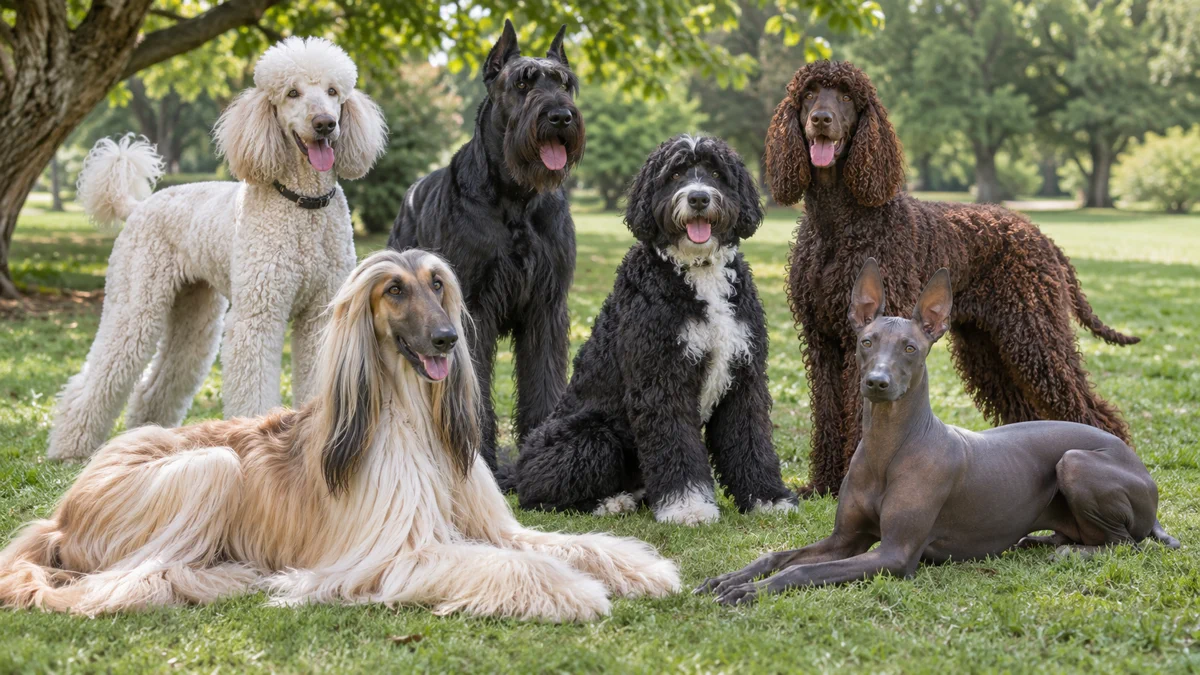
The largest low-shedding options use several different coat strategies.
- Curly continuously growing coats, such as the Standard Poodle
- Harsh wiry coats, such as the Giant Schnauzer
- Dense curly or wavy water-dog coats, such as the Portuguese Water Dog
- Crisp water-resistant curls, such as the Irish Water Spaniel
- Long silky coats with relatively low loose shedding, such as the Afghan Hound
- Hairless varieties, such as the Standard Xoloitzcuintli
None is maintenance-free, and they have dramatically different personalities despite sharing lower-shedding coat characteristics.
Quick Comparison of Large Low-Shedding Dog Breeds
| Breed | Approximate Adult Weight | Coat | Main Ownership Consideration |
|---|---|---|---|
| Giant Schnauzer | About 55–95 lb | Dense wiry double coat | Powerful, protective and high energy |
| Standard Poodle | About 40–70 lb | Dense curly coat | Low shedding but high grooming |
| Irish Water Spaniel | About 45–68 lb | Crisp curly water-resistant coat | Active sporting dog |
| Portuguese Water Dog | About 35–60 lb | Curly or wavy low-shedding coat | Needs vigorous daily activity |
| Afghan Hound | About 50–60 lb | Long silky coat | Several hours of grooming each week |
| Standard Xoloitzcuintli | About 30–55 lb | Hairless or short coated | Hairless variety needs skin care |
| Large Peruvian Inca Orchid | About 26.5–55 lb | Hairless or coated | Active sighthound temperament |
1. Giant Schnauzer
For people specifically searching for one of the biggest low-shedding dog breeds, the Giant Schnauzer deserves serious attention.
Adult males can weigh approximately 75 to 95 pounds, while females generally weigh about 55 to 80 pounds.
That places the Giant well above most other breeds commonly recommended for lower-shedding households.
Its coat consists of:
- A dense soft undercoat
- A harsh wiry outer coat
- Characteristic beard and eyebrows
The coat needs weekly brushing and regular clipping or stripping.
But the biggest issue is not grooming.
Giant Schnauzers are powerful working dogs with substantial exercise, training, and mental-stimulation requirements.
They are intelligent, territorial, protective, and physically strong.
An owner choosing one simply because it sheds less than a German Shepherd would be overlooking most of what makes the breed challenging.
2. Standard Poodle
The Standard Poodle is probably the most familiar answer to the search for a larger dog that sheds very little.
Standard Poodles stand over 15 inches and generally weigh about 40 to 70 pounds, with males typically larger than females.
Their dense curly coat releases relatively little loose hair into the home.
But Poodles are not low-maintenance dogs.
A longer coat can mat near the skin without thorough brushing, and many pet owners keep the coat in a shorter practical trim.
Professional grooming every several weeks is common.
The Standard Poodle is also:
- Highly intelligent
- Athletic
- Trainable
- People-oriented
- Mentally active
It is better suited to someone who wants an interactive training companion than someone looking only for a clean floor.
Which Is Bigger: Standard Poodle or Giant Schnauzer?
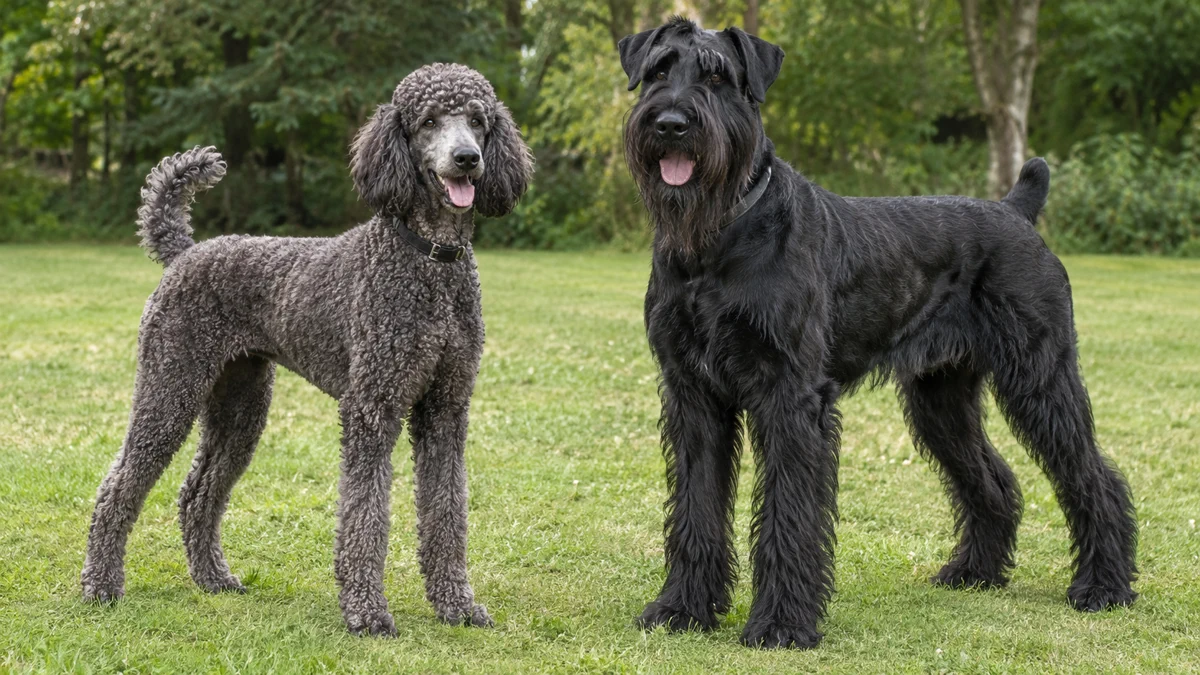
The Giant Schnauzer is generally the more substantial dog.
A Standard Poodle commonly weighs 40 to 70 pounds, while a male Giant Schnauzer may reach approximately 95 pounds.
That difference also affects:
- Food consumption
- Transportation
- Crate size
- Physical handling
- Training consequences
If you want a large but comparatively lighter athletic dog, the Standard Poodle may be easier to manage physically.
3. Portuguese Water Dog
Portuguese Water Dogs generally weigh approximately 35 to 60 pounds.
The breed was developed as an all-around fisherman’s helper along Portugal’s coast.
Its dense coat may be:
- Tightly curled
- Looser and wavy
The coat sheds very little but requires regular and fairly extensive grooming.
Portuguese Water Dogs are also serious athletes.
They tend to enjoy:
- Swimming
- Retrieving
- Long walks
- Agility
- Obedience
- Dock diving
- Water work
A Portuguese Water Dog is therefore not necessarily an easy choice for a low-activity household simply because its coat drops little hair.
4. Irish Water Spaniel
The Irish Water Spaniel is the tallest of the AKC spaniels.
Adults typically weigh around 45 to 68 pounds and stand approximately 21 to 24 inches.
The breed is instantly recognizable by:
- A dense liver-colored curly coat
- A topknot of loose curls
- A smooth face
- A distinctive tapered “rat tail”
Its coat releases relatively little loose hair but still requires brushing at least weekly and periodic trimming.
The Irish Water Spaniel is also a working sporting dog with high exercise needs.
Someone wanting a larger low-shedding dog for swimming, retrieving, hiking, or other active pursuits may find the breed particularly interesting.
Portuguese Water Dog vs Irish Water Spaniel
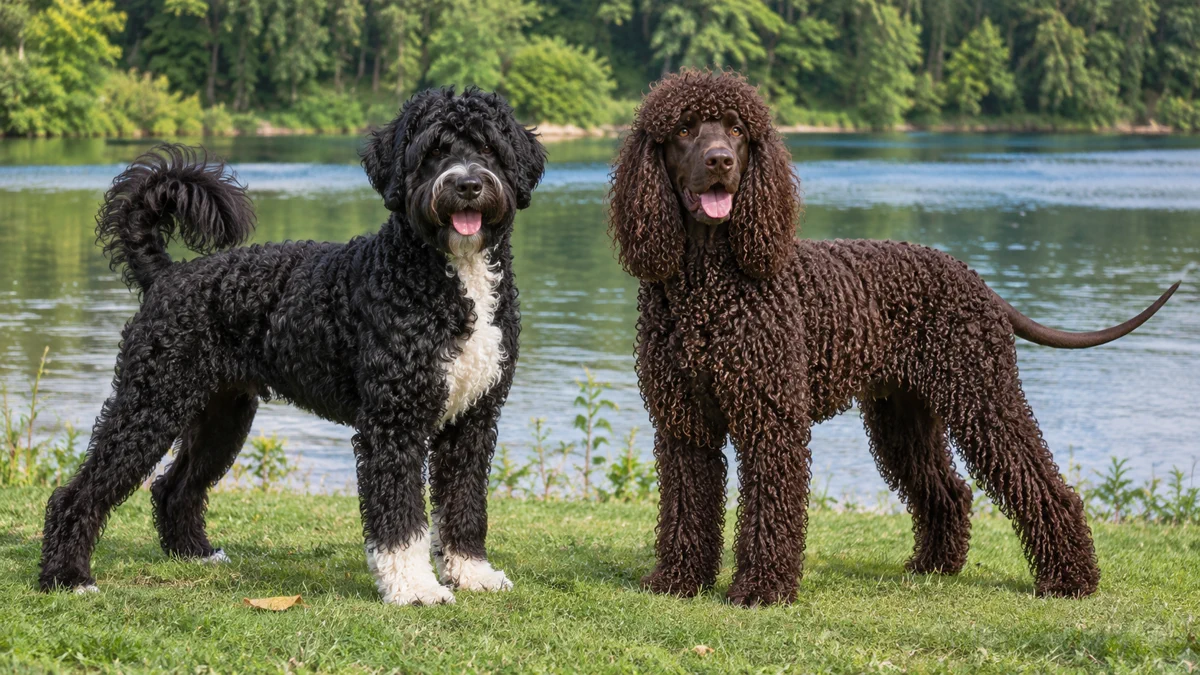
Both are athletic water-working breeds with coats that shed relatively little, but they are not interchangeable.
Portuguese Water Dogs generally have curly or wavy black, brown, or white coats and tend to be highly interactive training partners.
Irish Water Spaniels have a highly distinctive liver-colored curly coat and are sporting gundogs with strong swimming ability.
Both require significantly more exercise than their low-shedding coats might lead a casual buyer to expect.
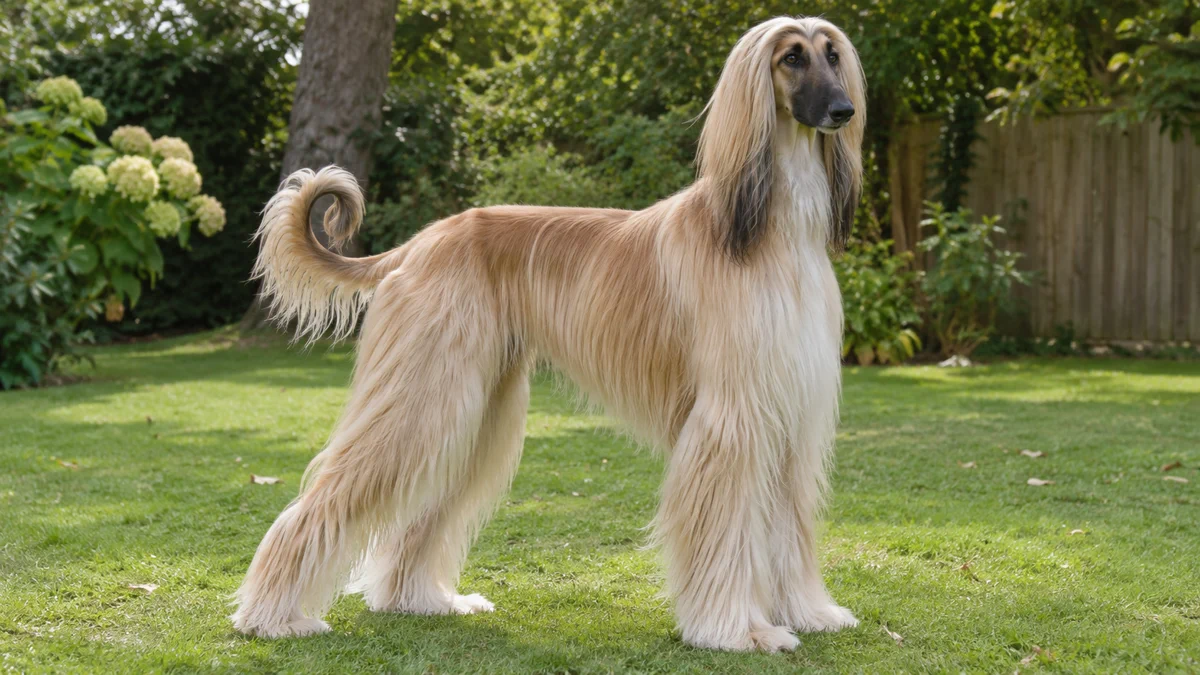
5. Afghan Hound
The Afghan Hound demonstrates one of the biggest misconceptions about shedding.
A dog can have extremely long hair without necessarily leaving the same volume of loose coat around the house as a heavy seasonal shedder.
Adult Afghan Hounds generally weigh around 50 to 60 pounds.
The magnificent long silky coat is one reason the breed appears on lists of breeds considered by some allergy sufferers.
But the maintenance cost is substantial.
Afghan Hound: Low Shedding but High Grooming
Adult Afghan Hounds can require several hours of brushing every week.
The coat needs to remain:
- Clean
- Conditioned
- Free of tangles
- Free of mats
- Clear of outdoor debris
Regular bathing is part of coat maintenance.
The breed is also an athletic sighthound with strong prey drive and needs opportunities to exercise safely.
An Afghan Hound is therefore a good example of why “low shedding” and “easy dog” should never be treated as synonyms.
6. Standard Xoloitzcuintli
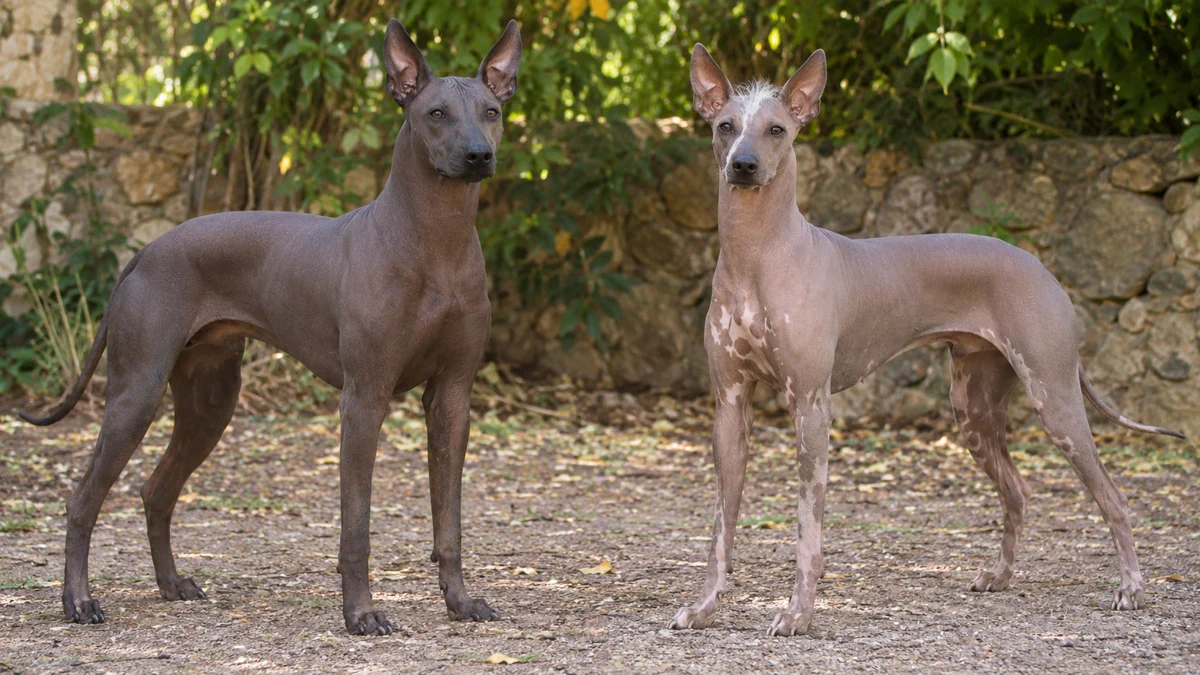
The Xoloitzcuintli offers a completely different solution to the shedding question.
The breed comes in:
- Toy
- Miniature
- Standard
and in both:
- Hairless
- Coated
Standard Xolos stand approximately 18 to 23 inches and can weigh around 30 to 55 pounds.
The hairless variety naturally leaves extremely little coat around the home because most of the body has no hair.
However, hairless does not mean maintenance-free.
Owners need to consider skin condition, temperature, sun exposure, bathing, and normal dental and nail care.
Hairless dogs still produce allergens and should not be treated as guaranteed allergy-safe pets.
7. Large Peruvian Inca Orchid
The Peruvian Inca Orchid is another hairless breed available in multiple sizes.
The large variety can stand approximately 19.75 to 25.75 inches and weigh about 26.5 to 55 pounds.
Like the Xoloitzcuintli, it exists in both hairless and coated forms.
The hairless variety minimizes coat shedding but still requires normal skin management.
This is also an agile sighthound-type dog rather than a passive large companion.
What Is the Biggest Low-Shedding Dog Breed?
Among the larger established breeds commonly included in low-shedding or allergy-oriented breed lists, the Giant Schnauzer is one of the biggest.
Adult males can reach approximately 95 pounds.
That makes the breed substantially larger than:
- Standard Poodle
- Portuguese Water Dog
- Irish Water Spaniel
- Afghan Hound
- Standard Xoloitzcuintli
But choosing the biggest option should never be the goal by itself.
A 90-pound protective working dog requires substantially more training and physical management than a 50-pound companion or sporting breed.
Does Low Shedding Mean No Dog Hair in the House?
No.
Even dogs commonly described as non-shedding can release some hair.
Brushing, clipping, bathing, normal hair breakage, and coat changes all produce some loose material.
The practical difference is usually that you see much less free hair on:
- Floors
- Sofas
- Clothing
- Car seats
- Bedding
compared with a heavy-shedding double-coated breed.
Large Low-Shedding Does Not Mean Hypoallergenic
No dog is 100% hypoallergenic.
Dog allergies can involve proteins from:
- Dander
- Saliva
- Skin
- Other biological material
Shedding can spread allergen-carrying particles through a home, so reduced shedding may help some people, but it does not remove the allergens themselves.
Individual reactions also vary significantly.
If allergies are a major issue, spending time with adult dogs of the specific breed before bringing one home is much more useful than trusting a marketing claim.
Low Shedding Does Not Mean Low Grooming
In fact, several of the largest low-shedding breeds require more grooming than many heavy shedders.
A Standard Poodle needs regular clipping.
A Giant Schnauzer needs weekly brushing plus regular clipping or stripping.
A Portuguese Water Dog requires regular coat maintenance.
An Irish Water Spaniel needs weekly brushing and periodic trimming.
An Afghan Hound can require hours of brushing each week.
The benefit is less loose hair throughout the home, not freedom from coat maintenance.
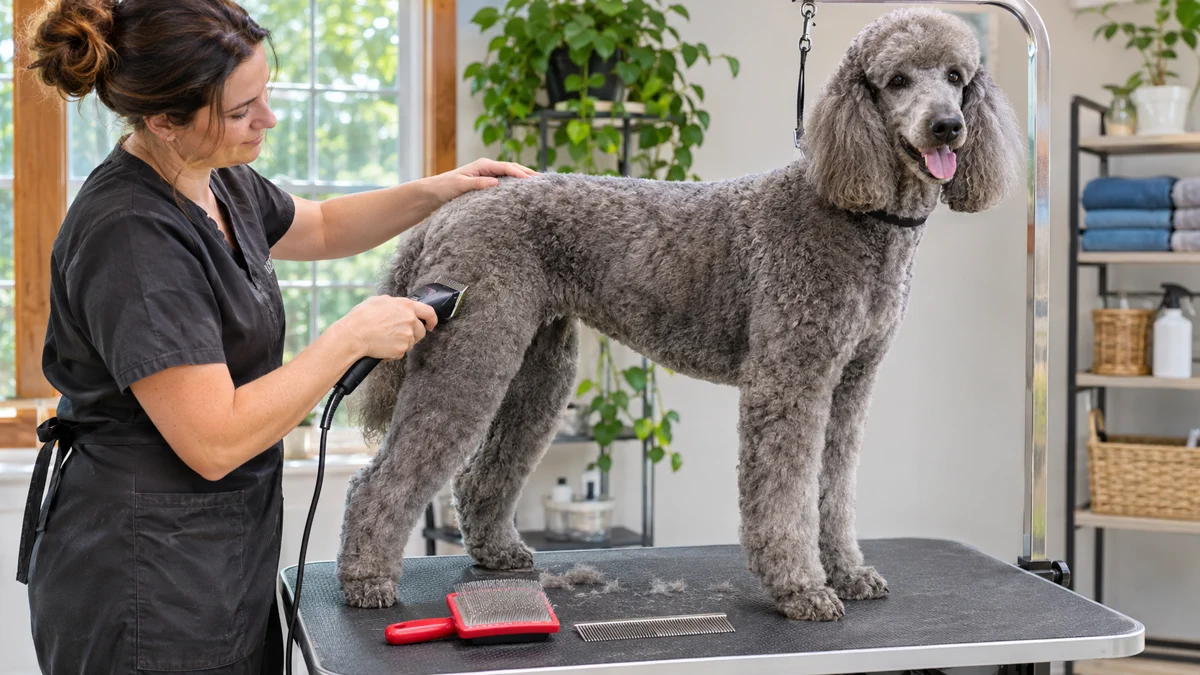
How Much Does Professional Grooming Matter?
For large dogs, professional grooming can become a meaningful recurring expense.
A larger body means:
- More coat to brush
- More shampoo
- More drying time
- Longer clipping sessions
- More physical handling
A Standard Poodle maintained professionally throughout its life can therefore require a very different grooming budget from a short-coated large dog.
Consider that cost before choosing a low-shedding breed specifically to reduce housecleaning.
Exercise Needs Matter More Than Shedding
Several large low-shedding breeds were developed for physically demanding work.
Portuguese Water Dog
Originally worked with fishermen and remains athletic and energetic.
Irish Water Spaniel
A powerful sporting and water-retrieving breed.
Standard Poodle
Highly intelligent, athletic, and capable of substantial daily activity.
Giant Schnauzer
A powerful working breed requiring extensive physical and mental engagement.
Afghan Hound
A fast sighthound that needs secure opportunities for appropriate exercise.
A low-shedding coat cannot compensate for a major lifestyle mismatch.
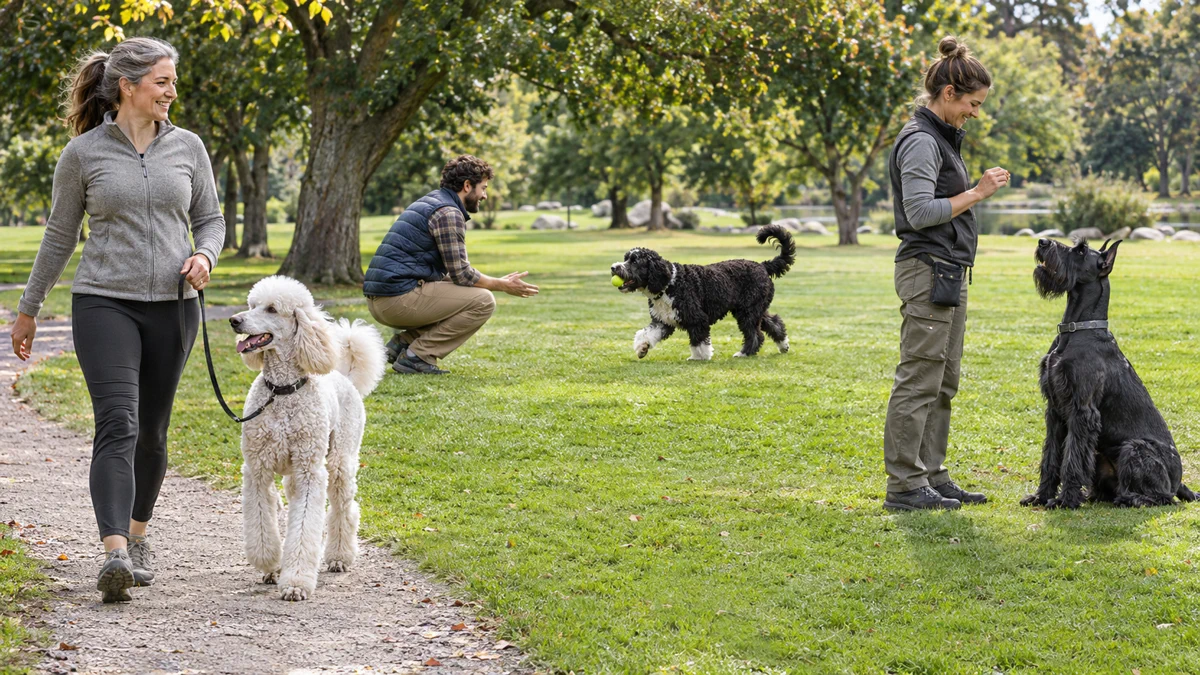
Which Large Low-Shedding Breed Is Most Trainable?
Standard Poodles are particularly strong candidates for owners who want an intelligent, highly trainable larger dog.
Portuguese Water Dogs are also intelligent and responsive to training.
Giant Schnauzers learn quickly but add strong protective instincts and considerable power, so training carries greater responsibility.
Irish Water Spaniels are working sporting dogs that benefit from active owners and engaging training.
Afghan Hounds tend to be more independent and should not be selected by someone expecting Poodle-style responsiveness.
Which Large Low-Shedding Breed Is Best for Families?
There is no universal best choice.
Standard Poodles and Portuguese Water Dogs may fit some active families particularly well when their exercise and grooming needs are understood.
A Giant Schnauzer requires more experienced management because of its size, energy, territorial tendencies, and protective nature.
Afghan Hounds and Irish Water Spaniels bring different hunting and sporting instincts.
Always evaluate:
- Children’s ages
- Dog-training experience
- Activity level
- Other pets
- Adult dog size
- Individual temperament
Supervise interactions between children and dogs regardless of breed.
Which Large Low-Shedding Breed Is Best for Apartments?
Body size alone makes apartment life more demanding for large dogs, but square footage is not the only issue.
A well-exercised Standard Poodle may settle indoors better than an under-stimulated smaller working dog.
Consider:
- Elevator access
- Daily outdoor exercise
- Barking
- Neighbor proximity
- Grooming space
- Ability to transport the dog
Do not choose a large low-shedding breed primarily because you think reduced hair automatically makes it suitable for a small apartment.
Which Large Low-Shedding Dog Needs the Least Coat Grooming?
Hairless varieties such as the Standard Xoloitzcuintli eliminate most conventional coat brushing and clipping.
But they replace coat maintenance with skin-related care.
Among coated breeds, there is no truly maintenance-free option in this group.
If minimal grooming matters more than minimal shedding, you may need to reconsider whether a large low-shedding breed is the right category for you.
Are Poodle Mixes Guaranteed Not to Shed?
No.
Crossing a Poodle with another breed does not guarantee that every puppy will inherit the Poodle’s coat or shedding pattern.
Coat genetics can vary between puppies from the same litter.
If predictable shedding is one of your highest priorities, an established breed with a consistent coat type generally gives you more information about the adult coat.
Large Low-Shedding Dogs vs Heavy Double-Coated Dogs
| Characteristic | Large Low-Shedding Breed | Heavy Double-Coated Breed |
|---|---|---|
| Loose hair around home | Usually lower | Often high |
| Professional clipping | Common in several breeds | Usually not the main maintenance method |
| Seasonal coat blow | Usually limited | Can be substantial |
| Brushing | Still important | Still important |
| Allergy guarantee | None | None |
Large Low-Shedding vs Small Low-Shedding Dogs
The basic coat advantage can be similar, but adult size changes almost everything else.
A 70-pound Standard Poodle needs more:
- Food
- Space
- Transportation capacity
- Grooming time
- Physical handling ability
than a 10-pound Toy Poodle even though both have closely related coat characteristics.
If the large body itself is not important to you, compare our Small Low-Shedding Dog Breeds guide before deciding.
Which Large Low-Shedding Dog Is Right for You?
| If Your Priority Is… | Start Researching… |
|---|---|
| Largest low-shedding working option | Giant Schnauzer |
| Highly trainable athletic companion | Standard Poodle |
| Active water-loving family companion | Portuguese Water Dog |
| Sporting and water-retrieving dog | Irish Water Spaniel |
| Elegant large sighthound | Afghan Hound |
| Larger hairless companion | Standard Xoloitzcuintli |
| Larger uncommon hairless sighthound | Peruvian Inca Orchid |
10 Questions to Ask Before Choosing a Large Low-Shedding Dog
- Do I want less loose hair or am I trying to manage allergies?
- Can I handle a 50- to 90-pound adult dog?
- How much daily exercise can I provide?
- Can I afford regular professional grooming?
- How often am I willing to brush at home?
- Do I want a sporting dog, working dog, sighthound, or companion?
- Am I comfortable with protective instincts?
- Do I have children or other pets?
- Have I spent time around the breed if allergies are involved?
- Would a smaller low-shedding dog actually suit my life better?
Final Thoughts
Large dogs that shed very little do exist, but the available breeds come with very different lifestyles.
The Giant Schnauzer is one of the largest options and combines relatively low shedding with substantial working-drive, training, and protective instincts. The Standard Poodle provides an athletic, highly trainable alternative with a curly coat that produces little loose hair but requires regular clipping.
Portuguese Water Dogs and Irish Water Spaniels offer water-working ability and low-shedding coats for active households. Afghan Hounds combine lower loose-hair shedding with one of the most demanding long-coat grooming routines. Standard Xoloitzcuintlis and large Peruvian Inca Orchids offer hairless alternatives with entirely different skin-care needs.
None is completely hypoallergenic, and none should be chosen solely because it leaves less hair on the sofa.
The right large low-shedding dog is the one whose adult size, exercise needs, temperament, training demands, grooming schedule, and coat type all fit your life.
Reduced shedding is an advantage. Compatibility is what determines whether the breed actually works in your home.