By
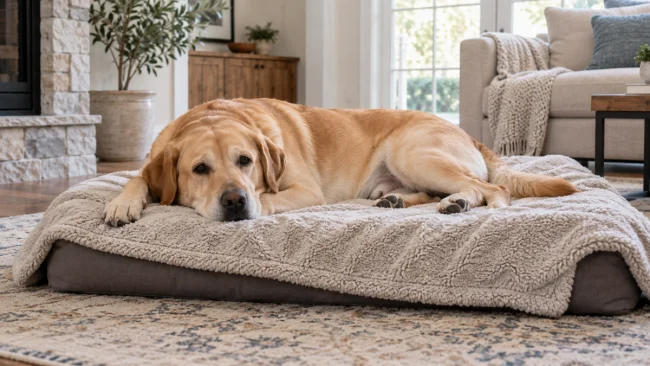
Dog blankets for large dogs need to solve a simple problem that product size labels often make unnecessarily confusing: a big dog needs enough usable fabric to lie, stretch, turn, and reposition without spending most of the night half off the blanket.
The words Large, XL, XXL, and Jumbo are not standardized blanket dimensions. One brand’s XL can be substantially smaller than another brand’s Large or Extra Large. For that reason, actual length and width matter much more than the size name printed on the product page.
Large dogs also create practical household issues that small blankets do not. A thick oversized blanket can occupy most of a washing machine, become heavy when wet, take longer to dry, and form bulky folds on a dog bed or couch.
The right large dog blanket therefore balances four things: your dog’s resting footprint, the surface being covered, the material, and your ability to wash it easily.
For more dog blanket guides covering materials, furniture, weather, and special features, visit our Dog Blankets topic hub.
Quick Comparison: What Should a Large Dog Blanket Fit?
| Use | What to Measure | Coverage Priority | Main Mistake |
|---|---|---|---|
| Direct floor resting | Dog’s full resting footprint | Whole body plus useful margin | Choosing only by breed label |
| Large dog bed | Usable mattress surface | Sleeping area without blocking entry | Buying a blanket much smaller than the bed |
| Couch | Dog’s normal seating zone | Seat, paws and leaning area | Measuring only the dog |
| Human bed | Area where the dog actually sleeps | Localized or full-width protection | Buying more fabric than you can wash |
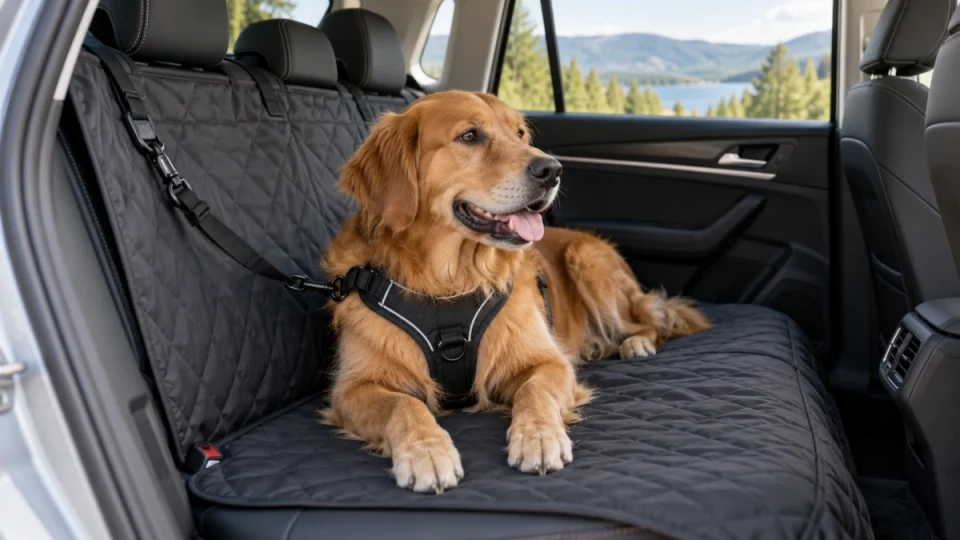
| Car or travel | Vehicle surface | Seat or cargo protection | Choosing a thick indoor blanket without considering travel cleanup |
The blanket does not always need to match the dog’s body dimensions exactly. It needs to fit the combination of the dog and the intended surface.
Large, XL and XXL Do Not Mean the Same Thing Everywhere
Do not use the size label as your main buying decision.
Current pet blankets sold as Large, XL, XXL, Jumbo, or giant-breed sizes can differ substantially in actual length and width.
Always find the real dimensions.
Compare:
- Length
- Width
- Thickness or layer count
- Whether measurements describe the finished blanket or usable sleeping surface
If the listing provides only Small, Medium, Large, and XL without actual dimensions, there is not enough information to determine whether it will fit your large dog properly.
Do Not Choose a Large Dog Blanket by Weight Alone
Two dogs that weigh the same can occupy very different amounts of space.
Body shape matters.
For example, large dogs can differ substantially in:
- Body length
- Leg length
- Chest width
- Tail position
- Sleeping posture
A heavy compact dog that curls tightly may need less floor area than a lighter but very long dog that sleeps fully stretched.
Weight can help describe general dog size, but actual resting dimensions are more useful for blanket coverage.
Sleeping Style Changes the Size You Need
Dogs That Curl Up
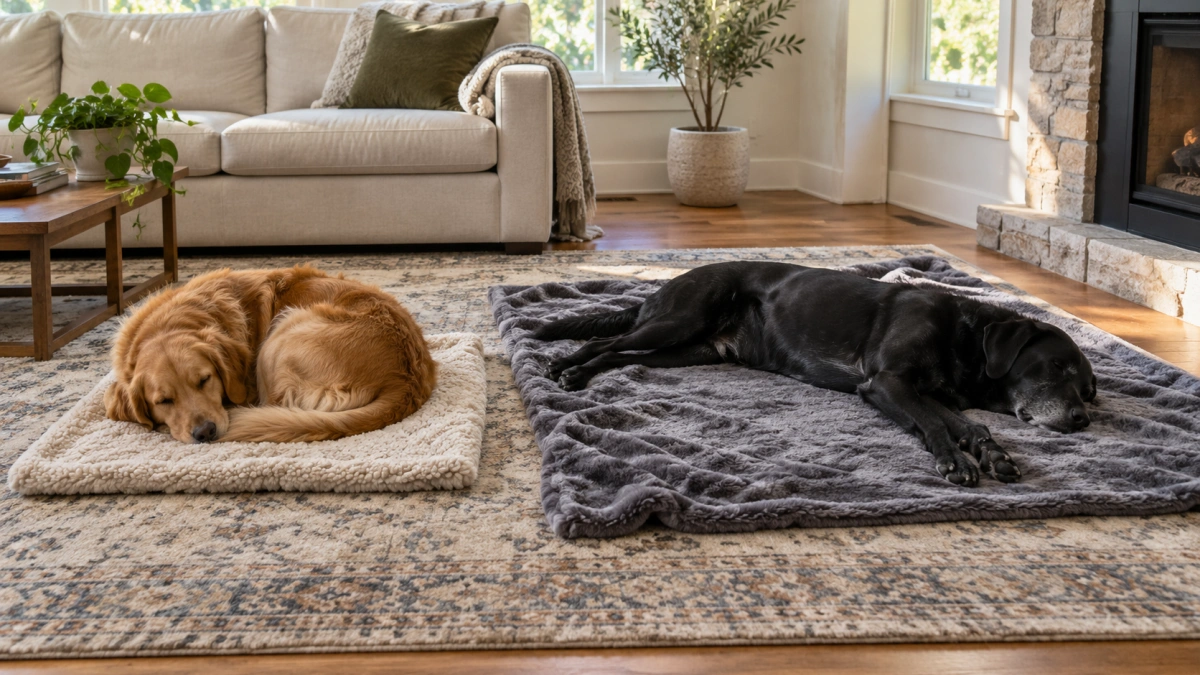
A curled dog creates a relatively compact sleeping footprint.
You may not need an enormous blanket if the dog consistently sleeps in a tight circle and the blanket is being used only on the dog bed.
Dogs That Stretch Out
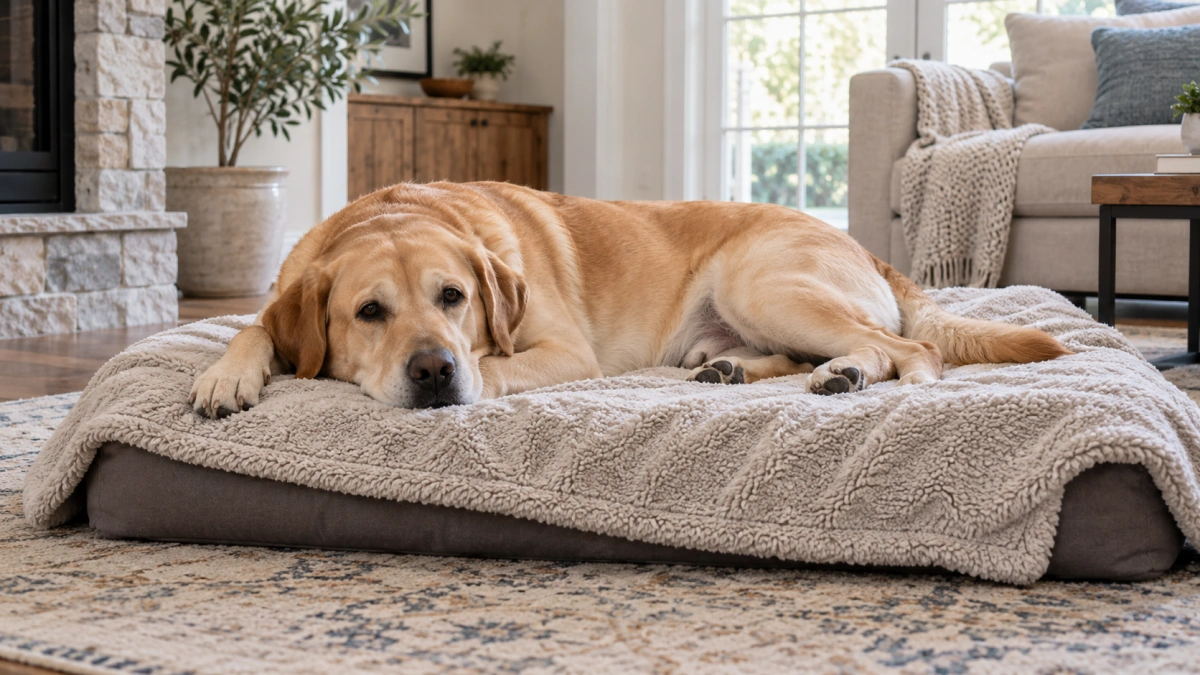
A large dog lying on its side with the front and rear legs extended needs considerably more length and width.
This is where undersized blankets become obvious: the torso stays on the fabric while paws, hindquarters, or the head extend beyond the edges.
Dogs That Change Position Frequently
Provide more usable margin around the resting footprint.
A blanket that fits only one exact sleeping position may stop fitting as soon as the dog rolls over.
How to Measure a Large Dog for a Blanket
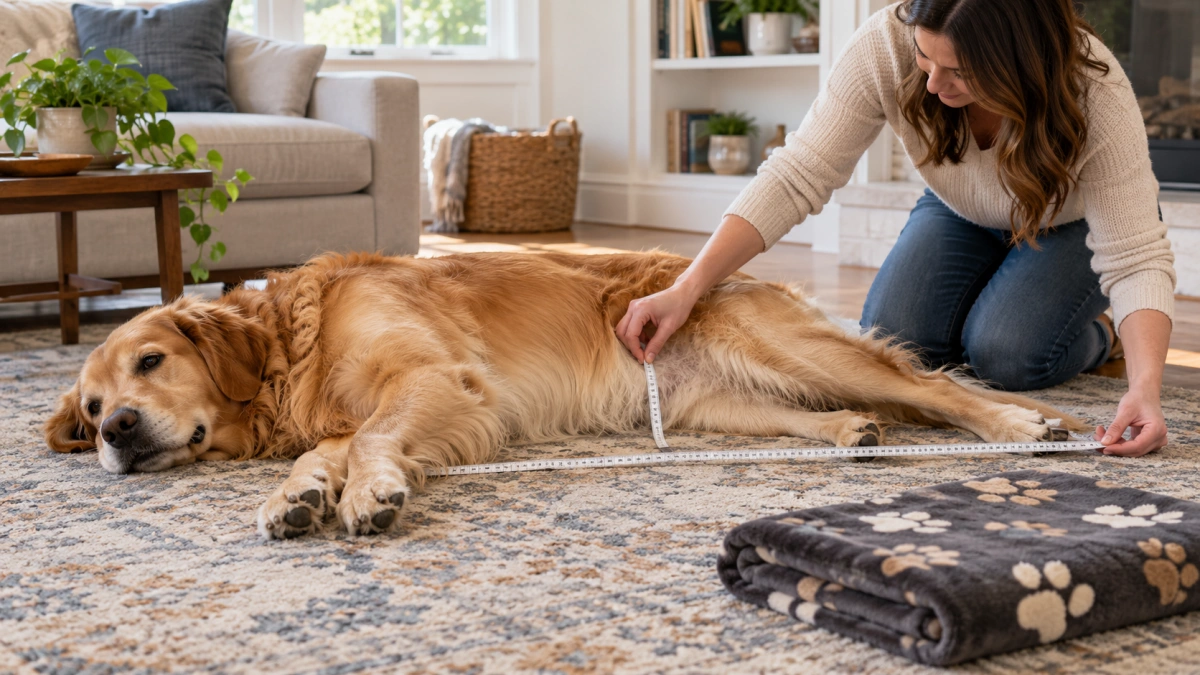
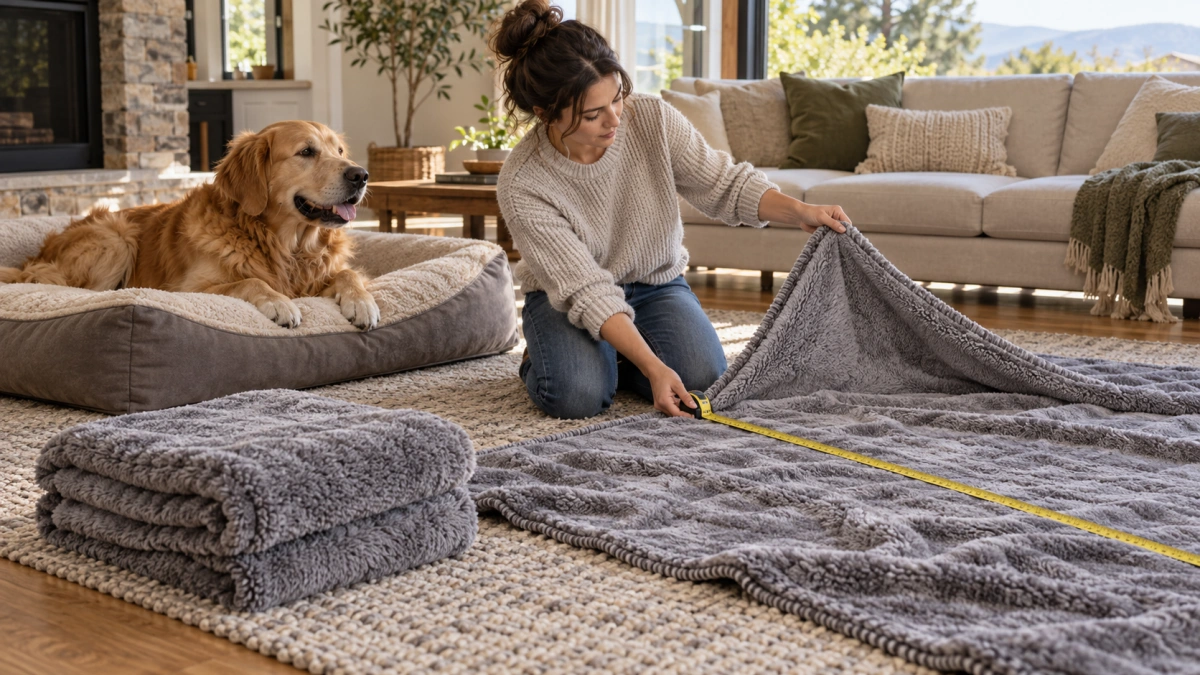
Measure your dog during a normal resting position rather than while the dog is standing.
For a dog that sleeps stretched out:
- Wait until the dog is lying naturally on its side.
- Estimate or measure the length of the full resting footprint.
- Include the head and normal leg extension.
- Measure the widest area created by the body and extended legs.
- Add practical margin for repositioning.
There is no universal number of extra inches that every blanket needs.
The appropriate margin depends on whether the blanket will be:
- Used directly on the floor
- Tucked onto a bed
- Placed over furniture
- Used for nesting
Measure the actual use case instead of automatically buying the largest option.
Measure the Surface Separately
The dog’s body is only half of the size decision.
You may actually be trying to cover:
- A large dog bed
- Two sofa cushions
- A section of a human mattress
- A car seat
- An SUV cargo floor
Measure that surface independently.
Then choose dimensions large enough for both the dog’s movement and the area you want protected.
Usable Coverage Matters More Than Total Fabric
A blanket may technically be large while still providing less useful resting area than expected.
Usable coverage can be reduced by:
- Thick folded edges
- Decorative borders
- Large fringe
- Excessive bunching
- Tucking substantial fabric beneath a mattress
Think about how much flat fabric remains available after the blanket is placed where you will actually use it.
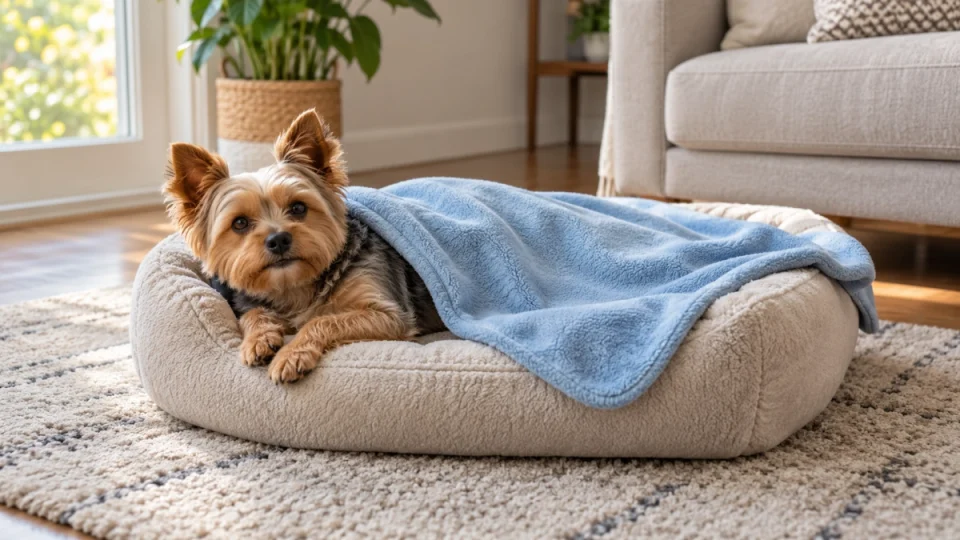
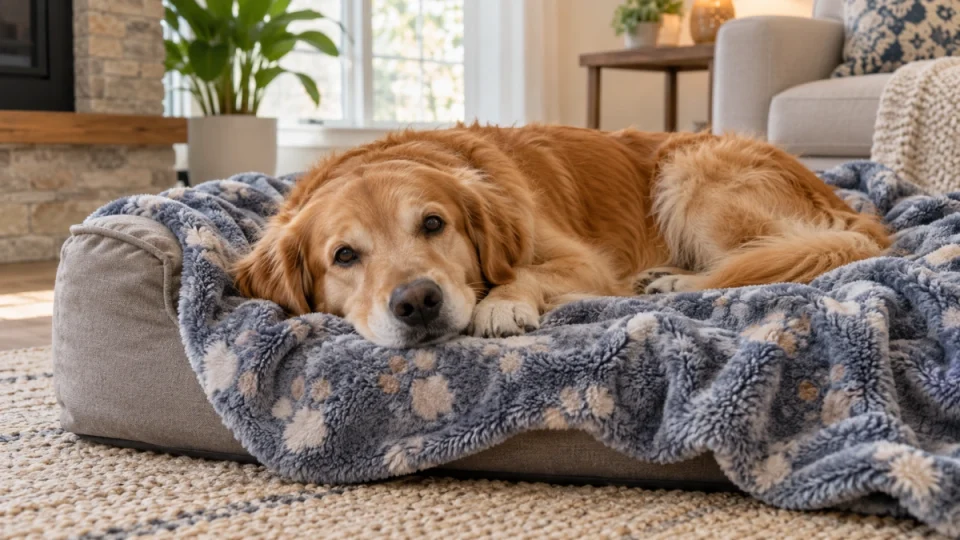
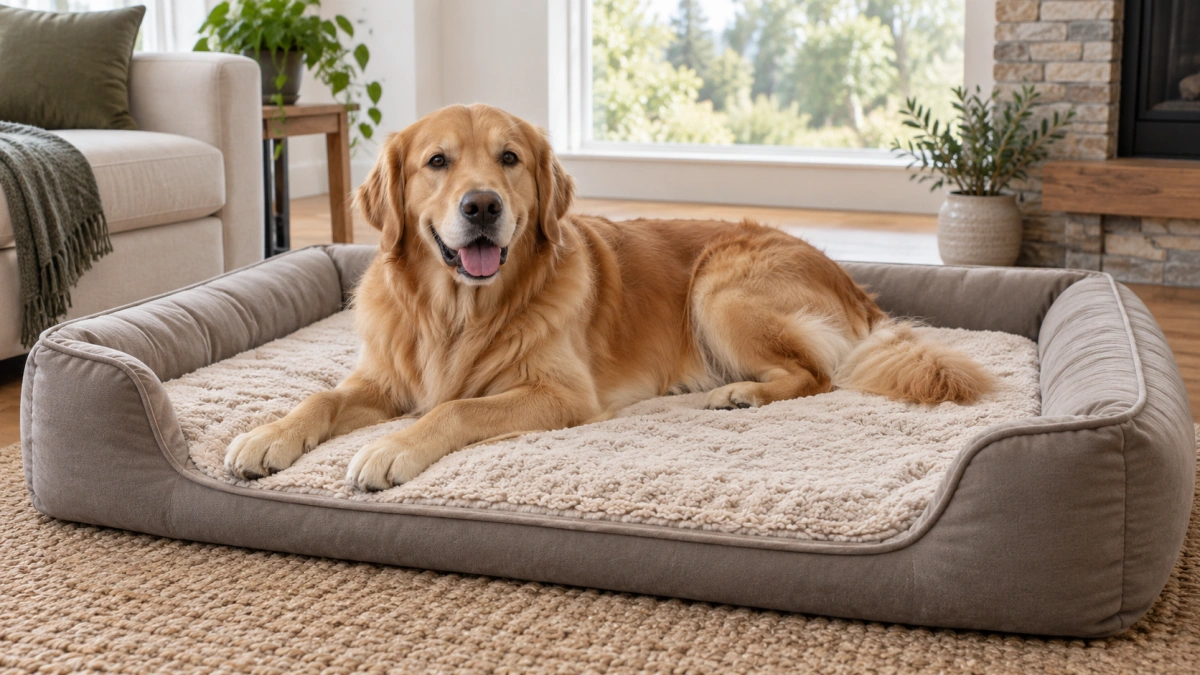
Large Dog Blankets for Dog Beds
When a blanket is used on a large dog bed, the mattress should provide the structural support.
The blanket can provide:
- A washable contact layer
- Warmth
- Hair collection
- Nesting material
- Seasonal texture changes
Try to cover most of the sleeping area without creating so many folds that the surface becomes unstable.
For a bolster bed, measure the flat interior sleeping zone rather than the outside dimensions of the bolsters.
For more detailed bed placement guidance, see our guide to dog blankets for beds.
Large Dog Blankets for Couches
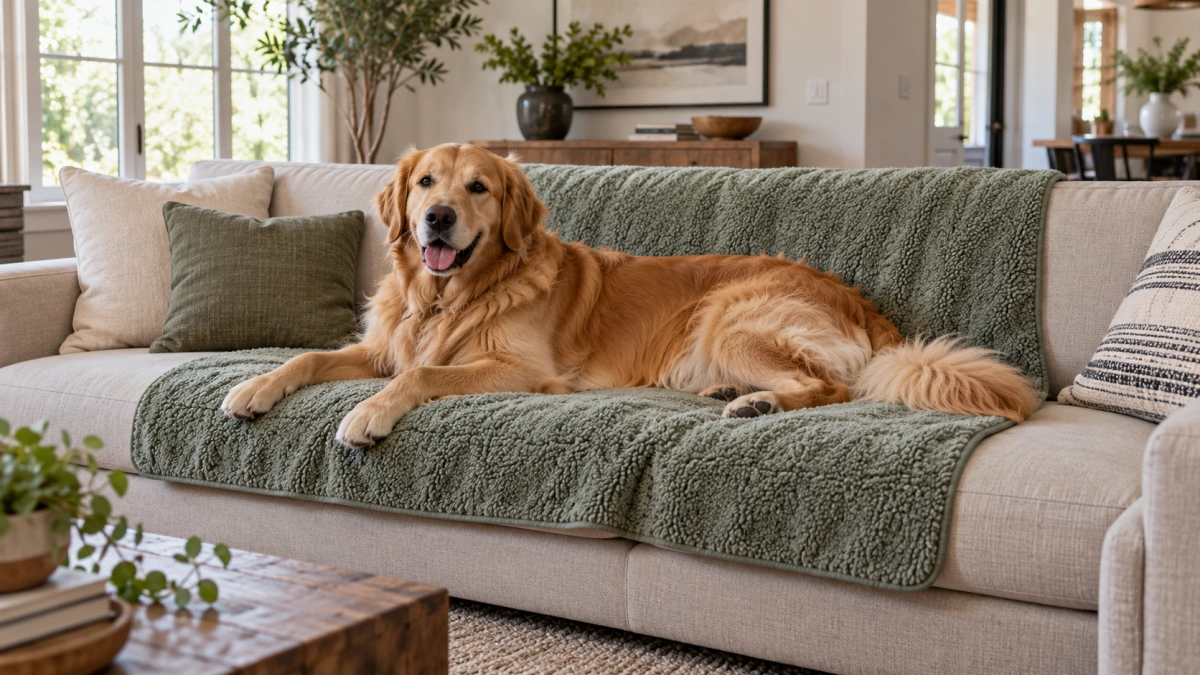
Large dogs can occupy much more furniture than their curled body size suggests.
A dog may:
- Stretch across two or three cushions
- Lean against the seat back
- Put paws on an armrest
- Change direction several times
If furniture protection is the goal, measure the couch area rather than the dog.
Your blanket may need to cover the full seat depth and several cushions even if the dog itself would fit on a smaller blanket on the floor.
For sectional layouts, grip, and upholstery-specific choices, see our guide to dog blankets for couches.
Large Dog Blankets for Human Beds
If your large dog sleeps on your bed, decide whether the blanket is meant to:
- Protect only the dog’s normal sleeping zone
- Cover the foot of the bed
- Cover half the mattress
- Protect most of the comforter
Localized coverage is often easier to wash than using a giant pet blanket across the entire bed.
If your dog changes sleeping positions throughout the night, larger coverage becomes more useful.
What About Giant Breeds?
Very large and giant dogs make actual measurements especially important.
A blanket marketed for “large breeds” may still be too short for a long Great Dane, Mastiff, Saint Bernard, Newfoundland, Irish Wolfhound, or similarly large dog when fully stretched.
Do not select solely from a breed list.
Measure the individual dog and compare the real product dimensions.
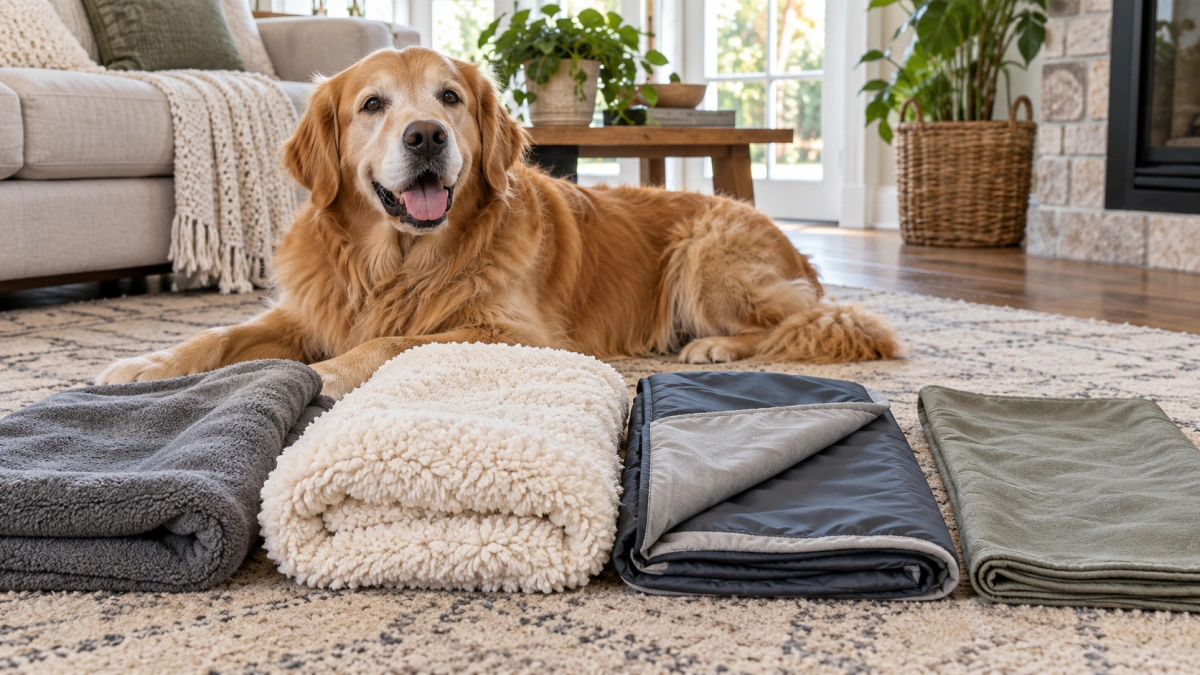
Which Material Is Best for Large Dogs?
Large dogs do not require one specific material simply because of their size.
Choose material by temperature, shedding, mess, and household maintenance.
Short Fleece
A practical all-around option because it provides moderate warmth without the laundry bulk of very deep plush.
Low-Pile Microfiber or Smooth Fabric
Useful for heavy shedders and warm environments because hair can be easier to remove and the blanket can be lighter.
Plush or Sherpa
Useful for dogs that actively seek warmer, deeper surfaces.
The trade-off is greater bulk, more trapped hair, and longer drying.
Waterproof Multi-Layer Blanket
Useful when the large dog frequently has wet paws, drool, accidents, or uses expensive furniture.
The barrier adds additional weight and laundry bulk.
Flat Woven Fabric
Can work well when you want a lighter, lower-loft furniture or travel layer.
Large Dogs Do Not Automatically Need Thick Blankets
Dog size does not determine preferred warmth.
A large short-coated dog in a cool room may appreciate additional insulation, while a large double-coated dog in a warm home may avoid thick fleece or sherpa.
Observe whether your dog:
- Seeks the blanket
- Pushes it away
- Moves to a hard cool floor
- Curls under fabric
- Stretches away from warm bedding
Choose warmth from the dog’s actual behavior and environment rather than assuming a large blanket should also be thick.
Which Material Is Best for Heavy Shedding?
Large dogs can produce a large amount of visible shed hair simply because they have more body surface.
If cleanup is a priority, consider:
- Lower pile
- Dense surface construction
- Easy vacuuming
- Machine washability
Deep sherpa, shag, and faux fur may be comfortable but give loose hair more places to settle.
For a deeper material comparison, see our guide to dog blankets that resist pet hair.
Do Large Dogs Need Waterproof Blankets?
Only when liquid protection solves a real problem.
Waterproof construction may help with:
- Wet coats
- Drool
- Muddy paws
- Puppy accidents
- Senior-dog accidents
- Furniture protection
If your large dog is dry, house-trained, and mainly sheds hair, a simpler washable blanket may be lighter and easier to maintain.
Durability Matters, but Large Does Not Mean Destructive
A large dog puts more body mass and leverage against bedding while standing, turning, and nesting, so secure seams and stable fabric are useful.
But size alone does not mean the dog will destroy blankets.
Choose additional durability when your individual dog:
- Digs intensely
- Scratches before lying down
- Chews corners
- Pulls seams
Do not sacrifice comfort for heavy-duty fabric unless the behavior actually requires it.
Blanket Thickness Does Not Provide Orthopedic Support
A thick fluffy blanket may feel softer, but it should not be treated as a substitute for a supportive dog bed.
The mattress underneath provides the primary structural support.
This matters particularly when a large dog needs a stable sleeping surface.
Use the blanket as a removable comfort, warmth, or cleaning layer rather than trying to build a supportive bed from several folded blankets.
Large Senior Dogs
For an older large dog, prioritize simple access and stable bedding.
A useful setup may include:
- A supportive low-entry dog bed
- A flat washable blanket
- Minimal bulky folds
- Enough blanket area for repositioning
Avoid assuming that adding more layers will solve difficulty getting comfortable.
If your senior dog develops new pain, weakness, difficulty rising, or major changes in sleeping behavior, veterinary assessment is more appropriate than simply adding thicker bedding.
Large Puppies and Growing Dogs
A puppy from a large or giant breed can outgrow a blanket quickly.
You do not necessarily need to buy the final adult size immediately if the blanket becomes impractical in the current crate or bed.
Instead, balance:
- Current body size
- Current bed or crate dimensions
- Expected growth
- Laundry convenience
A simple washable blanket that is inexpensive to replace can make more sense during rapid growth.
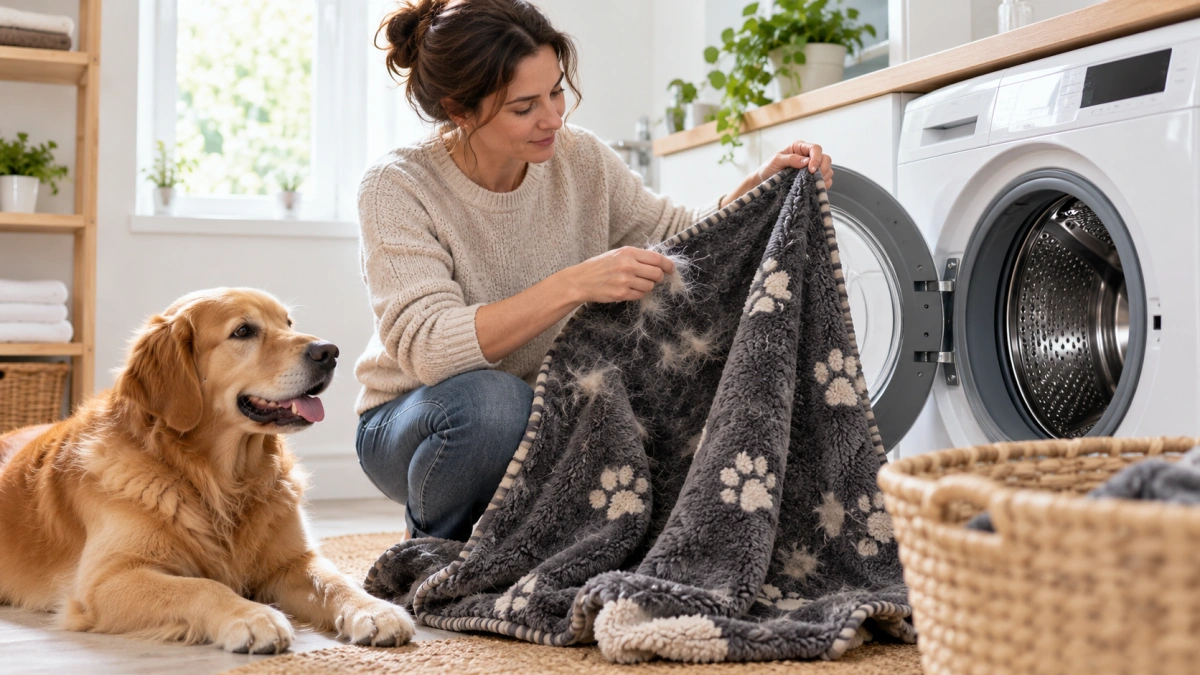
Can Your Washer Handle a Large Dog Blanket?
This is one of the most overlooked buying questions.
A large lightweight fleece blanket may wash easily.
A giant multi-layer waterproof sherpa blanket can become much bulkier and heavier when wet.
Before buying, consider:
- Blanket dimensions
- Dry weight
- Layer count
- Water absorption
- Your washer’s usable drum capacity
Do not force a large blanket into an overloaded washing machine.
The blanket needs enough space to move during the wash cycle according to your appliance instructions.
Large Blankets Can Take Longer to Dry
Drying time increases with:
- Blanket size
- Thickness
- Deep pile
- Waterproof membranes
- Multiple layers
A blanket should be fully dry before returning it to the dog bed or storing it.
If laundry turnaround is important, a large single-layer or medium-weight fleece blanket may be more convenient than the thickest plush option.
Would Two Medium-Large Blankets Be Better Than One Giant Blanket?
Sometimes.
One giant blanket provides continuous coverage, but two smaller blankets can offer:
- Easier washing
- Faster drying
- More flexible couch coverage
- Simple laundry rotation
For example, two overlapping blankets may protect a sectional more conveniently than one enormous heavy throw.
However, avoid creating unstable piles on a dog bed.
Why a Two-Blanket Rotation Works Well for Large Dogs
Large blankets take up more laundry space, which makes having a spare particularly useful.
Keep:
- One blanket in use
- One clean blanket ready
The dog can keep using the bed or couch area while the first blanket is being washed and fully dried.
Our 9-Point Large Dog Blanket Check
Use these nine factors before choosing a blanket for a large or giant dog.
1. Real Dimensions
Ignore Large, XL, and XXL until you know the actual length and width.
2. Resting Footprint
Does the blanket accommodate your dog’s normal curled or stretched sleeping position?
3. Movement Margin
Is there enough extra area for turning and repositioning?
4. Surface Coverage
Does it fit the dog bed, couch, mattress, or travel surface you actually want to protect?
5. Material
Does the fabric match your dog’s warmth, shedding, and texture preferences?
6. Thickness
Does the blanket provide useful comfort without creating unnecessary heat or laundry bulk?
7. Durability
Can the seams and fabric handle your individual dog’s normal nesting behavior?
8. Laundry
Can your washer and dryer realistically handle the blanket?
9. Support
If the dog needs a supportive sleeping surface, is there a proper mattress underneath rather than relying on blanket thickness?
A blanket that passes these nine checks is much more useful than one selected simply because the product page calls it “XXL.”
Common Large Dog Blanket Buying Mistakes
- Buying by XL or XXL label instead of actual measurements
- Choosing only by dog weight
- Ignoring the dog’s sleeping style
- Measuring the dog but not the dog bed
- Measuring the dog but not the couch
- Buying the largest blanket without considering laundry
- Choosing deep sherpa for a dog that prefers cool surfaces
- Assuming large dogs always need thick blankets
- Buying deep plush when hair cleanup is a major concern
- Adding waterproof construction when it is not needed
- Assuming a giant blanket is automatically more durable
- Using blanket thickness as a substitute for a supportive bed
- Creating deep unstable folds for a senior dog
- Forcing an oversized blanket into a small washing machine
- Ignoring drying time
Large Dog Blanket Buying Checklist
- What are my dog’s actual resting dimensions?
- Does the dog curl or stretch?
- How much movement margin is needed?
- What are the real blanket dimensions?
- Am I ignoring the Large / XL / XXL marketing label?
- Will the blanket be used on the floor, dog bed, couch, human bed, or car?
- What are the dimensions of that surface?
- Do I need fleece, smooth low pile, plush, sherpa, or waterproof construction?
- How warm is the room?
- How heavily does my dog shed?
- Does my dog dig or chew bedding?
- Are the seams secure?
- Will the blanket fit my washing machine?
- How bulky will it become when wet?
- Can I dry it completely?
- Would two smaller blankets be easier to manage?
- Should I keep a second blanket for laundry rotation?
- Is a supportive dog bed underneath doing the real support work?
Final Thoughts
The best dog blankets for large dogs are chosen by measurements, not by the letters XL or XXL.
Start by watching how your dog really sleeps. A curled large dog needs a different amount of space from a dog that stretches its legs fully across the floor.
Then measure the surface. A blanket meant for a large dog bed should match the usable mattress area, while a couch blanket may need to cover several cushions and part of the backrest.
Choose material according to the dog’s environment and your maintenance priorities. Short fleece gives a useful balance of warmth and easy care, low-pile fabrics can simplify hair removal, plush and sherpa provide more insulation, and waterproof construction is valuable when liquid protection is actually necessary.
Finally, think about laundry before buying the biggest product available. Large multi-layer blankets can become heavy and bulky when wet. A slightly lighter blanket—or two easier-to-wash blankets—may be much more practical over years of use.
For a large dog, enough coverage matters. Extra fabric beyond what you can use, wash, and dry does not.