By
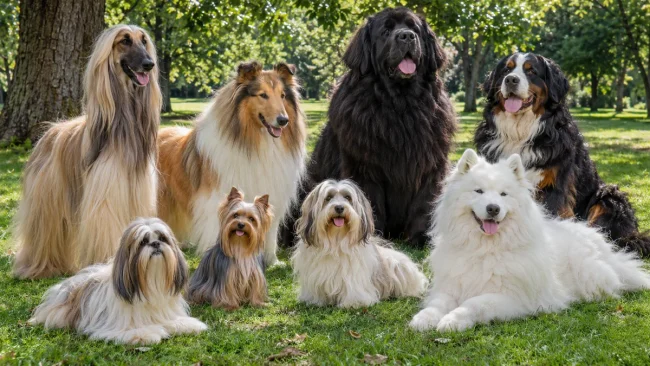
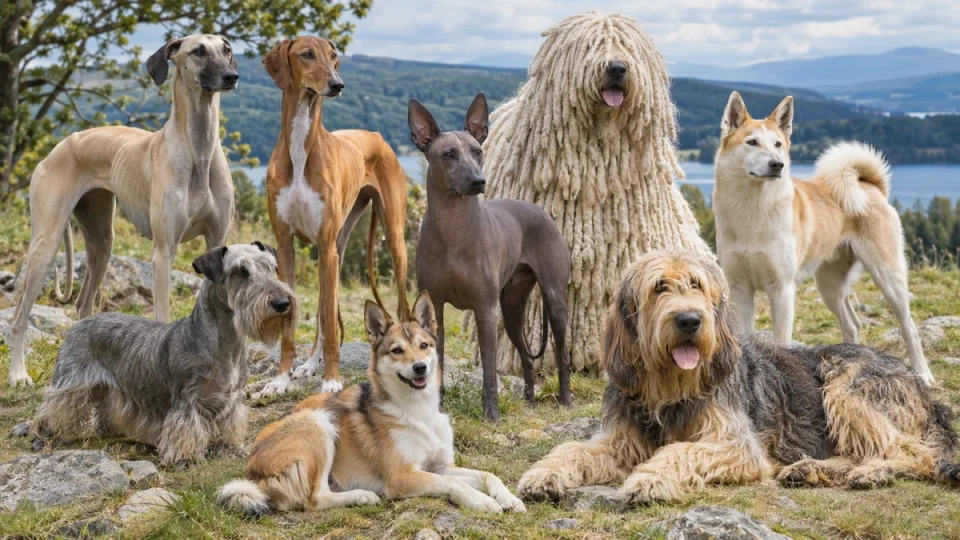
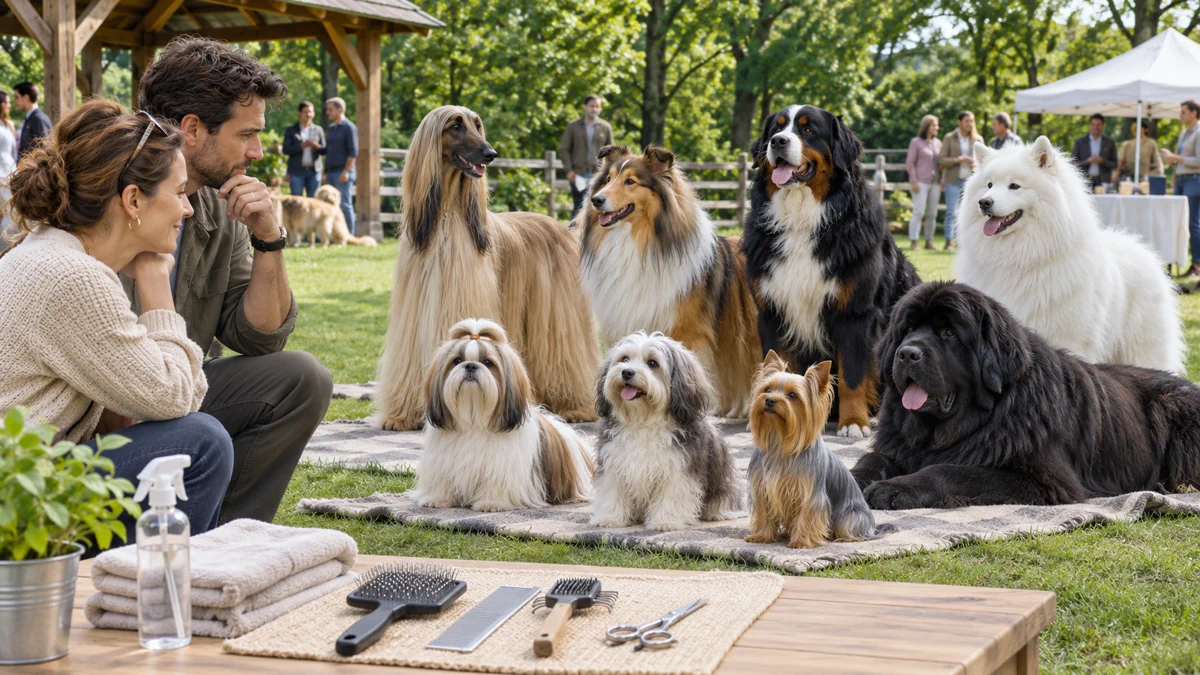
Long-haired dog breeds range from tiny companion dogs with silky coats to giant working breeds protected by thick layers of weather-resistant fur. An Afghan Hound, Yorkshire Terrier, Rough Collie, Newfoundland and Puli can all be described as long-haired dogs, yet their coats behave very differently.
That difference matters far more than coat length alone.
Some long coats grow continuously and need frequent brushing and trimming. Others are double coats that shed a dense undercoat seasonally. Some dogs have feathering concentrated around the ears, legs, chest and tail, while a few breeds naturally develop cords instead of a conventionally brushed coat.
Before choosing a dog because you love flowing hair or a fluffy appearance, consider how much brushing, bathing, drying, shedding management and professional grooming the coat will require throughout the dog’s life.
This guide compares common long-haired dog breeds by coat type, body size and grooming needs so you can tell the difference between a beautiful coat you enjoy looking at and one you are genuinely prepared to maintain.
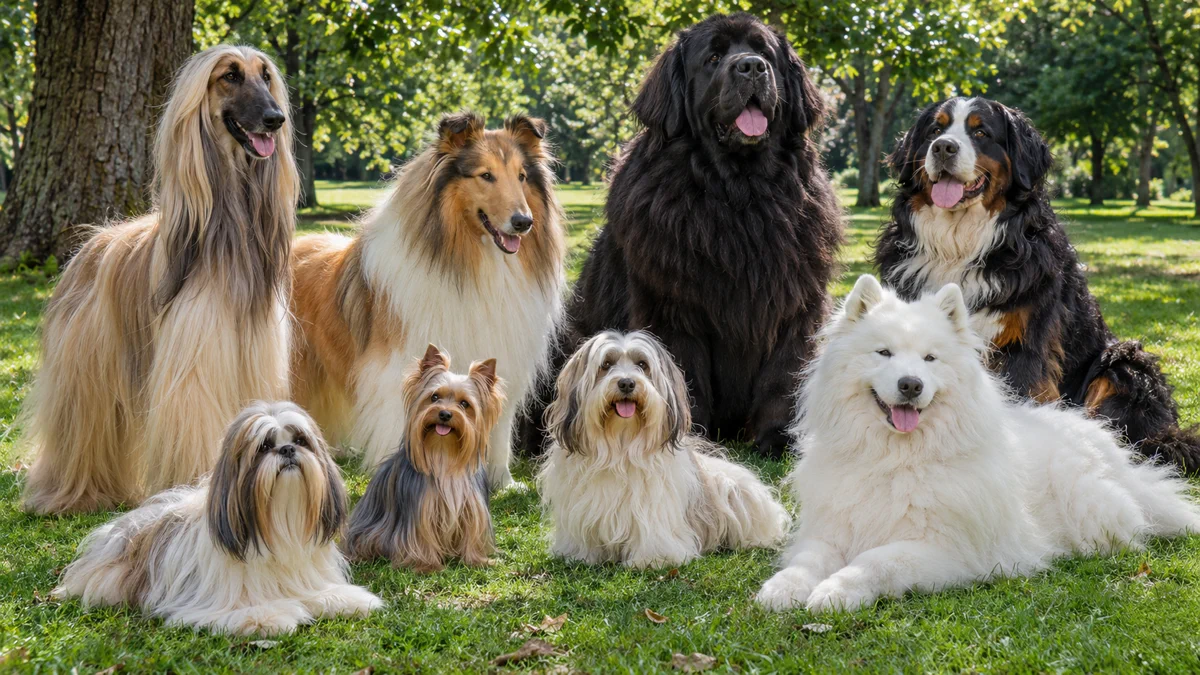
What Counts as a Long-Haired Dog Breed?
There is no single universal hair-length measurement that officially separates every long-haired dog from every medium-coated dog.
Breed standards instead describe the coat expected for each individual breed.
The practical definition is a dog whose normal adult coat grows long enough to create obvious length, feathering, furnishings, cords or substantial outer-coat coverage that requires more maintenance than a typical smooth coat.
Long-haired breeds can include:
- Silky companion breeds
- Drop-coated dogs
- Long double-coated working breeds
- Feathered sporting and herding dogs
- Fluffy northern breeds
- Corded breeds
That variety is why choosing grooming tools only from the label “long-haired dog” can lead to mistakes.
Not All Long-Haired Dog Coats Are the Same
The American Kennel Club’s professional grooming system separates canine coats into several functional types, including drop, double, curly, wire and jacketed coats.
Several of those categories can produce visibly long hair.
Drop Coat
Drop coats consist of longer hair that naturally falls to the sides of the body and tends to continue growing rather than following the same seasonal shedding pattern as many double coats.
Examples include:
- Yorkshire Terrier
- Havanese
- Some other long-haired companion breeds
Long Double Coat
A long double coat has a longer protective outer layer and a softer dense undercoat beneath it.
Examples include:
- Newfoundland
- Bernese Mountain Dog
- Great Pyrenees
- Rough Collie
- Samoyed
Silky Long Coat
Breeds such as the Afghan Hound, Maltese and Yorkshire Terrier may have long hair with a smoother or silkier texture than heavy northern double coats.
Corded Coat
Pulik and Komondors can develop natural cords as their adult coats mature.
Corded coats require separation, cleaning and extremely thorough drying rather than normal daily brushing through the full coat.
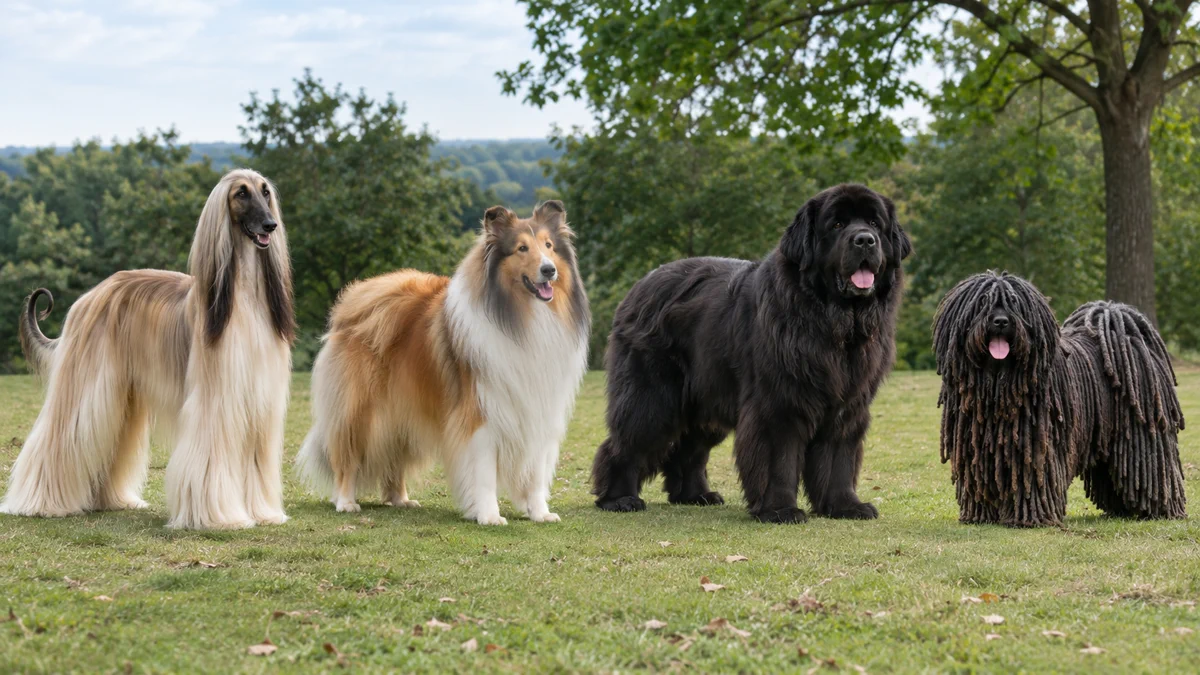
Quick Comparison of Long-Haired Dog Breeds
| Breed | Size | Coat Type | General Grooming Commitment |
|---|---|---|---|
| Afghan Hound | Large | Long silky coat | Very high |
| Shih Tzu | Small | Long flowing double coat | High when kept long |
| Yorkshire Terrier | Very small | Long silky drop coat | High when kept long |
| Maltese | Very small | Long silky hair | High when kept long |
| Havanese | Small | Long soft coat | Moderate to high |
| Rough Collie | Medium-large | Long double coat | Moderate to high |
| Bernese Mountain Dog | Large | Long double coat | Moderate, with heavy shedding |
| Newfoundland | Giant | Long water-resistant double coat | High |
| Great Pyrenees | Large | Long double coat | Moderate, with substantial shedding |
| Samoyed | Medium-large | Profuse double coat | High |
| Puli | Medium | Corded or brushed coat | Specialized |
| Komondor | Large | Heavy corded coat | Specialized |
1. Afghan Hound
The Afghan Hound is one of the most recognizable long-haired breeds in the world.
Its mature coat is long, fine and silky and was historically useful in the mountainous regions where the breed developed.
The visual effect can be spectacular, but maintaining a full coat requires substantial commitment.
AKC notes that adolescent and adult Afghans require several hours of brushing each week to prevent tangles and mats and remove debris.
Regular bathing and conditioning are also part of maintaining the coat.
This is therefore a poor choice for someone who wants dramatic long hair but dislikes grooming.
2. Shih Tzu
The Shih Tzu demonstrates how grooming style can dramatically change the practical maintenance of a long-haired breed.
A full-length Shih Tzu coat requires daily brushing.
Owners need to work through the coat in sections rather than brushing only the surface because hidden tangles can develop closer to the skin.
Hair around the face also needs attention to keep it from irritating the eyes.
Many companion Shih Tzus are therefore kept in shorter “puppy trims.”
A shorter trim reduces coat length but does not eliminate routine brushing, bathing, nail care or facial maintenance.
3. Yorkshire Terrier
Yorkshire Terriers combine a tiny body with a coat that can become remarkably long.
The adult coat is fine and silky rather than thick and woolly.
A traditional full coat needs careful brushing and protection from tangles.
Many pet Yorkies are maintained in shorter trims because they are easier to manage around normal household activity.
The important point is that body size does not predict grooming difficulty. A seven-pound dog can require more coat work than a much larger short-haired breed.
4. Maltese
The Maltese is another very small breed capable of growing a long, flowing white coat.
The coat can look simple in photographs, but fine long hair can tangle without consistent maintenance.
Owners keeping a longer style should expect regular brushing and combing, with particular attention to areas where friction occurs.
Shorter companion trims can reduce the amount of hair that needs daily management.
5. Havanese
The Havanese has a long, soft coat that may be straight or somewhat wavy.
Unlike a heavy northern working coat, its hair creates a softer drop-coated appearance.
Regular brushing is needed to prevent tangles, especially around areas such as:
- Behind the ears
- Under the front legs
- Chest
- Leg furnishings
- Areas affected by harness friction
Havanese can also be kept in shorter practical trims, although the coat still requires maintenance.
Small Long-Haired Dog Breeds
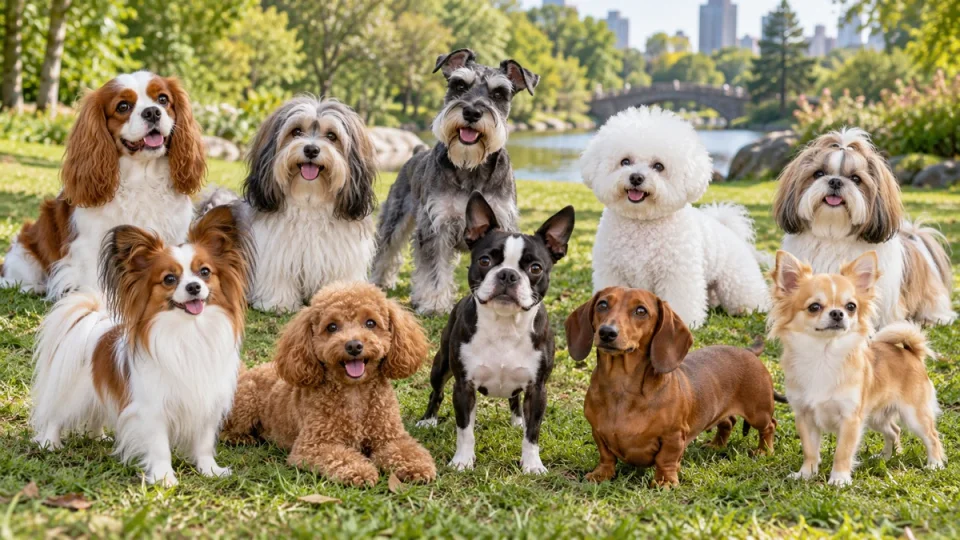
If you want the visual appeal of a long coat without the body size of a Newfoundland or Bernese Mountain Dog, several small breeds are worth researching.
Examples include:
- Shih Tzu
- Yorkshire Terrier
- Maltese
- Havanese
- Lhasa Apso
- Japanese Chin
- Papillon
Their coats are not identical.
A Papillon has long feathering but significantly less overall coat than a full-coated Shih Tzu. A Yorkshire Terrier has fine drop hair. A Lhasa Apso can carry a heavy long coat that requires regular brushing and bathing.
Small size can make bathing and lifting easier, but it does not automatically reduce the number of grooming sessions.
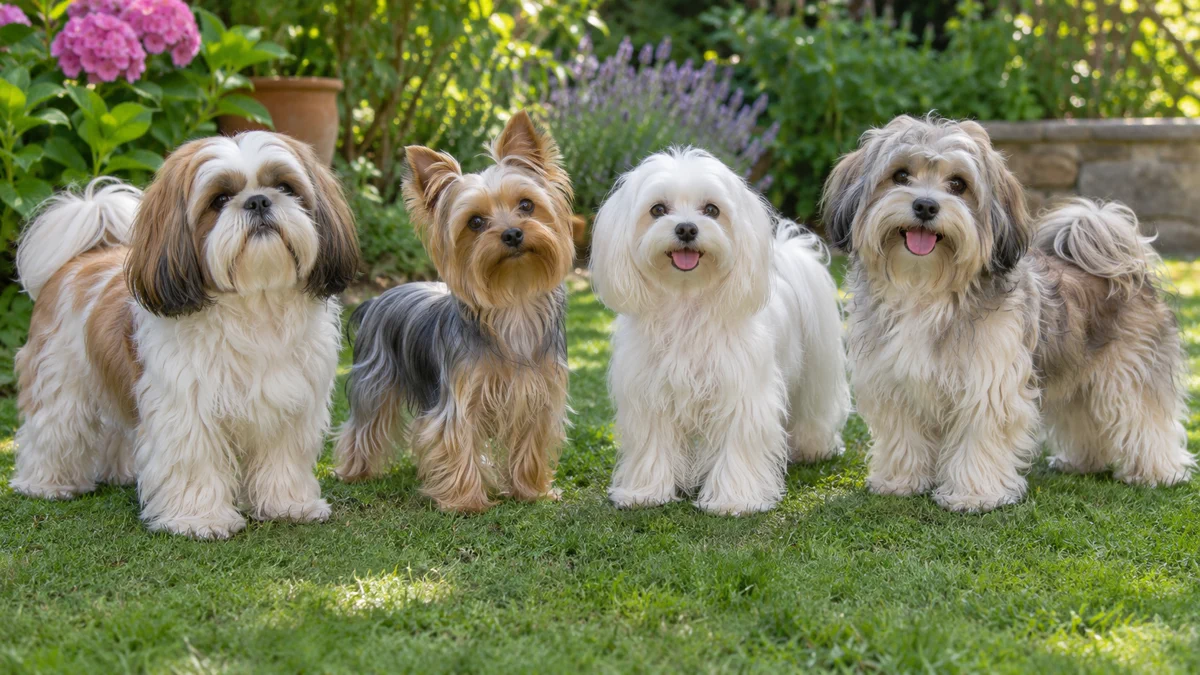
6. Rough Collie
The Rough Collie has an abundant long double coat rather than continuously growing silky hair.
Its coat consists of a protective outer layer over a dense undercoat.
The characteristic mane, feathering and full tail create substantial visual volume.
Regular brushing helps remove loose undercoat and prevents tangles, especially in areas of heavier coat.
This type of coat also means owners should expect seasonal shedding rather than assuming long hair automatically means low shedding.
7. Bernese Mountain Dog
The Bernese Mountain Dog has a thick, moderately long double coat developed for Swiss working conditions.
Its coat is less floor-length than an Afghan Hound’s but produces considerable hair because of the dog’s large body and dense undercoat.
Regular brushing is particularly useful during seasonal shedding.
Owners should also check feathered areas and places where friction can create tangles.
8. Newfoundland
The Newfoundland combines giant body size with a long, dense, water-resistant double coat.
That makes grooming physically different from brushing a 10-pound companion dog.
A full grooming session involves far more coat surface area, more drying time and significantly more loose undercoat.
AKC identifies Newfoundlands as one of the working breeds with a long double coat consisting of a protective topcoat and thick undercoat.
9. Great Pyrenees
Great Pyrenees have a substantial weather-resistant double coat developed for livestock-guardian work.
The long outer coat and thick undercoat provide protection, but they also generate loose hair.
Owners should plan for consistent brushing and heavier seasonal shedding.
Despite the long white coat, routine grooming should focus on maintaining a functional natural coat rather than frequent cosmetic clipping.
Large Long-Haired Dog Breeds
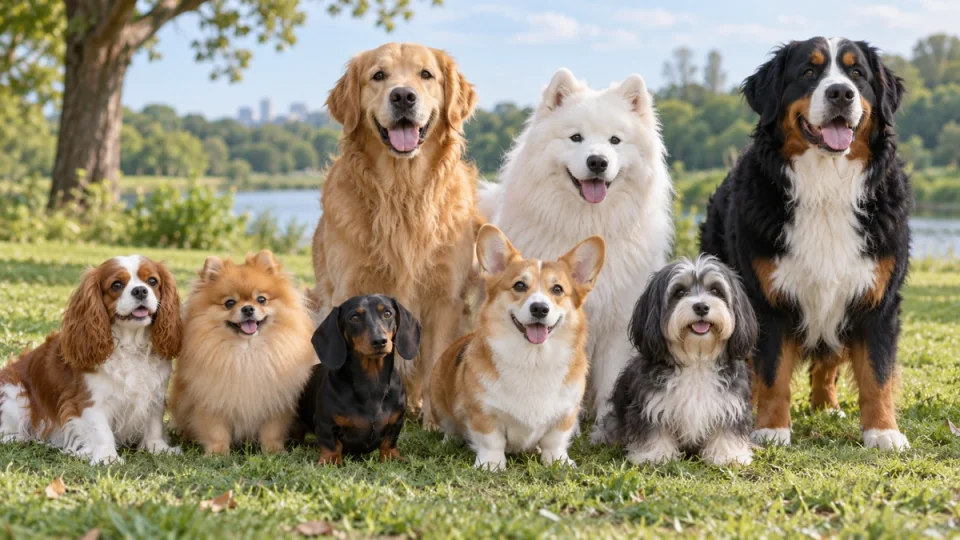
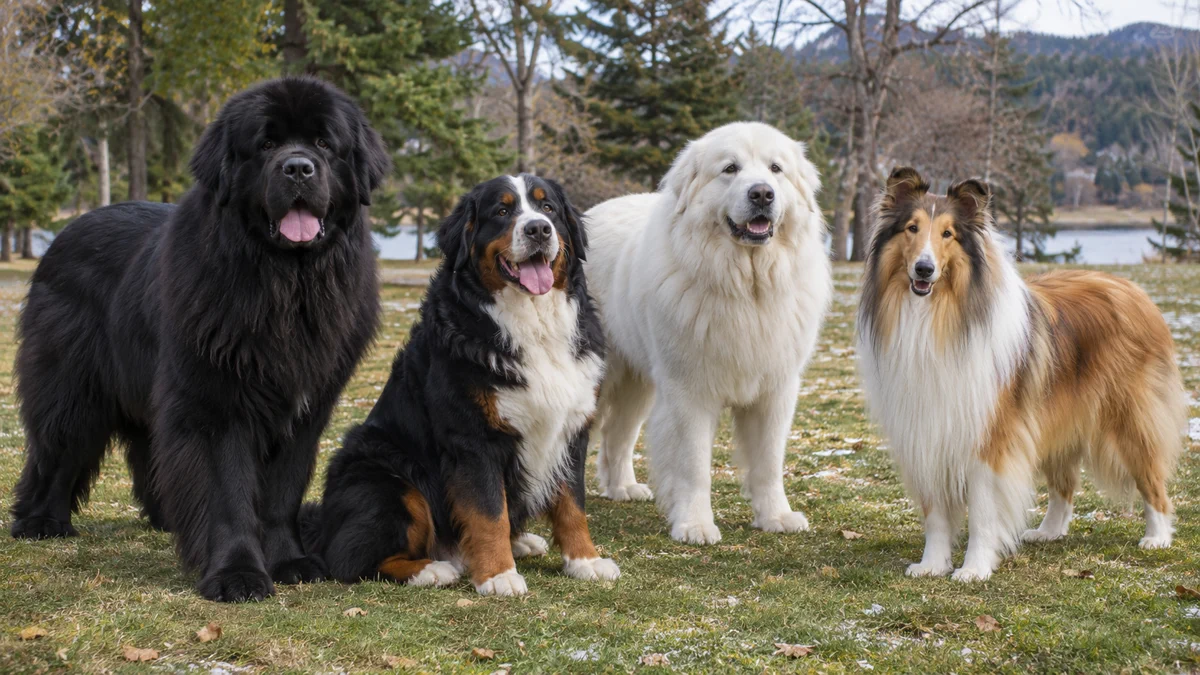
Popular large and giant long-haired breeds include:
- Newfoundland
- Bernese Mountain Dog
- Great Pyrenees
- Rough Collie
- Samoyed
- Afghan Hound
- Leonberger
- Saint Bernard
For large long-haired dogs, grooming workload is affected by both coat type and total body surface area.
A large dog can also require:
- A larger bathing area
- More drying time
- More powerful grooming equipment
- More space for brushing
- More household cleaning during shedding season
For broader size comparisons, visit our Large Dog Breeds guide.
10. Samoyed
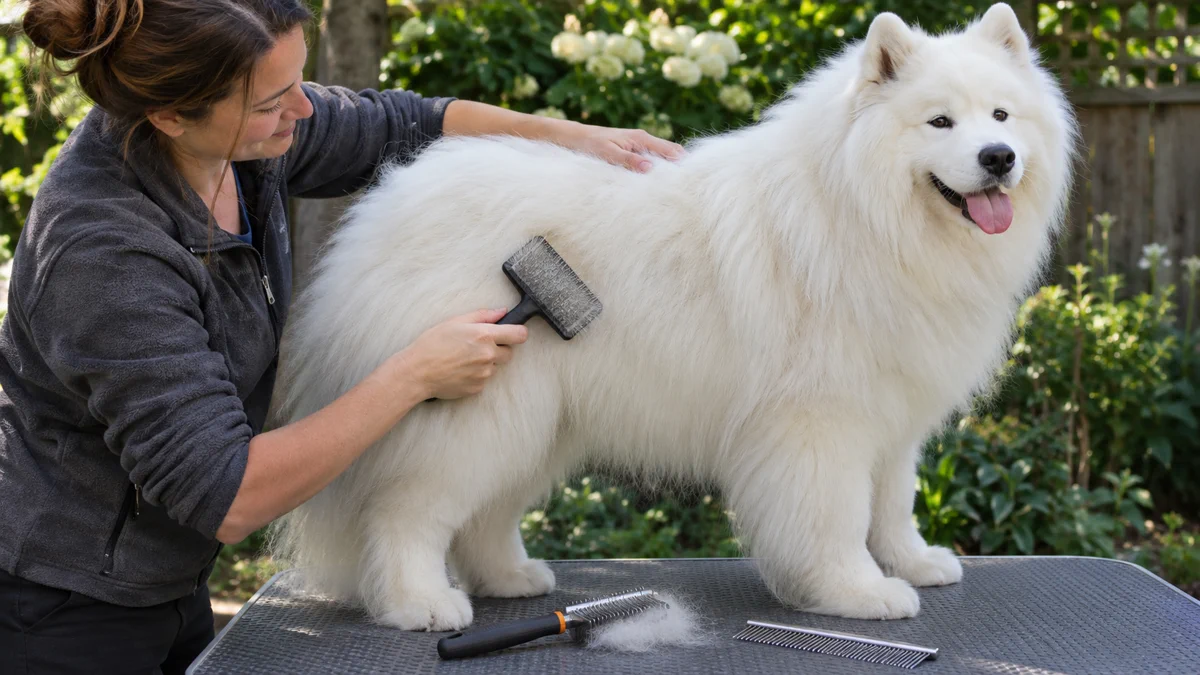
The Samoyed has one of the most substantial coats among northern working breeds.
The outer coat is longer and harsher, while the undercoat is thick, soft and woolly.
This coat helped the breed work in extremely cold conditions.
AKC notes that Samoyeds shed throughout the year and even more heavily during seasonal coat changes.
Daily brushing can help manage loose hair, dirt and tangles.
Anyone attracted to the famous fluffy white appearance should also be comfortable with substantial shedding and frequent grooming.
Long Double Coats and Shedding
A major distinction between long double coats and many continuously growing drop coats is shedding behavior.
Double-coated dogs have:
- A protective outer coat
- A softer insulating undercoat
The undercoat can shed heavily during seasonal changes.
Regular grooming helps remove loose undercoat before it forms dense tangles or spreads throughout the home.
AKC grooming guidance recommends tools such as appropriate rakes, slicker brushes and metal combs depending on coat density.
Should You Shave a Long Double-Coated Dog?
Generally, shaving a healthy double coat simply to reduce shedding or make the dog cooler is not recommended.
The outer coat and undercoat perform different protective functions.
AKC grooming guidance notes that shaving can interfere with coat function and regrowth.
Instead, use regular brushing, undercoat removal, appropriate bathing and thorough drying to maintain the coat.
There are situations where clipping or shaving may be medically necessary or required to remove severe matting, but those decisions are different from routine cosmetic shaving.
When severe mats are present, consult a professional groomer or veterinarian rather than attempting painful dematting at home.
How Often Should You Brush a Long-Haired Dog?
There is no one schedule for every breed.
AKC general grooming guidance notes that long-haired dogs may need brushing anywhere from several times each week to daily.
Dogs with coats that mat quickly or are maintained at full length often need the most frequent care.
Examples include:
- Full-coated Shih Tzus
- Afghan Hounds
- Long-coated Maltese
- Yorkshire Terriers in full coat
- Havanese with long coats
Long double-coated breeds may also need more frequent grooming during seasonal shedding periods.
Why Brushing Only the Top Layer Is Not Enough
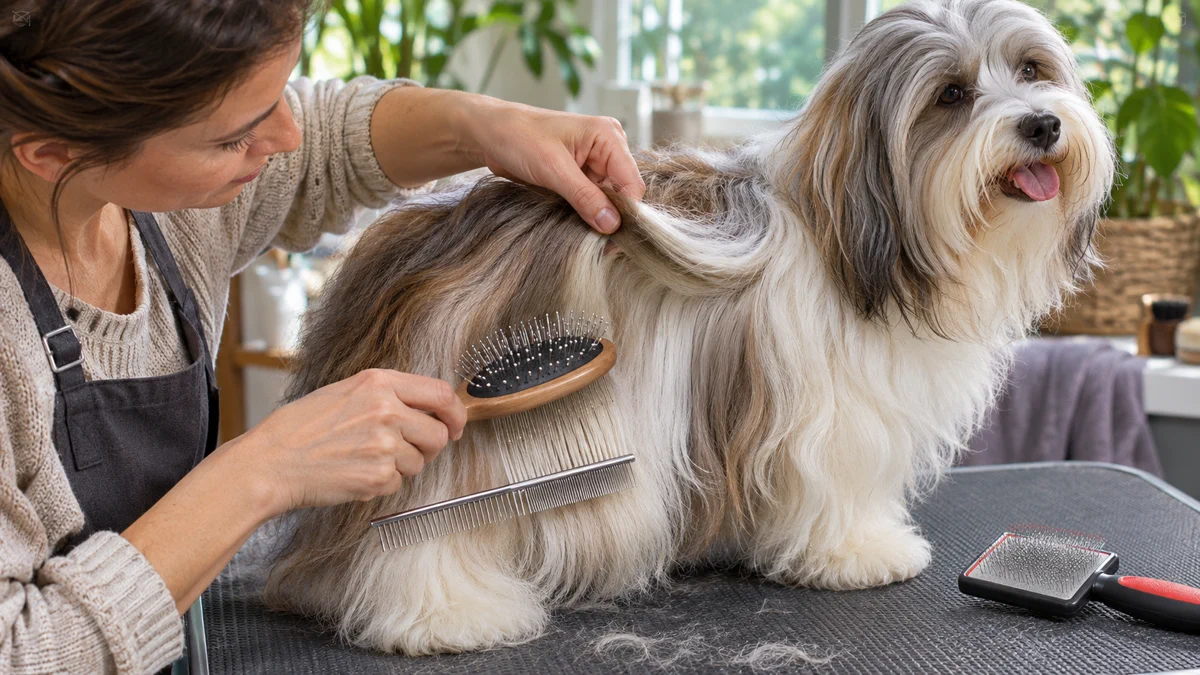
A long coat can look smooth on the surface while mats are forming closer to the skin.
Problem areas commonly include:
- Behind the ears
- Armpits
- Groin
- Chest
- Collar area
- Harness contact points
- Back of the legs
- Tail furnishings
Work gently through sections of coat and use a comb to check whether the hair is free of tangles all the way to the skin.
Do not repeatedly pull through a painful mat.
Which Grooming Tools Do Long-Haired Dogs Need?
The correct tools depend on coat structure, but common options include:
- Pin brush
- Slicker brush
- Metal comb
- Undercoat rake for appropriate double coats
- Dog-specific shampoo
- Conditioner when suitable for the coat
- High-quality dryer for heavy coats
- Nail clippers or grinder
AKC recommends selecting brushes and grooming tools according to the individual coat rather than assuming one brush works for every dog.
How Often Should Long-Haired Dogs Be Bathed?
Bathing frequency depends on coat type, lifestyle and how well the coat is maintained between baths.
AKC grooming guidance notes that dogs with medium or longer coats may need bathing on schedules ranging from weekly to every several weeks depending on the breed and individual circumstances.
A full-coated Shih Tzu or Afghan Hound may follow a different routine from a large double-coated Great Pyrenees.
Over-bathing without appropriate products can dry the coat or skin, while leaving dirty long hair unmanaged can encourage tangles.
Drying Is Part of Grooming
Long hair must be dried thoroughly after bathing.
Leaving dense or long coat damp can encourage tangles, skin irritation and odor.
This becomes particularly important with:
- Heavy double coats
- Long drop coats
- Corded coats
A Newfoundland or Samoyed can take far longer to dry than a short-coated small dog.
Do Long-Haired Dogs Shed More?
Not always.
Hair length and shedding level are separate characteristics.
A long double-coated Samoyed can shed heavily.
A Yorkshire Terrier has long hair but follows a different coat-growth pattern and releases loose hair differently.
A Poodle can grow long curly hair while producing relatively little loose hair around the home, though the coat requires frequent clipping.
Choose based on the combination of coat type, shedding and grooming—not hair length alone.
Hair vs Fur: Does the Difference Matter?
People often casually use “hair” and “fur” interchangeably, but canine coat growth cycles can differ.
AKC grooming information notes that Poodles, Maltese and Havanese are examples of breeds with longer hair-growth phases, while breeds such as Golden Retrievers and Collies have coat structures commonly described as fur.
The practical result is different maintenance.
Continuously growing coats usually need clipping or trimming, while shedding double coats require loose undercoat removal.
Corded Long-Haired Dog Breeds
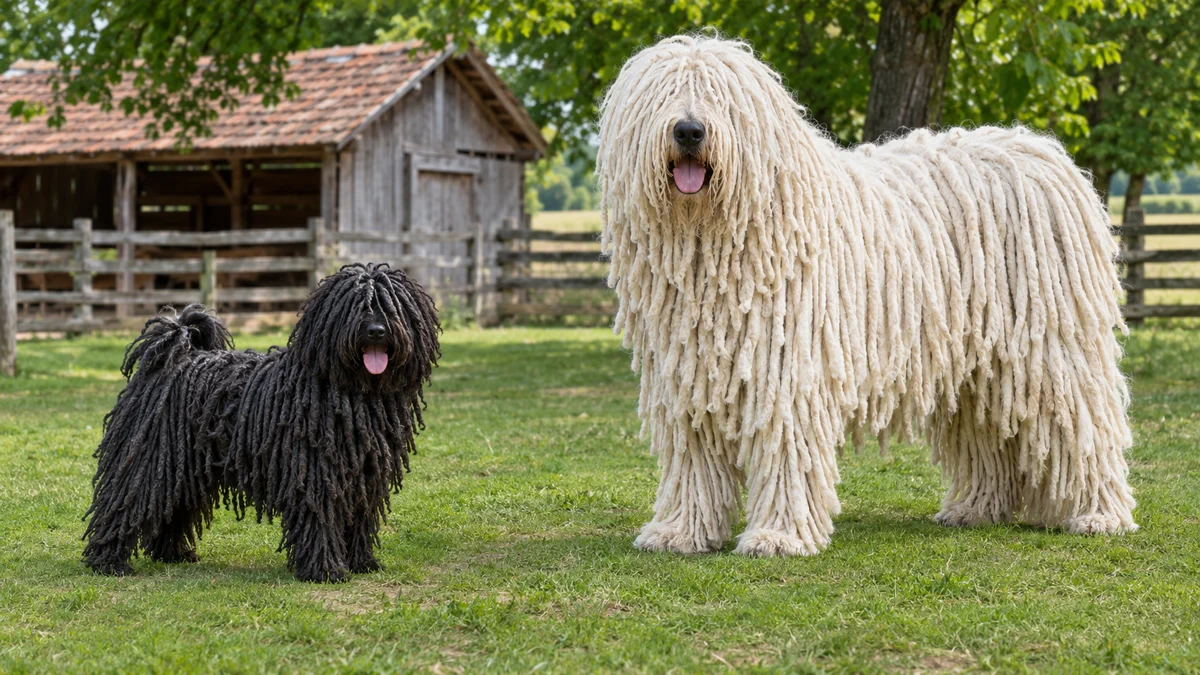
Corded coats are one of the most unusual forms of long canine coat.
Two classic examples are:
- Puli
- Komondor
Puppies are not born with mature cords.
As the adult coat develops, sections naturally begin to mat together and must be separated into controlled individual cords.
The process requires patience and careful coat management.
Established cords are generally not brushed like ordinary long hair.
Bathing also requires special attention because dense cords can absorb significant water and must dry completely.
Long-Haired Dogs and Hot Weather
It may seem logical to assume that every long-haired dog should be clipped extremely short during summer, but coat biology is more complicated.
Double coats help protect skin and participate in insulation.
Instead of automatically shaving, focus on:
- Removing loose undercoat
- Keeping the coat clean and free of mats
- Providing shade
- Providing fresh water
- Walking during cooler hours
- Using air conditioning when appropriate
Breed-specific climate tolerance still matters. A Samoyed and Shih Tzu have different structures and different heat-management concerns.
Do Long-Haired Dogs Get More Mats?
Many do because longer hair creates more opportunities for strands to twist together.
Mats can develop faster when hair is:
- Damp
- Dirty
- Rubbing under a harness
- Not brushed to the skin
- Changing from puppy to adult coat
Severe mats are not merely cosmetic. They can pull on the skin and hide irritation, moisture or other problems underneath.
Can You Keep a Long-Haired Breed in a Shorter Trim?
For several continuously growing companion breeds, yes.
Shih Tzus, Yorkshire Terriers, Maltese and Havanese are commonly maintained in shorter practical companion trims.
That can reduce the time required to maintain floor-length hair.
But a shorter haircut does not eliminate grooming.
Hair still grows, tangles can still occur and regular clipping must be repeated.
This is different from shaving a functional double-coated working breed simply because its coat is long.
Long-Haired Dogs and Outdoor Lifestyles
Long coats collect more environmental material than smooth coats.
After hikes or outdoor play, check for:
- Burrs
- Seeds
- Twigs
- Mud
- Tangles
- Ticks
Pay particular attention to feathering around the feet, legs, chest and ears.
Which Long-Haired Breed Is Easiest to Groom?
There is no universal easiest breed because grooming difficulty depends on the hairstyle you maintain and the dog’s lifestyle.
A small companion dog in a practical short trim may be easier for some owners than maintaining a giant double coat.
However, someone comfortable with regular brushing may prefer a naturally maintained double coat over a breed requiring professional clipping every few weeks.
Think in terms of the type of work you prefer rather than searching for a completely maintenance-free long coat.
Which Long-Haired Dogs Shed the Most?
Heavy double-coated breeds can produce substantial loose hair.
Examples include:
- Samoyed
- Newfoundland
- Bernese Mountain Dog
- Great Pyrenees
- Rough Collie
Shedding often increases during seasonal coat changes.
If household hair is your main concern, choose based on shedding pattern rather than simply avoiding short-coated breeds.
Which Long-Haired Dogs Are Smaller?
Good small long-haired breeds to research include:
- Shih Tzu
- Maltese
- Yorkshire Terrier
- Havanese
- Lhasa Apso
- Papillon
- Japanese Chin
For a broader size-based comparison, see our Best Small Dog Breeds guide.
Which Long-Haired Dogs Are Large?
Large and giant options include:
- Newfoundland
- Bernese Mountain Dog
- Great Pyrenees
- Afghan Hound
- Rough Collie
- Samoyed
- Leonberger
- Saint Bernard
Remember that increasing adult size increases the physical scale of the grooming job as well as food, equipment and transportation requirements.
Rare Long-Haired Dog Breeds
Some less-common breeds also have distinctive long or unusual coats.
Examples include the Komondor, Puli and several uncommon European working or companion breeds.
If rarity is the main search intention, see our Rare Dog Breeds guide rather than choosing a dog only because its coat looks unusual.
Is a Long-Haired Dog Breed Right for You?
Before choosing a long-haired breed, ask:
- Am I willing to brush several times per week or even daily?
- Can I recognize and prevent mats?
- Am I comfortable with seasonal shedding?
- Can I afford professional grooming if the breed requires clipping?
- Do I have space to bathe and dry a large dog?
- Am I prepared to check the coat after outdoor activity?
- Do I prefer trimming a growing coat or brushing a shedding double coat?
- Can I maintain facial, ear, foot and sanitary areas?
- Does the breed’s exercise and temperament fit my household?
- Would I still want this breed if its coat were kept in a practical pet style?
Final Thoughts
Long-haired dog breeds include everything from seven-pound Yorkshire Terriers and Maltese to giant Newfoundlands and heavily coated livestock guardians.
What connects them visually does not connect them in grooming biology.
Afghan Hounds have long silky coats requiring frequent brushing and bathing. Shih Tzus and other small companion breeds can be maintained in full coat or shorter practical trims. Rough Collies, Bernese Mountain Dogs and Newfoundlands have long double coats that shed. Samoyeds combine a profuse outer coat with a dense woolly undercoat. Pulik and Komondors require specialized cord management.
That is why the right question is not simply, “Do I want a long-haired dog?”
Ask what type of long coat you are prepared to care for.
If you enjoy brushing, bathing, drying and maintaining coat health, a long-haired breed can be extremely rewarding. If those tasks already sound exhausting, choose a coat that fits your routine rather than assuming you will learn to enjoy hours of grooming after the dog arrives.
Choose the whole dog—temperament, size, exercise and coat—not the photograph of the hair.