By

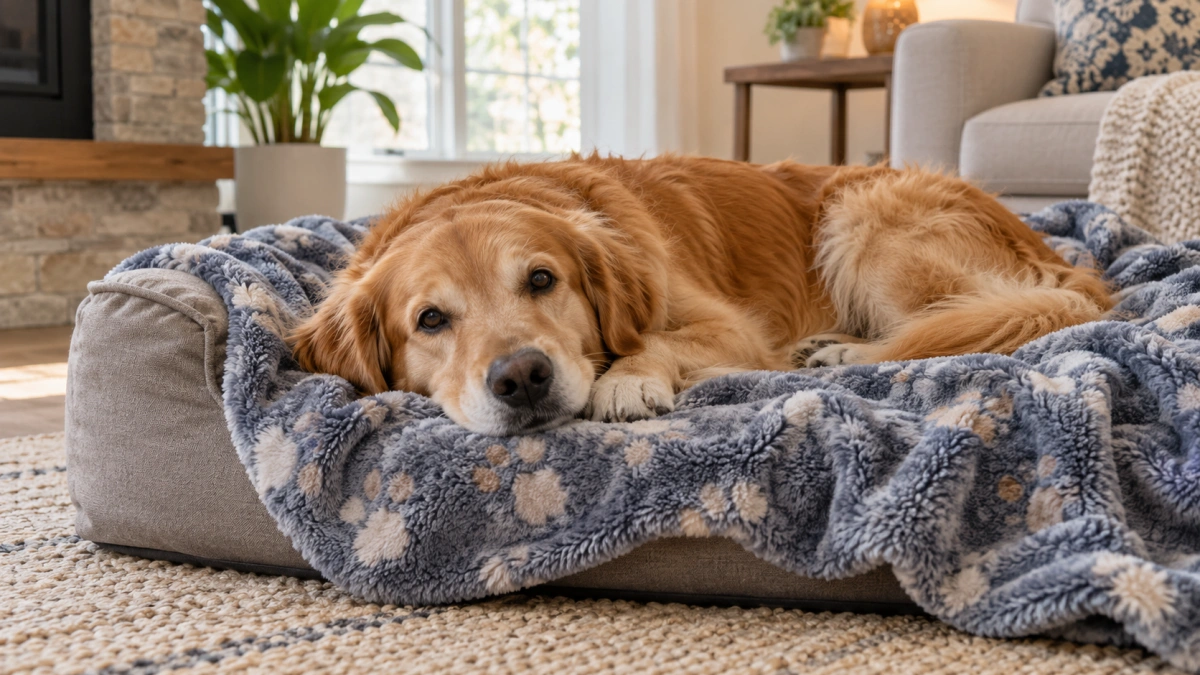
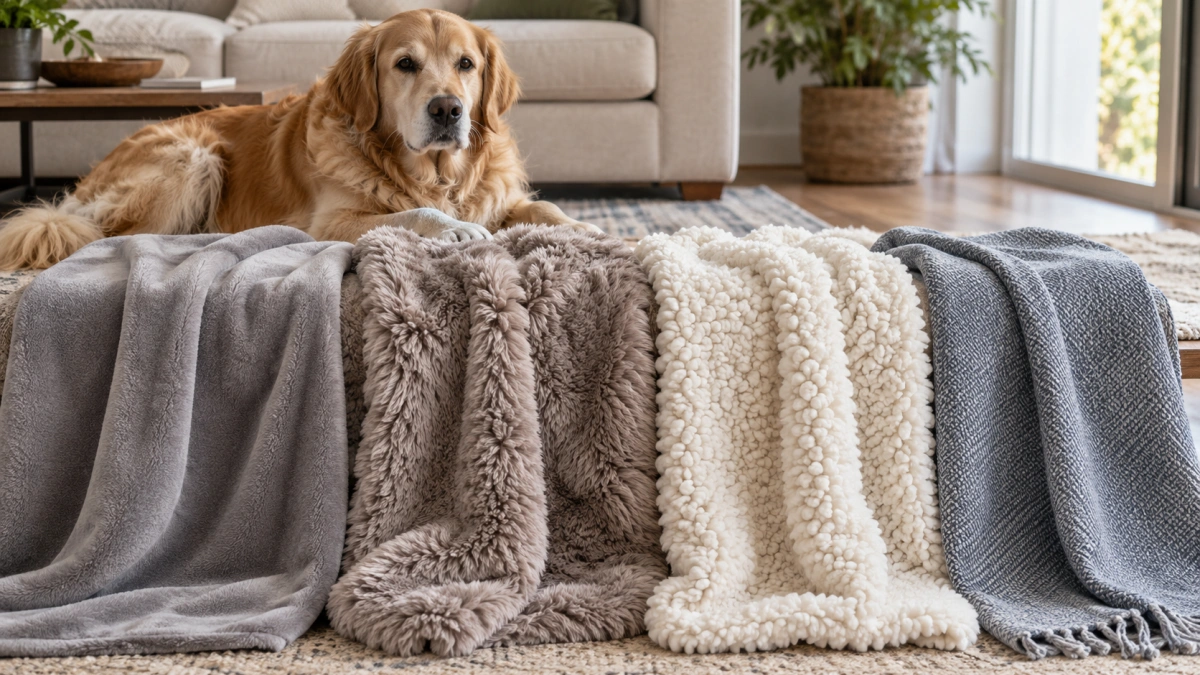
Fleece and plush dog blankets are popular because they add softness and warmth without requiring you to replace your dog’s entire bed. But fleece, plush, sherpa, faux fur, fuzzy fabrics, and cotton do not all feel or perform the same way.
Some materials prioritize easy washing and moderate warmth. Others use deeper pile to create a warmer, softer nesting surface. The trade-off is often more trapped dog hair, slower drying, greater bulk, and more maintenance.
The best material depends on your dog’s coat, sleeping style, room temperature, shedding level, and where the blanket will be used.
For broader help choosing size, use, and general blanket features, see our best dog blankets guide or browse the full Dog Blankets topic hub.
Quick Comparison: Which Dog Blanket Material Should You Choose?
| Material | Warmth | Texture | Hair Cleanup | Best Use |
|---|---|---|---|---|
| Short fleece | Moderate | Soft and relatively flat | Moderate | Everyday indoor use |
| Deep plush | Moderate to high | Very soft and fluffy | Harder | Dogs that enjoy soft nesting surfaces |
| Sherpa-style fleece | High | Curly, deep and warm | Harder | Cool rooms and winter bedding |
| Faux fur | Moderate to high | Long, soft fibers | Usually harder | Decorative or very plush bedding |
| Cotton or cotton blend | Low to moderate | Flatter and breathable | Depends on weave | Mild weather and lighter bedding |
| Microfiber-style fabric | Low to moderate | Fine and smooth to lightly plush | Often easier when low pile | Easy-care everyday use |
This table describes common tendencies, not guarantees. The exact construction, pile, thickness, and layer count can change how two blankets made from the same fiber perform.
What Is a Fleece Dog Blanket?
Most pet fleece blankets use synthetic fibers such as polyester that are brushed or processed to create a soft raised surface.
Common advantages include:
- Low to moderate weight
- Useful warmth
- Soft texture
- Good flexibility
- Easy folding
- Common machine-washable construction
- Relatively fast drying compared with very thick bedding
That combination makes fleece one of the most versatile dog blanket materials.
However, fleece varies widely. Thin polar-style fleece, dense anti-pill fleece, microfleece, and fluffy fleece do not provide identical warmth or maintenance.
What Is a Plush Dog Blanket?
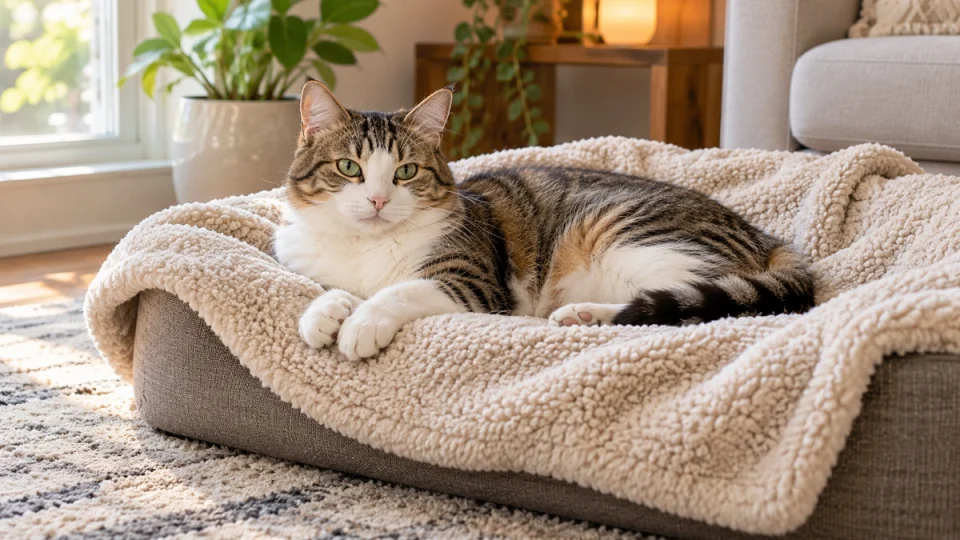
“Plush” usually describes the surface feel rather than one specific fiber.
A plush dog blanket has a soft raised pile that can be deeper and more velvety than standard fleece.
Its advantages include:
- Soft contact surface
- More cushioning feel
- Greater visual luxury
- Good nesting comfort
The trade-offs can include:
- More trapped dog hair
- Longer drying
- More bulk in the washer
- Greater heat retention
If your dog prefers sleeping on cool hard floors during warm weather, deep plush may be more insulation than the dog wants.
What Is Sherpa?
Sherpa-style fabric is designed to resemble the curly, wool-like texture of shearling, but most pet sherpa blankets use synthetic fibers rather than actual sheepskin.
Sherpa creates numerous small loops and raised fibers that trap air.
That makes it useful for:
- Cold rooms
- Winter use
- Dogs that seek warm surfaces
- Nesting
However, the same texture can hold:
- Dog hair
- Lint
- Small debris
more readily than a smooth low-pile surface.
Fleece vs Plush Dog Blankets
| Feature | Fleece | Plush |
|---|---|---|
| Surface | Usually shorter and flatter | Usually deeper and softer |
| Warmth | Moderate | Moderate to high |
| Dog hair | Can cling but often easier than deep plush | More likely to settle into pile |
| Drying | Often faster | Often slower |
| Bulk | Lower | Higher |
| Nesting feel | Good | Very good for dogs that like deep softness |
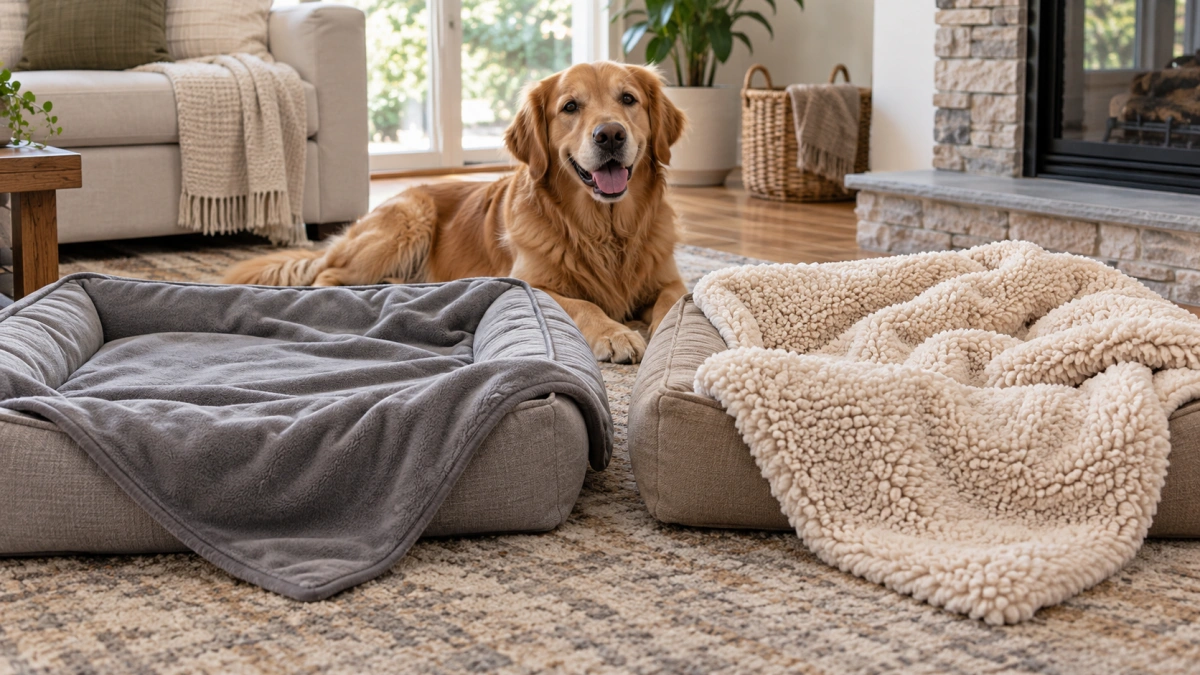
Choose fleece when you want an everyday balance of warmth, weight, and washing convenience.
Choose plush when your dog clearly prefers deeper softness and the additional cleaning effort is acceptable.
Why Pile Depth Matters
Pile is the raised fiber above the base fabric.
Greater pile depth generally creates:
- More trapped air
- A softer feel
- More insulation
- More places for loose hair to settle
Lower pile generally creates:
- A flatter surface
- Less bulk
- Faster drying
- Easier hair removal
This is why simply comparing “polyester fleece” with “polyester plush” is not enough. The surface structure can matter more than the broad fiber name.
Fleece vs Sherpa Dog Blankets
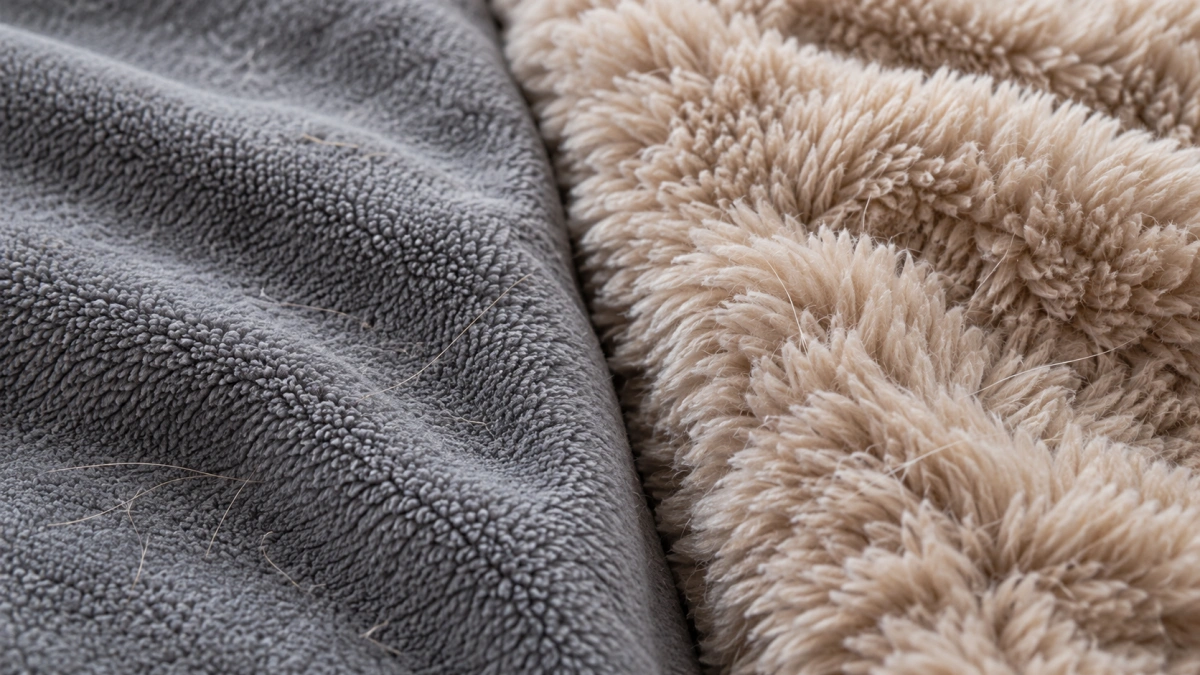
Standard fleece and sherpa are both common synthetic pet blanket surfaces, but sherpa is usually more textured and insulating.
| Feature | Fleece | Sherpa |
|---|---|---|
| Pile | Shorter | Deeper and curly |
| Warmth | Moderate | Higher |
| Drying speed | Usually faster | Usually slower |
| Hair retention | Moderate | Often higher |
| Season | Versatile | Best for cooler conditions |
If your dog regularly pushes thick bedding aside, sherpa may be unnecessarily warm.
If your dog curls tightly into blankets during winter, sherpa may provide the deeper texture it prefers.
What About Faux Fur Dog Blankets?
Faux fur uses longer synthetic fibers to imitate animal fur.
It can create:
- A very soft surface
- More visual depth
- A luxurious appearance
- A warm nesting area
But longer fibers can also make maintenance more demanding.
Dog hair may become visually hidden between faux-fur fibers, and very deep pile can collect debris.
If your dog digs vigorously, inspect faux fur regularly for:
- Pulled fibers
- Torn backing
- Loose seams
- Areas where fabric is thinning
Faux fur works best when softness and appearance matter more than the lowest-maintenance cleaning routine.
What Are Fluffy and Fuzzy Dog Blankets?
“Fluffy” and “fuzzy” are marketing descriptions rather than standardized textile categories.
A fuzzy dog blanket could be:
- Plush polyester
- High-pile fleece
- Sherpa
- Faux fur
- Microplush
Do not choose only because the product title says “fluffy.”
Check:
- Actual material
- Pile depth
- Weight
- Backing
- Wash instructions
- Drying instructions
Are Cotton Dog Blankets Better?
Cotton is neither automatically better nor worse than fleece.
It solves a different problem.
A flatter cotton or cotton-blend blanket can be useful when you want:
- Less plush insulation
- A woven textile feel
- Moderate breathability
- A lighter contact layer
But cotton construction varies significantly.
A tightly woven cotton blanket behaves differently from:
- Brushed cotton
- Flannel
- Loose cotton knit
- Heavy quilted cotton
Cotton can also absorb more moisture and may dry more slowly than thin synthetic fleece.
Evaluate the complete blanket, not only the fiber label.
Which Material Is Warmest?
Warmth depends on more than the fiber itself.
Important factors include:
- Pile depth
- Fabric density
- Thickness
- Number of layers
- Air trapped between fibers
- Whether the blanket is folded
In general, a thick sherpa or deep plush blanket tends to provide more insulation than a thin fleece or flat cotton blanket.
But this does not mean maximum warmth is always desirable.
Dogs with dense coats, dogs in warm rooms, and dogs that actively seek cool floors may prefer less insulation.
What Does GSM Mean on a Dog Blanket?
Some blanket listings include GSM, meaning grams per square meter.
It describes fabric mass per unit area.
A higher GSM fabric is generally heavier than a lower GSM fabric of the same area, but GSM alone does not tell you everything about:
- Warmth
- Softness
- Breathability
- Pile height
- Layer construction
For example, a blanket can combine two fabrics of different GSM values or add a waterproof membrane between them.
Use GSM as one specification, not as a universal warmth score.
Which Material Works Best by Season?
Summer and Warm Indoor Conditions
Look toward:
- Thin fleece
- Light microfiber
- Flatter cotton blends
- Low-pile fabrics
If your dog actively seeks cool surfaces, a specialized cooling dog blanket may be more appropriate than any thick plush option.
Fall and Mild Winter
Medium fleece often gives a useful balance of warmth and easy care.
Cold Rooms and Winter
Plush and sherpa become more useful when your dog actively seeks warmer bedding.
If you are considering active or electric heat rather than passive fabric insulation, see our guide to heated and warm dog blankets.
Which Material Is Best for Dogs That Burrow?
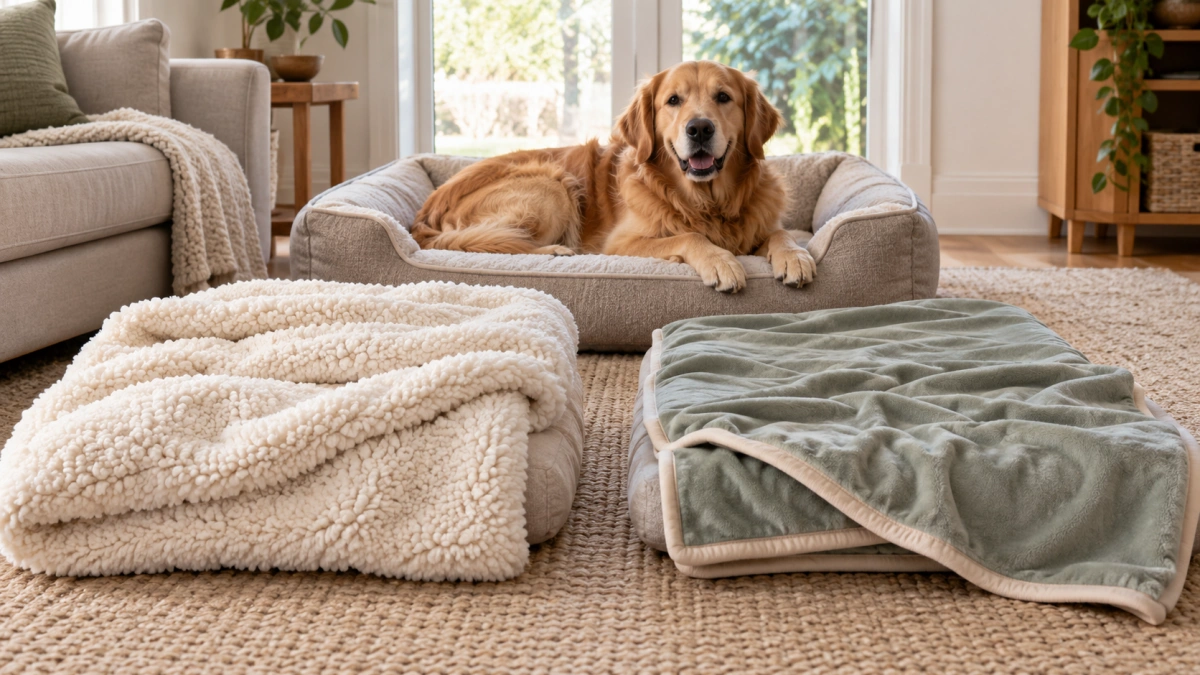
Dogs that naturally push, circle, nest, or burrow into fabric may prefer:
- Fleece
- Plush
- Sherpa
because these materials create a soft surface that is easy to rearrange.
However, do not provide large amounts of loose deep fabric to a dog that:
- Chews blankets
- Swallows fibers
- Becomes tangled
- Destroys seams
Comfort and safety need to be considered together.
Which Material Is Best for Dogs That Get Hot Easily?
Avoid assuming every dog needs a fluffy blanket.
Dogs that often:
- Leave their bed for tile
- Push fleece aside
- Stretch out rather than curl up
- Pant in warm rooms
may prefer lower-pile, lighter bedding.
AKC also cautions that fleecy blankets can be too warm during hot weather, particularly for dogs prone to overheating.
A lightweight blanket can still define a sleeping area without creating deep insulation.
Which Material Is Easiest for Dog Hair?
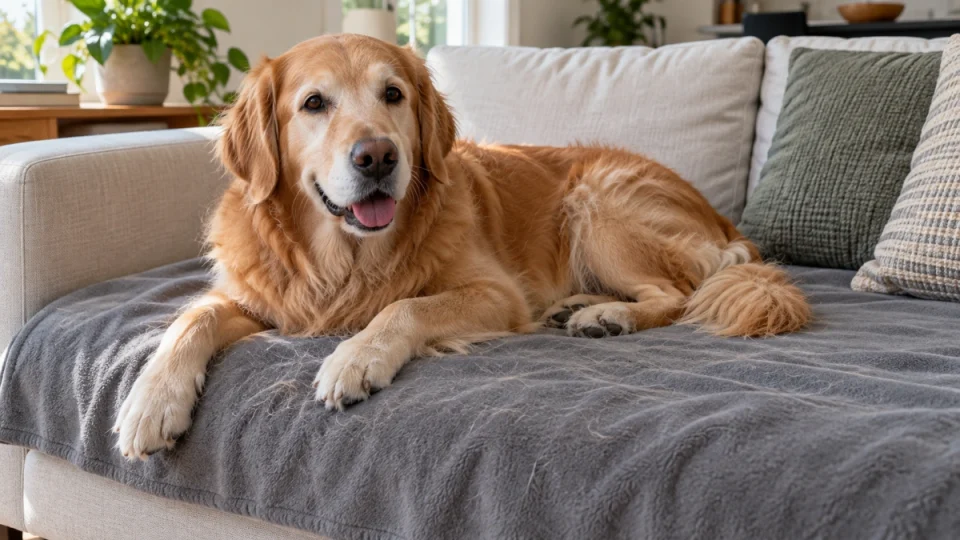
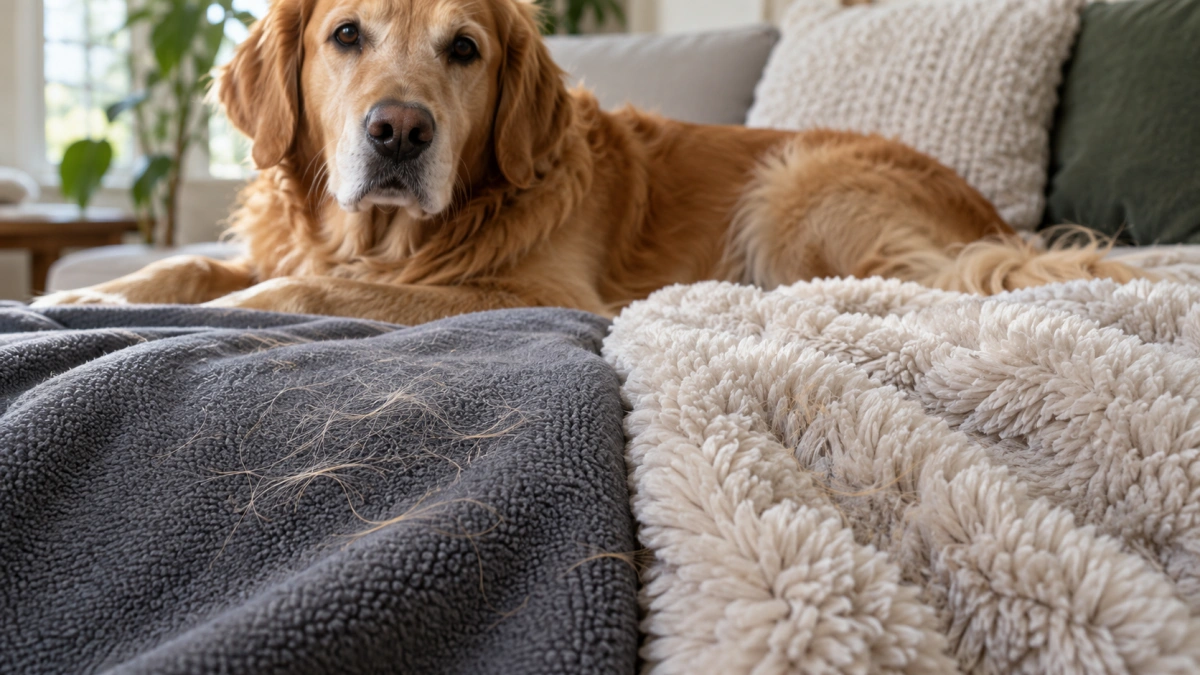
If shedding is a major concern, deeper pile usually means more places for hair to settle.
Typical maintenance tendencies are:
- Low-pile fleece: moderate
- Smooth microfiber: often easier
- Flat cotton weave: depends on weave
- Deep plush: harder
- Sherpa: harder
- Faux fur: harder
This does not mean fleece or sherpa is bad bedding. It means warmth and softness come with a cleaning trade-off.
If dog-hair management is your main buying priority, see our dedicated guide to dog blankets that resist pet hair.
Which Material Is Best for a Dog Bed?
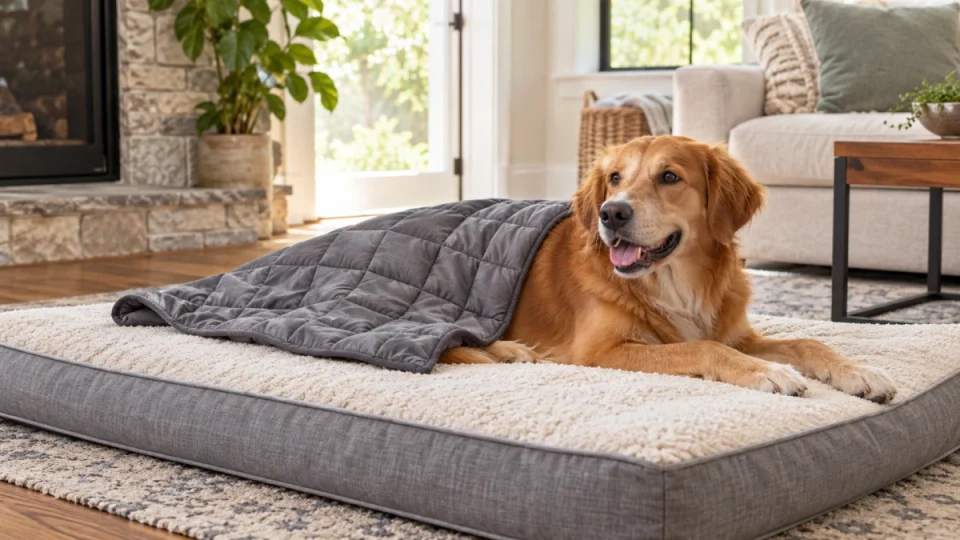
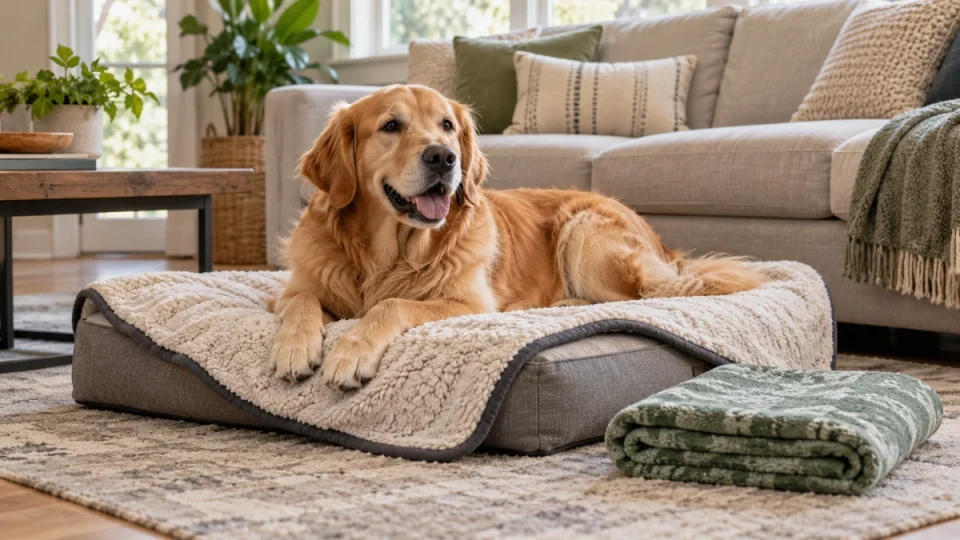
On a dog bed, the blanket acts as the removable contact layer while the mattress provides the main support.
Choose material based on the bed environment:
- Fleece for versatile everyday warmth
- Plush for deeper softness
- Sherpa for colder conditions
- Light cotton or low-pile fabric for less insulation
Avoid piling so much fabric onto the bed that it creates unstable folds or blocks a low entrance.
For blanket sizing and placement on mattresses, see our guide to dog blankets for beds.
Which Material Is Best for a Couch?
For couch use, comfort is only one concern.
Also compare:
- Furniture coverage
- Appearance
- Hair cleanup
- Grip
- Washability
Deep plush may look luxurious but collect more fur.
A lower-pile fleece or smooth fabric may be easier to maintain in a high-use living room.
Are Loose-Knit Blankets Good for Dogs?
Loose decorative knits can look attractive, but they introduce larger openings and loops.
Dog claws can catch in those spaces, and chewing dogs can pull threads loose.
AKC specifically advises considering durability because loose knit blankets are more likely to snag on nails and teeth.
For everyday dog use, a stable fleece, woven textile, or tightly constructed fabric is generally easier to manage.
What About Tassels and Fringe?
Decorative fringe can create another chew target.
Avoid or supervise blankets with:
- Long tassels
- Loose fringe
- Large decorative loops
- Attached pompoms
particularly if your dog regularly mouths fabric.
Simple finished edges are usually more practical for everyday pet bedding.
Fleece, Plush and Sherpa for Puppies
Puppies need easy-clean bedding because accidents and chewing are common.
Fleece can be practical because many products are lightweight and machine washable.
Very deep plush and sherpa may require more effort to clean after accidents.
Whatever material you choose, inspect it regularly for:
- Chewed corners
- Torn seams
- Loose fibers
- Exposed filling
Remove damaged bedding if the puppy is swallowing material.
Fleece, Plush and Sherpa for Senior Dogs
Older dogs may appreciate warmer or softer surfaces, especially in cooler rooms.
But do not automatically choose the thickest material.
For a senior dog with reduced mobility, very deep or bunched blankets can make the sleeping surface less stable.
Prioritize:
- Flat placement
- Easy bed entry
- Washability
- Moderate warmth
- A stable mattress underneath
If your dog suddenly becomes reluctant to lie down, rise, or use a bed, veterinary assessment is more appropriate than simply changing blanket material.
How to Wash Fleece and Plush Dog Blankets
Always follow the specific care label.
A practical routine is:
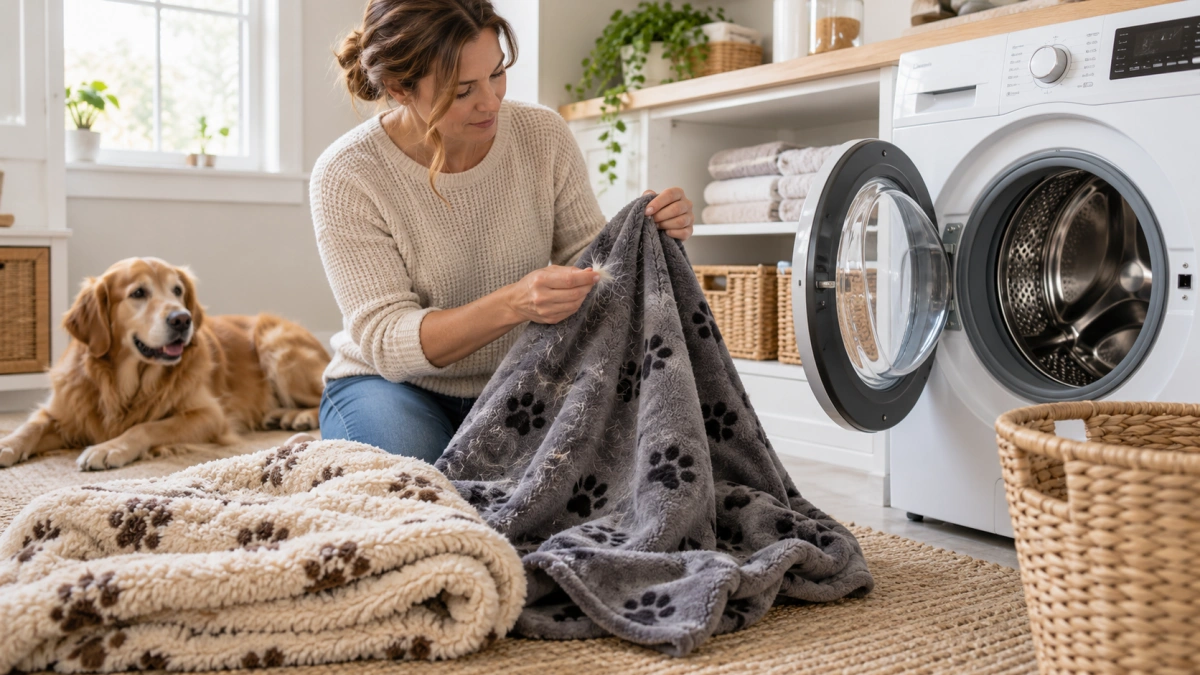
- Shake off loose dirt and hair.
- Vacuum or lint-roll heavy hair buildup.
- Inspect seams and fabric damage.
- Wash using the specified cycle and temperature.
- Dry using the approved method.
- Return the blanket only when fully dry.
AKC recommends shaking pet blankets before washing and following manufacturer instructions, while fully drying bedding helps avoid moisture remaining in the dog’s resting area.
Deep plush or sherpa may require more drying time than thin fleece because more material can hold moisture.
Does High Heat Damage Fleece?
Synthetic fleece, plush, sherpa, and faux fur can have different heat tolerances.
Do not assume a high dryer setting is safe simply because the product is polyester.
Excessive heat may affect:
- Surface texture
- Fiber shape
- Backing materials
- Decorative finishes
Use the dryer’s setting specified on the care label.
What Is Pilling?
Pilling occurs when small fiber balls form on a fabric surface through friction and wear.
It can affect:
- Appearance
- Surface feel
- How easily hair and lint become caught
Higher-quality construction may resist pilling better, but no broad material name guarantees it.
Look for product information about anti-pilling finishes or long-term wash durability when available.
Should You Buy a Reversible Blanket?
A reversible design can combine two different surfaces.
Common combinations include:
- Fleece + sherpa
- Plush + sherpa
- Fleece + smooth microfiber
- Plush + waterproof backing
This can provide useful flexibility.
For example, one surface may feel smoother and easier to clean while the other offers more warmth.
But evaluate both sides. A reversible blanket is not automatically better if the second layer only adds bulk you do not need.
Our 8-Point Dog Blanket Material Check
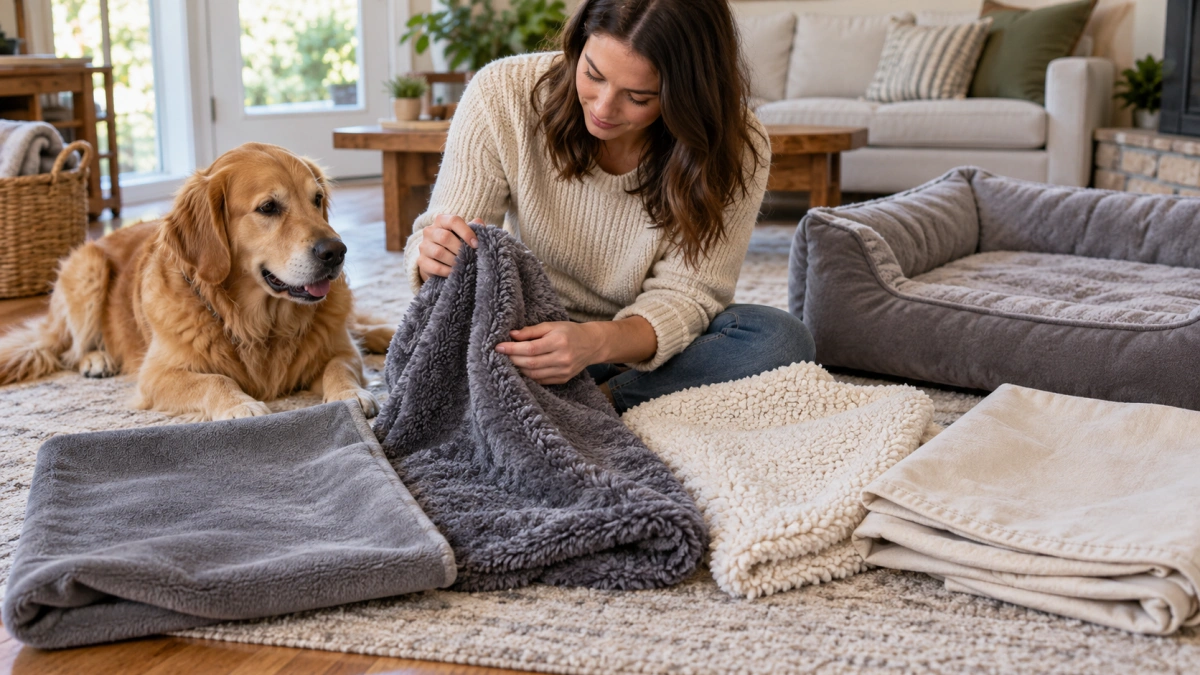
Use this framework to compare fleece, plush, sherpa, cotton, and other dog blanket materials.
1. Pile
How deep are the surface fibers?
2. Warmth
Does the insulation level suit your dog’s coat and room temperature?
3. Texture
Does your dog prefer smooth surfaces or deep nesting material?
4. Hair Management
How easily can loose dog hair be removed from the surface?
5. Drying
Can the blanket dry completely within your normal laundry routine?
6. Durability
Does the construction resist normal pawing, nesting, and repeated washing?
7. Snag Risk
Are there loose loops, fringe, or fibers likely to catch claws or teeth?
8. Use Location
Does the material make sense on the dog bed, couch, crate, car, or travel surface where you will use it?
A good material is one that balances comfort with the maintenance demands of your actual home.
Common Fleece and Plush Dog Blanket Buying Mistakes
- Assuming every fleece blanket has the same thickness
- Assuming plush always means warmer
- Choosing by softness alone
- Ignoring pile depth
- Buying sherpa for a dog that consistently avoids warm bedding
- Buying deep plush when easy hair cleanup is your top priority
- Assuming cotton is always cooler or more breathable regardless of weave
- Using GSM as the only warmth measurement
- Ignoring the total number of layers
- Choosing loose knit fabric for a dog whose claws snag bedding
- Buying tassels or fringe for a dog that chews fabric
- Ignoring dryer restrictions
- Allowing a thick blanket to remain damp
- Using very deep bunched bedding around a senior dog with mobility difficulty
Fleece and Plush Dog Blanket Buying Checklist
- Do I want moderate or high warmth?
- Does my dog prefer flat or deep-soft surfaces?
- How deep is the pile?
- Is the blanket fleece, plush, sherpa, faux fur, cotton, or a blend?
- How many layers does it have?
- Is a GSM value provided?
- Does the complete construction look appropriate for the season?
- How heavily does my dog shed?
- Can I remove hair easily?
- Does my dog dig or nest?
- Are there large loops or loose fringe?
- Is the blanket machine washable?
- What dryer setting is allowed?
- Will deep pile take too long to dry?
- Does it fit my dog bed, couch, crate, or other surface?
- Would a lighter material be more comfortable during warm weather?
Final Thoughts
Fleece, plush, sherpa, faux fur, fuzzy fabrics, and cotton dog blankets all involve trade-offs.
Short fleece is one of the most versatile choices because it balances warmth, softness, weight, and easy care. Deep plush provides a softer nesting surface but usually requires more work to remove fur and dry thoroughly.
Sherpa offers more insulation and texture, making it useful in cooler conditions, while faux fur emphasizes softness and appearance at the cost of more demanding maintenance.
Cotton and flatter woven fabrics can work well when you want less loft, but their performance still depends on weave, thickness, and overall construction.
Instead of asking which fiber is universally best, compare pile depth, warmth, texture, hair retention, drying time, durability, snag risk, and the place where the blanket will actually be used.
The right dog blanket material is the one your dog willingly uses and you can realistically keep clean.