By

Weighted dog blankets are heavier than ordinary pet blankets and are designed to place distributed pressure across part of a dog’s body. They are sometimes marketed as calming products, particularly for noise sensitivity, travel, restlessness, or other stressful situations.
That marketing needs to be interpreted carefully. Weighted blankets have been studied much more extensively in people than in dogs, and research on pressure-based products in dogs remains limited. A weighted blanket also is not the same product as a fitted pressure wrap or calming vest.
Safety matters more than the promise of a calming effect. A dog must be able to breathe normally, change position, stand up, and move away from the blanket without assistance. Human weighted blankets can be far too heavy for pets and should not be casually repurposed for dogs.
For general help choosing ordinary blankets by size, material, washing, and daily use, see our guide to best dog blankets.
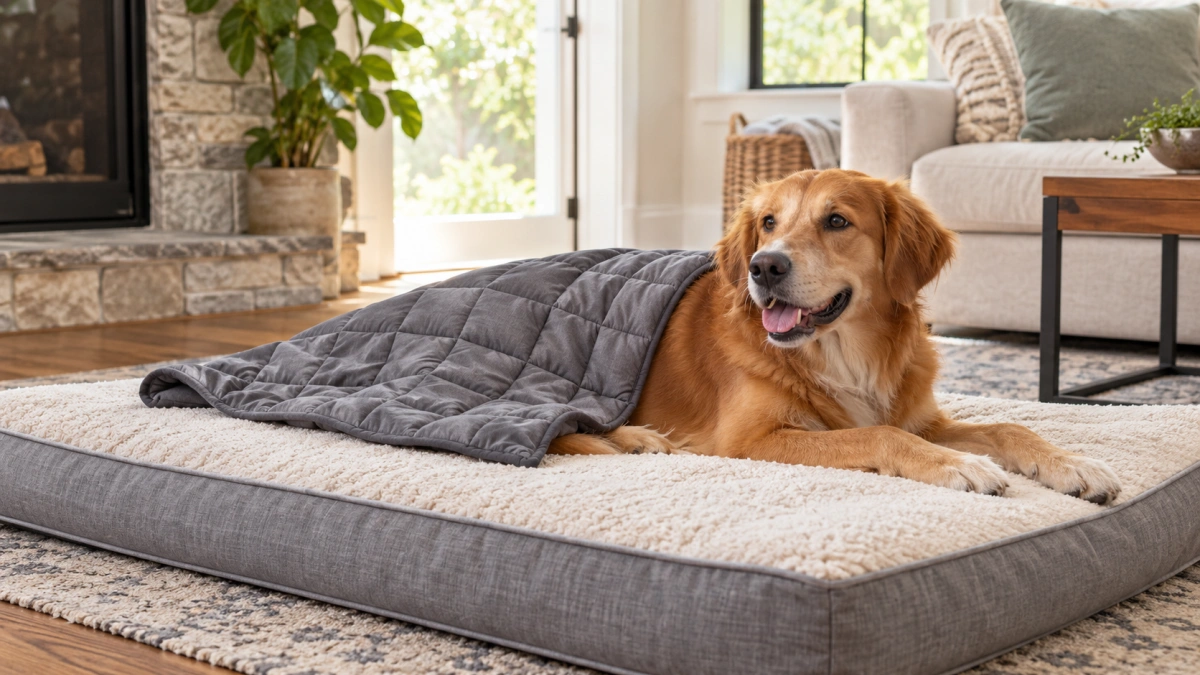
Quick Comparison: Weighted Dog Blanket vs Other Options
| Product | How It Works | Main Advantage | Main Concern |
|---|---|---|---|
| Pet-specific weighted blanket | Adds distributed weight across part of the body | Loose and removable when appropriately designed | Too much weight can restrict movement or breathing |
| Human weighted blanket | Uses substantially heavier distributed filling | Designed for human body size | Can be far too heavy for a dog |
| Pressure wrap or calming vest | Applies fitted pressure around the torso | Leaves legs free and is made as wearable dog equipment | Evidence for behavioral benefit is limited |
| Regular dog blanket | Adds softness or warmth without intentional weight | Simple, lightweight and easier to leave | Does not provide intentional pressure |
Do not treat these four categories as interchangeable.
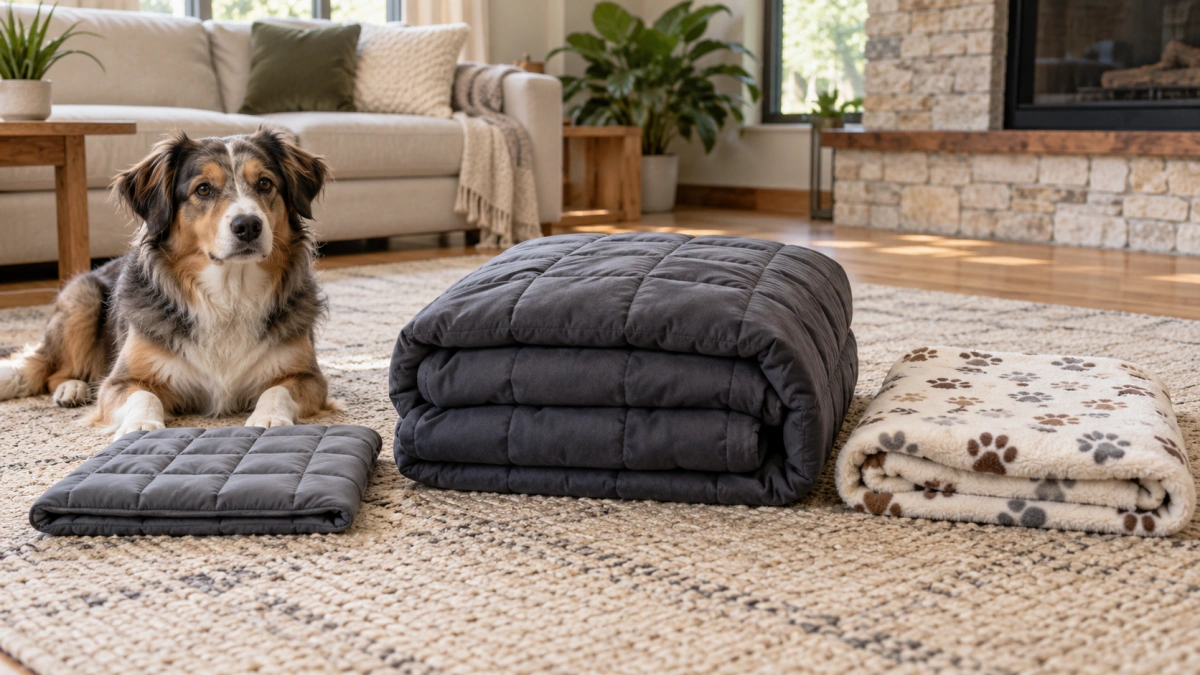
What Is a Weighted Dog Blanket?
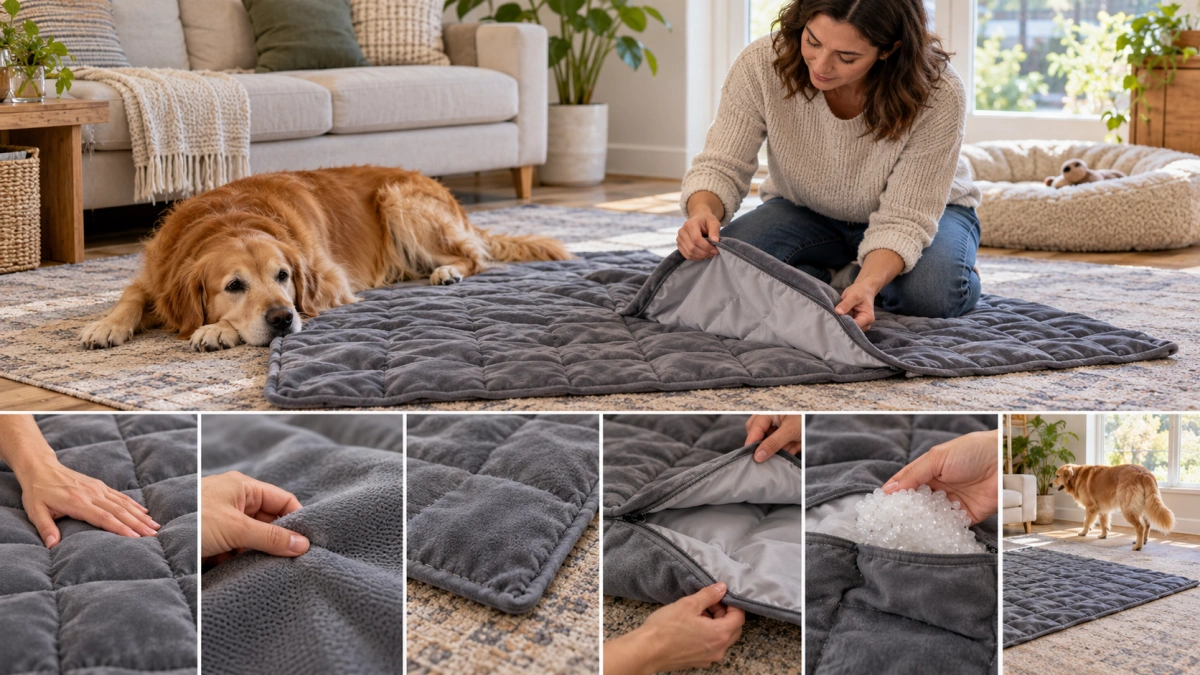
A weighted dog blanket contains additional mass distributed through sewn compartments, inserts, or another internal construction.
Compared with an ordinary blanket, it may include:
- Weighted internal sections
- Multiple stitched compartments
- A removable outer cover
- Specific dog-size recommendations
- Instructions for how the blanket should be positioned
The key distinction is intentional weight.
A thick fleece blanket may feel heavy when folded, but that does not automatically make it a purpose-designed weighted dog blanket.
Can Weighted Blankets Calm Dogs?
There is not strong evidence that weighted blankets themselves reliably reduce anxiety in dogs.
Some of the reasoning behind these products comes from the idea that gentle, distributed pressure may feel comforting to some individuals. However, most canine research in this area has focused on pressure wraps or fitted garments rather than loose weighted blankets.
A 2024 systematic review of pressure wraps in dogs found only four eligible studies. The reviewers concluded that evidence for reducing behavioral or physiological signs of anxiety was weak and limited, with low confidence because of small samples, inconsistent findings, and risk of bias.
That means a weighted blanket should not be presented as a proven treatment for:
- Anxiety
- Noise phobia
- Separation-related distress
- Sleep problems
- Pain
- Arthritis
If your dog shows persistent fear, panic, destructive behavior, excessive panting, trembling, escape attempts, or other significant stress behaviors, discuss the pattern with your veterinarian or a qualified veterinary behavior professional rather than relying on a blanket alone.
Pressure Wrap Evidence Is Not Weighted Blanket Evidence
This distinction matters.
A pressure wrap is worn around the dog’s body and distributes tension through a fitted garment.
A weighted blanket is loose bedding that places downward mass on the dog.
They differ in:
- Weight
- Pressure direction
- Freedom of movement
- Body coverage
- Heat retention
- Risk of bunching
Research involving a pressure vest cannot automatically be used to prove that a weighted blanket produces the same effect.
Never Assume a Human Weighted Blanket Is Safe for a Dog
Human weighted blankets are sized around human bodies and can weigh far more than a pet-specific blanket.
That creates several possible problems for a dog:
- Difficulty standing up
- Difficulty turning around
- Excess pressure over the chest
- Reduced ability to move away
- Heat buildup
- Entanglement in a large blanket
Veterinary guidance from PetMD specifically cautions that even a weighted blanket intended for a child may be too heavy for a small pet.
Do not place your own human weighted blanket over your dog simply because the product feels comfortable to you.
How Heavy Should a Weighted Dog Blanket Be?
There is no universally established veterinary percentage rule that guarantees a safe or effective weighted blanket for every dog.
Some pet-product manufacturers publish weight-to-body-weight limits or their own size charts. For example, some currently marketed pet-specific blankets instruct users not to exceed a specified percentage of the dog’s weight.
Treat that as manufacturer-specific product guidance—not as proof that the same percentage is medically validated for every dog or every weighted blanket.
Before using one, consider:
- The dog’s body weight
- Chest shape
- Breed
- Mobility
- Respiratory health
- Age
- Ability to stand up easily
- The blanket’s total weight
- How the weight is distributed
When in doubt, especially for a small dog or a dog with health or mobility concerns, ask your veterinarian before introducing intentional weight.
Size and Weight Must Be Evaluated Together
Blanket weight alone does not tell you how the pressure will feel.
The same total weight spread across a larger blanket may distribute differently from that weight concentrated in a smaller area.
Also consider what happens when the dog moves.
A blanket that begins evenly distributed can fold or bunch so that more weight shifts onto one part of the body.
This is one reason your dog should never be trapped beneath the blanket.
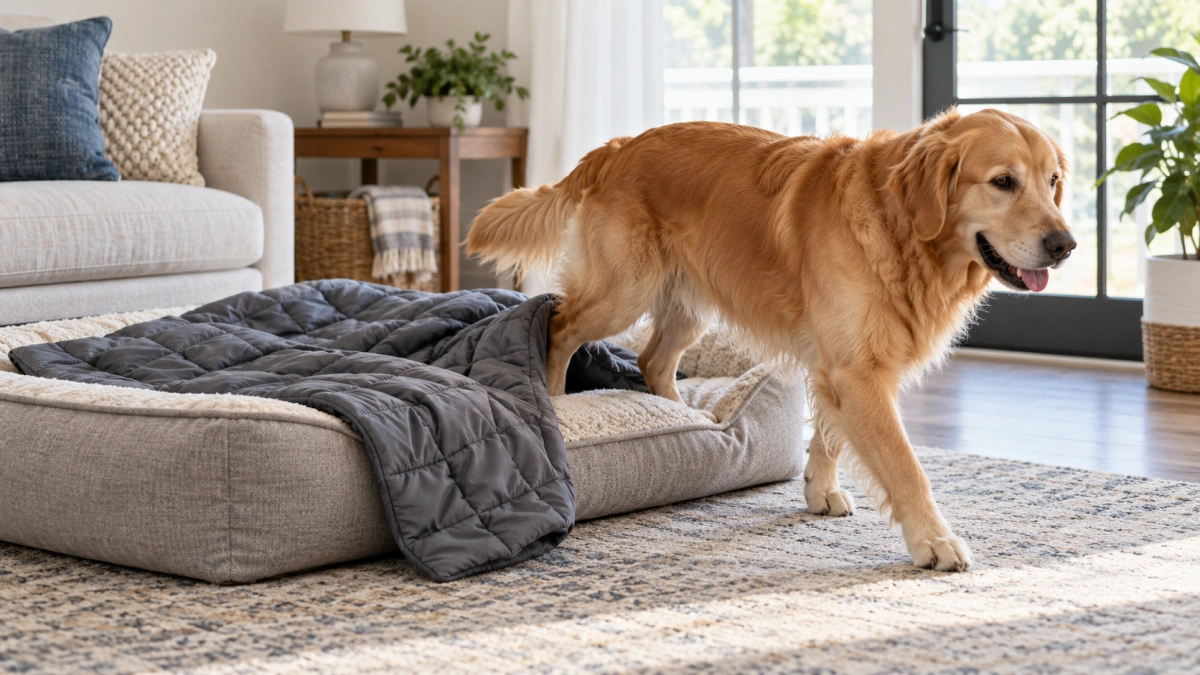
Your Dog Must Be Able to Move Away
Choice is one of the most important safety principles.
A weighted dog blanket should never function as restraint.
Your dog should be able to:
- Lift the head freely
- Move the front legs
- Turn the body
- Stand up
- Step away from the blanket
- Move to an uncovered resting surface
If the dog struggles to get up, becomes caught, or requires you to remove the blanket before it can leave, the setup is too restrictive.
Never Cover the Head or Restrict Breathing
Do not place intentional weight over the dog’s face or neck.
Avoid configurations that interfere with:
- Nose and mouth
- Neck movement
- Normal chest expansion
- Head lifting
- Changing sleeping position
Veterinary safety guidance has raised concern that excessive blanket weight can make breathing more difficult, particularly in smaller pets and animals that already have respiratory limitations.
The dog should remain visibly comfortable and able to breathe normally throughout use.

Which Dogs Need Extra Caution?
A weighted blanket deserves additional caution—or may be inappropriate—when a dog has difficulty moving or breathing normally.
Examples include dogs with:
- Respiratory disease
- Reduced mobility
- Neurological problems affecting movement
- Severe weakness
- Recent surgery
- Difficulty rising
- Heat intolerance
A veterinarian can help you decide whether intentional pressure is appropriate for a dog with a medical condition.
Weighted Blankets and Brachycephalic Dogs
Short-muzzled dogs such as Bulldogs, French Bulldogs, Pugs, Boston Terriers, and similar breeds already have anatomy that can make breathing and heat management more challenging.
Adding heavy or heat-trapping bedding deserves particular caution.
Do not use a weighted blanket to restrict a brachycephalic dog’s movement or place pressure around the head, neck, or chest.
If your dog already has noisy breathing, exercise intolerance, heat intolerance, or diagnosed airway problems, ask your veterinarian before considering intentional weighted pressure.
Weighted Blankets for Small Dogs
Small dogs are especially vulnerable to blankets designed around human body size.
A few pounds of added weight represents a much larger percentage of total body weight for a 10-pound dog than for a 70-pound dog.
Do not improvise with:
- Human weighted blankets
- Child weighted blankets
- Several heavy blankets stacked together
- Homemade weighted objects placed on the dog
If you consider a purpose-designed product, use the manufacturer’s smallest appropriate size and discuss it with your veterinarian if there is any concern about the dog’s health or mobility.
Weighted Blankets for Senior Dogs
Senior dogs require careful assessment because older age can coincide with:
- Reduced muscle strength
- Arthritis
- Balance changes
- Neurological disease
- Respiratory disease
- Difficulty rising
Do not assume a weighted blanket is beneficial simply because a dog is older or has joint discomfort.
A senior dog that cannot rise easily should not have additional weight making movement harder.
For many older dogs, a supportive low-entry bed and an ordinary lightweight or warm blanket may be more practical.
Weighted Blankets for Puppies
Puppies are generally poor candidates for unsupervised weighted bedding.
They may:
- Chew seams
- Swallow filling
- Become tangled
- Have difficulty moving heavy fabric
- Overheat while sleeping
If a puppy is showing significant fear or stress, address the behavior and environment rather than improvising with a heavy blanket.
Weighted Blanket vs Pressure Wrap
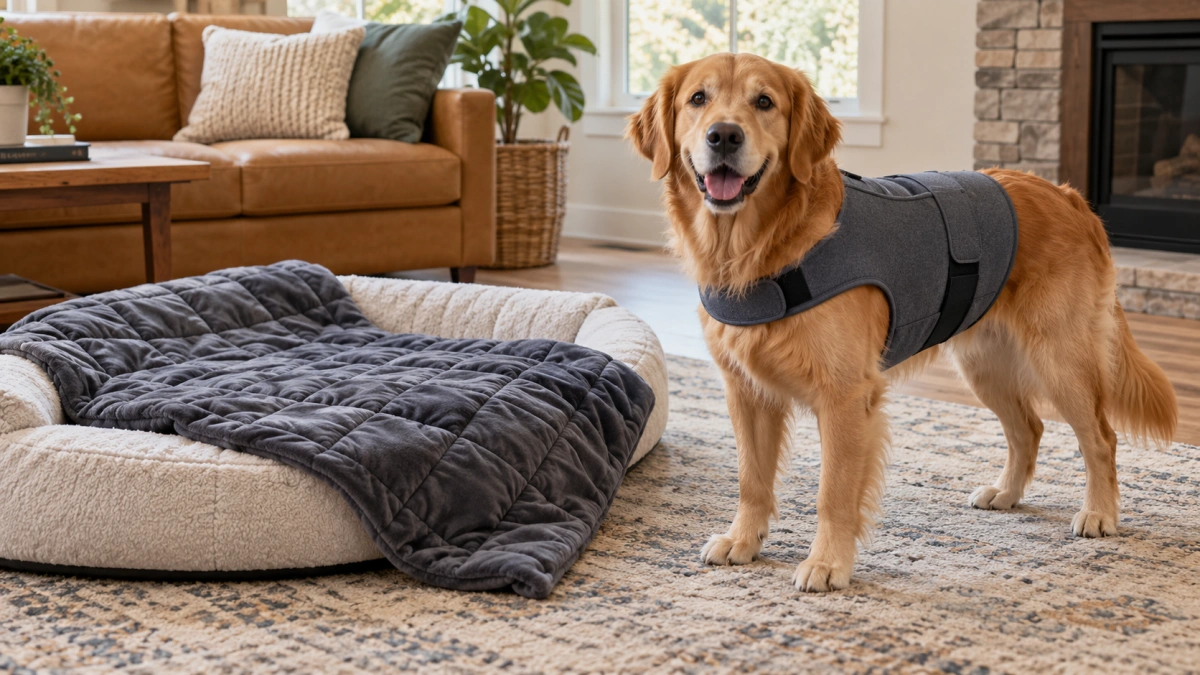
A pressure wrap or calming vest is fitted around the dog’s torso and is usually much lighter than a weighted blanket.
Potential advantages of a purpose-designed wrap include:
- Legs remain uncovered
- The dog can walk while wearing it
- No large blanket can bunch around the body
- The product is designed around canine anatomy
However, pressure wraps should not be described as guaranteed anxiety treatments either.
The current evidence suggests that some dogs may show modest benefit, but the research base is limited and inconsistent.
Watch Your Dog’s Behavior Instead of Forcing Use
A dog does not need to tolerate a weighted blanket simply because the product is marketed as calming.
Stop using it if your dog:
- Repeatedly tries to escape
- Freezes instead of relaxing
- Pants more heavily
- Appears restless
- Struggles to stand
- Shows increased agitation
- Chews at the blanket
- Becomes unusually warm
Calmness and immobility are not always the same thing.
A dog remaining perfectly still because movement is difficult should not be interpreted as evidence that the blanket is working.
Can a Dog Sleep Under a Weighted Blanket Overnight?
Unsupervised overnight use is difficult to justify when intentional weight is involved.
During sleep, you may not notice quickly if the dog:
- Becomes tangled
- Overheats
- Moves the blanket into an awkward position
- Needs help getting out
- Begins chewing the filling
For normal overnight bedding, a lightweight breathable blanket that the dog can easily move away from is the simpler option.
If a manufacturer gives specific supervised-use instructions, follow them rather than assuming a weighted product can remain on the dog all night.
Do Weighted Dog Blankets Cause Overheating?
Any additional bedding can affect heat retention.
A weighted blanket may contain:
- Multiple layers
- Dense filling
- Fleece
- Plush fabric
which can make it warmer than a thin ordinary blanket.
Use extra caution in:
- Warm rooms
- Hot weather
- Dogs with dense coats
- Brachycephalic dogs
- Dogs with known heat intolerance
Panting, restlessness, seeking cooler surfaces, or repeatedly trying to leave the blanket are reasons to remove it.
Chewing and Filling Safety
Weighted blankets often contain material that ordinary blankets do not.
Depending on construction, this can include:
- Plastic pellets
- Glass beads
- Weighted inserts
- Other dense filling
If the dog chews through a compartment, the filling may become accessible.
Potential risks include:
- Swallowing foreign material
- Gastrointestinal upset
- Intestinal obstruction
- Loose filling spreading through the home
Inspect the blanket before each use.
Do not continue using it if you find:
- Torn seams
- Exposed filling
- Damaged weight pockets
- Chewed edges
- Loose beads or pellets
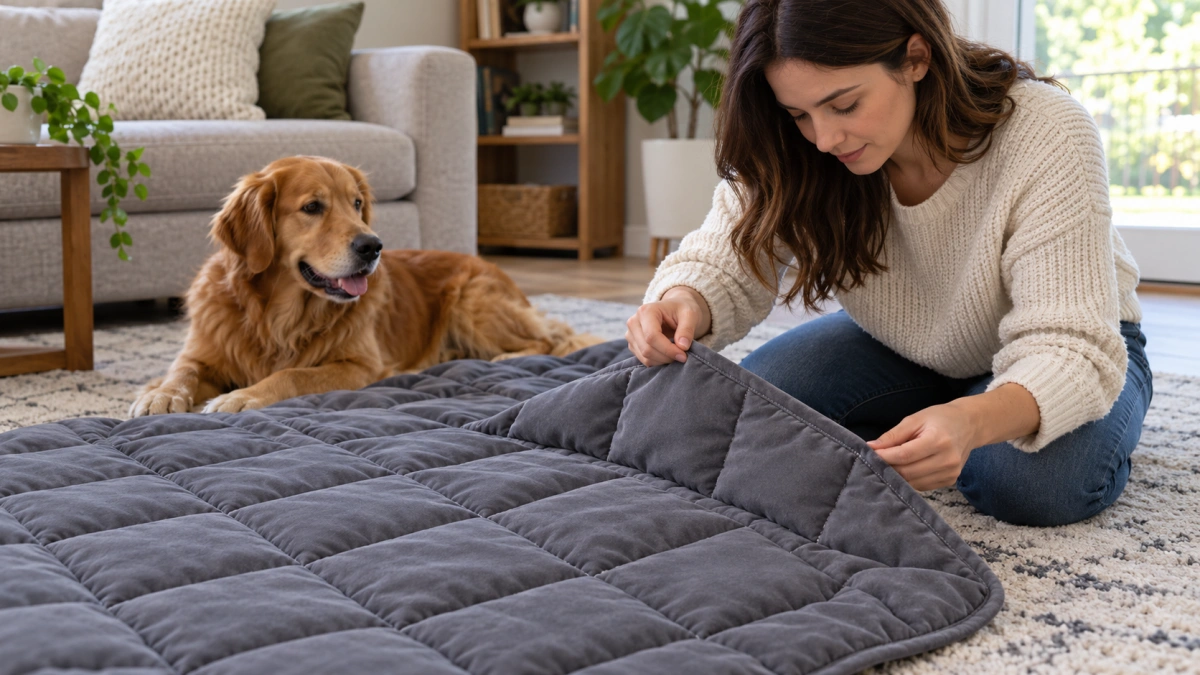
Where Should You Use a Weighted Dog Blanket?
If you choose to use a pet-specific weighted blanket, the safest environment is one where:
- You can supervise the dog
- The dog has room to move away
- The resting surface is stable
- The room is comfortably cool
- The blanket cannot fall from above and trap the dog
A large open dog bed or floor resting area generally provides more freedom than a confined space.
Should You Use a Weighted Blanket in a Crate?
A crate reduces the available escape area.
That makes intentional weight more concerning because the dog may have less room to move away, reposition, or get out from beneath the blanket.
Do not use a human weighted blanket inside a crate.
For ordinary crate bedding, lightweight, correctly sized blankets are easier to manage.
How to Introduce a Pet-Specific Weighted Blanket
Do not place it over the dog unexpectedly.
A cautious introduction can include:
- Place the blanket nearby without covering the dog.
- Allow the dog to investigate it voluntarily.
- Let the dog lie beside or on top of it if desired.
- If the product is designed to be draped, follow its exact placement instructions.
- Keep the first exposure brief.
- Watch whether the dog seeks the blanket or avoids it.
- Remove it immediately if movement, breathing, or behavior changes.
Do not hold the dog in position to force exposure.
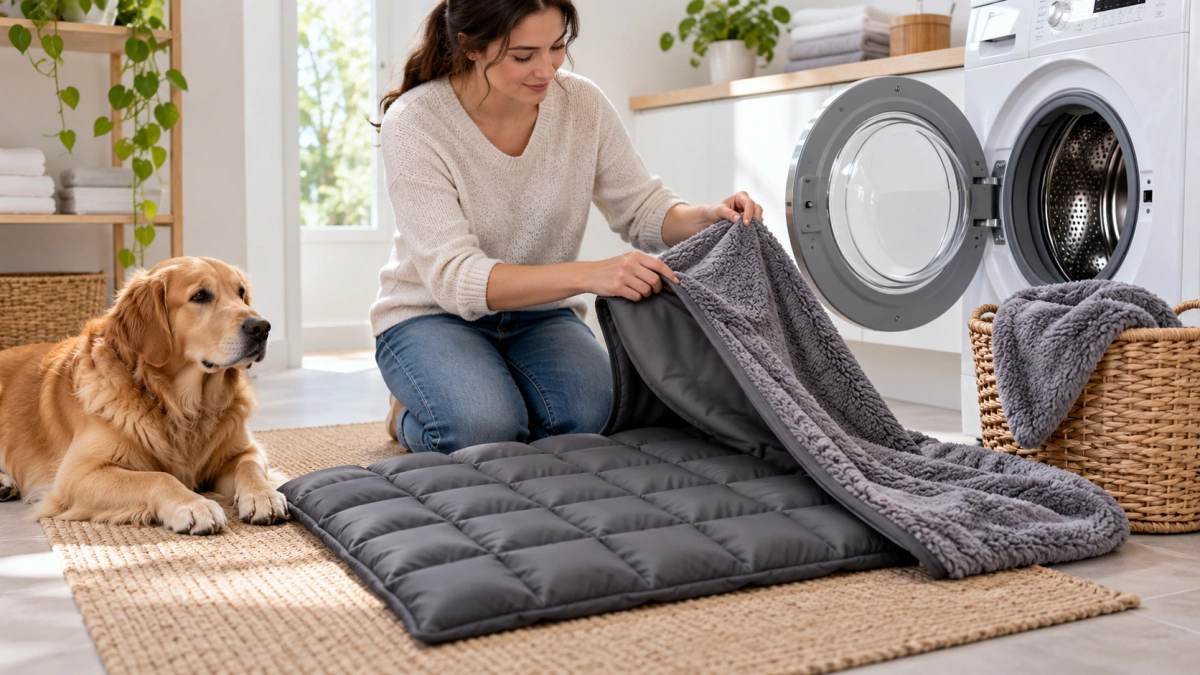
How to Wash a Weighted Dog Blanket
Weighted blankets may require different care from ordinary fleece throws because the internal filling adds substantial mass.
Some products use:
- A removable washable cover
- A separate weighted insert
- Machine-washable complete construction
- Spot-clean-only internal components
Always follow the exact product instructions.
Before washing:
- Inspect all weighted compartments.
- Check for torn seams.
- Remove loose dog hair.
- Remove the outer cover if instructed.
- Confirm whether the weighted insert can enter the washer.
- Check the washing machine’s capacity.
A wet weighted blanket can become substantially harder for a home washing machine to handle than an ordinary blanket.
Do not place an insert in the machine simply because the removable cover is washable.
Our 9-Point Weighted Dog Blanket Safety Check
Use this framework before considering a weighted product.
1. Product Type
Is this actually designed for dogs, or are you repurposing a human weighted blanket?
2. Total Weight
What is the real blanket weight, and what sizing guidance does the manufacturer provide?
3. Weight Distribution
Is the weight evenly divided into stable compartments, or can it bunch in one area?
4. Freedom of Movement
Can your dog stand up and walk away without your assistance?
5. Breathing
Are the head, neck, and breathing movements completely unrestricted?
6. Heat
Is the blanket breathable enough for the room temperature and your dog’s coat and breed?
7. Dog Health
Does the dog have respiratory, mobility, neurological, or other health issues that make added weight inappropriate?
8. Construction
Are the weight pockets, seams, filling, and cover fully intact and inaccessible to chewing?
9. Supervision
Can you watch how the dog responds instead of leaving the weighted product in place unattended?
If any of these checks creates concern, an ordinary lightweight dog blanket is the safer default while you discuss other options with your veterinarian.
Weighted Dog Blanket vs Regular Dog Blanket
Most dogs do not need intentional weight to enjoy a blanket.
A regular dog blanket can provide:
- Warmth
- Softness
- A familiar sleeping surface
- Nesting material
- Furniture protection
without introducing the same level of restriction or filling-related concerns.
If you simply want a comfortable everyday blanket, start with a normal appropriately sized product rather than assuming weighted is better.
Common Weighted Dog Blanket Buying Mistakes
- Using a human weighted blanket on a small dog
- Treating the “10% rule” as universal veterinary law
- Assuming more weight means more calming
- Using pressure-wrap research as proof for weighted blankets
- Covering the dog’s head or neck
- Leaving no uncovered escape area
- Using a blanket the dog cannot move away from
- Ignoring brachycephalic breathing concerns
- Using intentional weight on a dog with mobility problems without veterinary advice
- Leaving a weighted blanket on overnight without supervision
- Ignoring overheating
- Giving the blanket to a persistent chewer
- Continuing to use damaged weighted compartments
- Assuming machine washable means every insert can be machine washed
- Believing the blanket treats anxiety, arthritis, pain, or sleep disorders
Weighted Dog Blanket Buying Checklist
- Is the product specifically designed for dogs?
- What is the blanket’s total weight?
- What dog size does the manufacturer specify?
- Does the manufacturer publish a maximum weight guideline?
- Can the dog stand and walk away freely?
- Will the head and neck remain completely uncovered?
- Does the dog have any breathing problems?
- Is the dog brachycephalic?
- Does the dog have difficulty standing or turning?
- Does the dog chew blankets?
- Is the filling fully enclosed?
- Can the weight shift or bunch?
- Is the fabric breathable?
- Could the dog become too warm?
- Will I supervise use?
- Is the cover removable?
- Which components are actually machine washable?
- Can my washer safely handle the product’s wet weight?
- Am I buying it for comfort rather than expecting medical treatment?
- Would a lightweight blanket or dog-specific pressure wrap be a simpler option?
Final Thoughts
Weighted dog blankets deserve more caution than ordinary pet blankets because intentional weight changes how easily a dog can move, breathe, reposition, and regulate body heat.
Do not assume that a human weighted blanket is suitable for a dog. Products designed for people can be far heavier than a pet can safely manage, particularly for small dogs.
Also keep the evidence in perspective. Some canine pressure-wrap studies have reported small behavioral or physiological changes, but the overall research is limited, and pressure wraps are not the same as weighted blankets. A weighted blanket should therefore not be presented as a proven anxiety treatment.
If you choose a purpose-designed dog product, follow its size and weight instructions, keep the head and neck free, provide an uncovered escape area, inspect the filling and seams, supervise use, and stop immediately if your dog appears uncomfortable, warmer, more restless, or unable to move normally.
For dogs with respiratory disease, mobility limitations, significant anxiety, or other medical concerns, veterinary guidance is more valuable than experimenting with additional blanket weight.