By
By 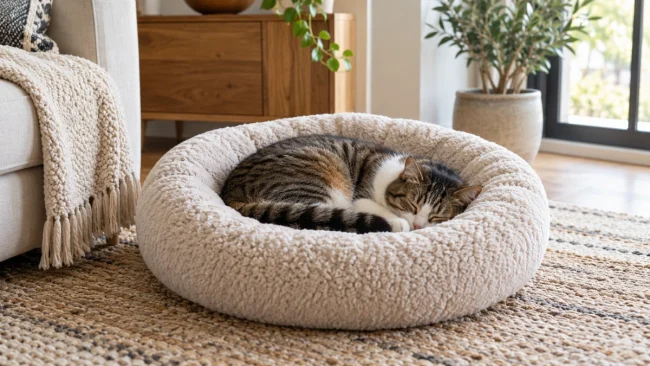
Round and donut cat beds are designed around one of the most common feline sleeping habits: curling the body into a compact circle. Their circular shape can create a defined resting area, while donut-style versions add a raised rim that gives the cat something soft to lean against or rest its head on.
However, not every round bed works the same way, and not every cat prefers this shape. A tightly curled sleeper may fit naturally inside a donut bed, while a cat that regularly stretches across a sofa or floor may need considerably more open sleeping space.
Sizing also requires more care than simply checking the advertised diameter. Thick raised edges reduce the amount of usable space in the center, so a 24-inch donut bed does not necessarily provide 24 inches of actual sleeping room.
For more guides about cat bed sizes, materials, shapes, and sleeping preferences, visit our Cat Beds topic hub.
What Is a Round Cat Bed?
A round cat bed is any circular sleeping surface designed for a cat to rest inside or on top of.
It may be:
- A flat round cushion
- A padded nest
- A round bolster bed
- A donut-shaped bed
- A circular foam mattress
The shape alone does not tell you how enclosed, soft, supportive, or deep the bed will feel.
Always look at the actual construction.
What Is a Donut Cat Bed?
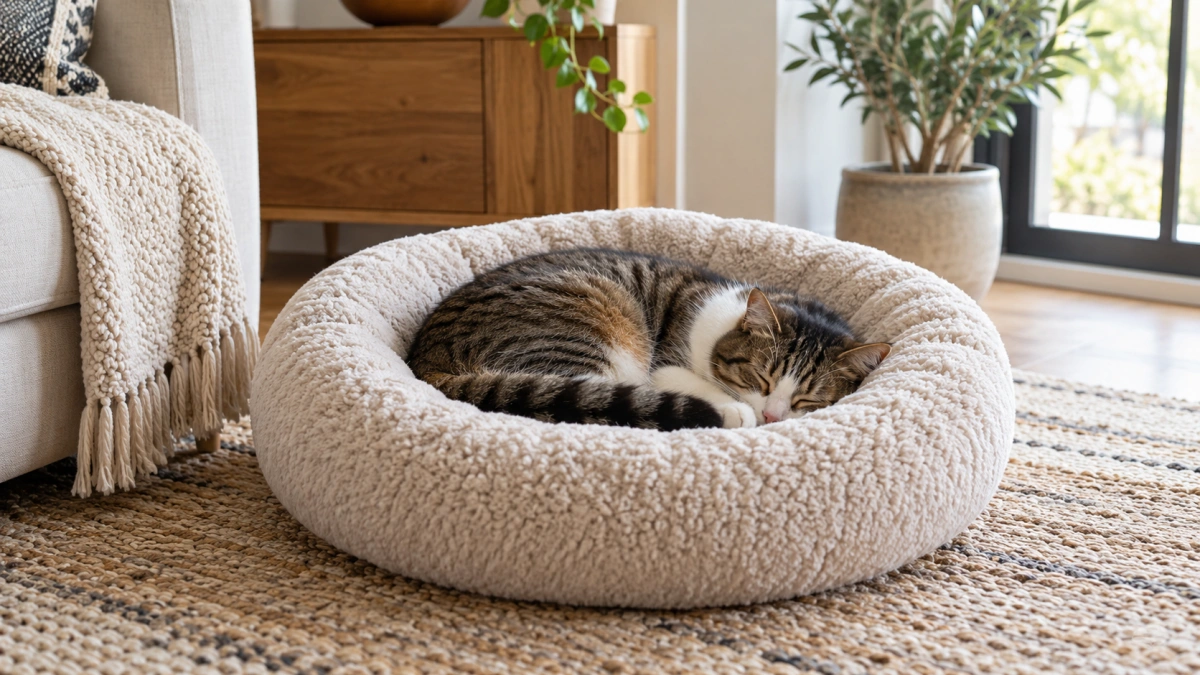
A donut cat bed is a round bed with a raised padded rim surrounding a softer or recessed central sleeping area.
The raised edge may give a curled cat a place to:
- Lean its back
- Rest its head
- Tuck its paws
- Press against while sleeping
Donut beds are often covered in plush, fleece, faux fur, or other soft fabrics, although the internal construction can vary significantly.
Some use loose polyester filling throughout the entire bed. Others combine a more supportive central base with a softer filled rim.
Round Cat Bed vs Donut Cat Bed
The main difference is the raised perimeter.
| Feature | Round Cat Bed | Donut Cat Bed |
|---|---|---|
| Basic shape | Circular | Circular |
| Raised rim | Optional | Usually prominent |
| Usable center | Often larger | Reduced by thick rim |
| Best suited to | Varies by construction | Curling and leaning sleepers |
| Head support | Depends on design | Common |
A simple round cushion may suit a cat that enjoys circular beds but does not want high sides.
A donut bed is more suitable when the cat actively seeks a raised edge or compact nesting shape.
Which Cats Usually Like Donut Beds?
Your cat’s existing sleeping position is one of the best clues.
A donut-style bed may be worth considering if your cat regularly:
- Curls tightly into a ball
- Sleeps pressed against cushions
- Rests its head on raised edges
- Tucks its nose toward its body
- Chooses compact sleeping spaces
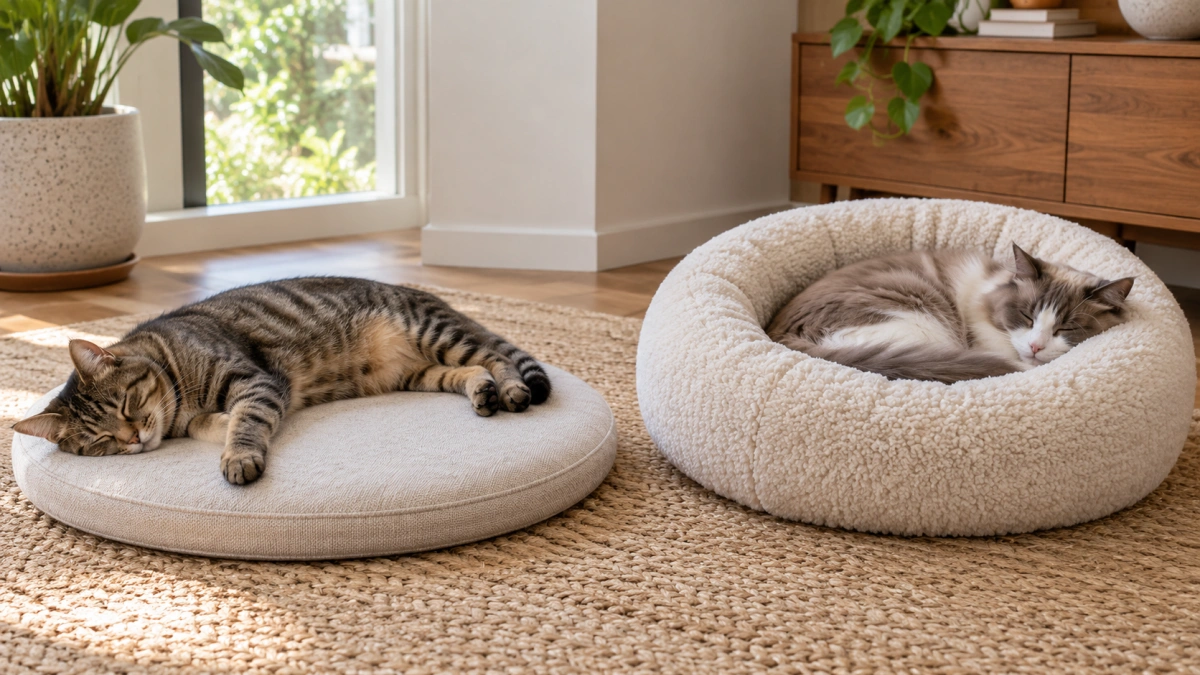
Cats that sleep curled into a ball may naturally fit the circular shape of a donut bed.
However, preference remains individual. A cat can frequently curl up and still prefer a flat blanket, sofa, cardboard box, or another type of bed.
Which Cats May Prefer a Different Shape?
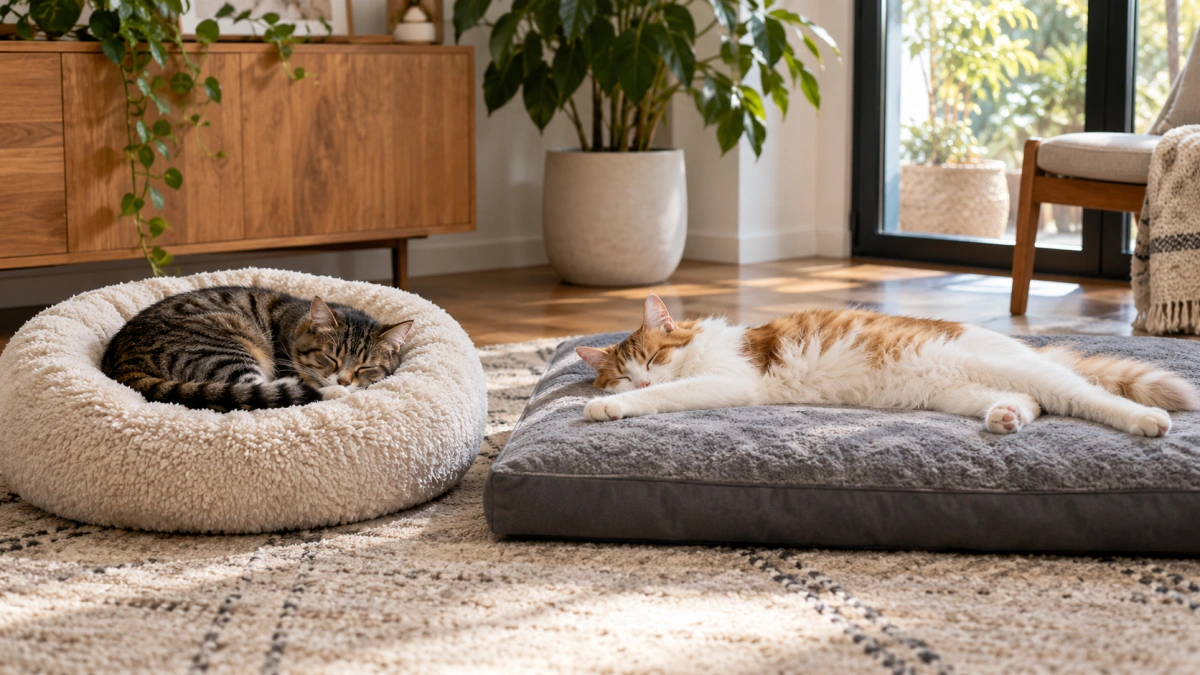
A round or donut bed may not be the best match for a cat that normally uses a long, open sleeping position.
Consider a rectangular or flat bed instead if your cat frequently:
- Sleeps fully stretched on its side
- Extends its front and rear legs
- Changes sleeping position frequently
- Prefers large open cushions
- Avoids raised edges
The goal is to match the bed to the cat rather than trying to make the cat adapt to a particular shape.
How to Size a Donut Cat Bed
The most important sizing detail is the usable interior space.
A listing may advertise the total outer diameter, but thick raised sides can remove several inches from both sides of the central sleeping area.
Before buying, look for:
- Total outer diameter
- Interior sleeping diameter
- Rim width
- Rim height
- Center cushion thickness
If the manufacturer provides only the exterior diameter, look closely at how thick the raised rim is before deciding whether your cat will fit.
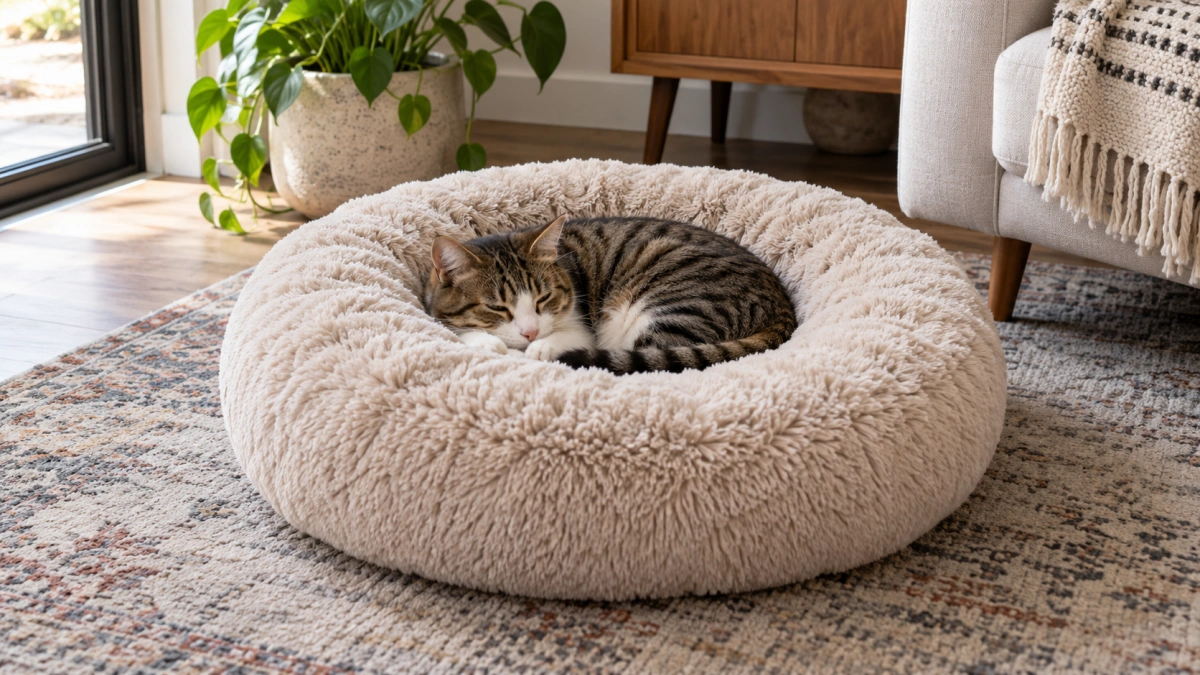
How to Measure Your Cat for a Round Bed
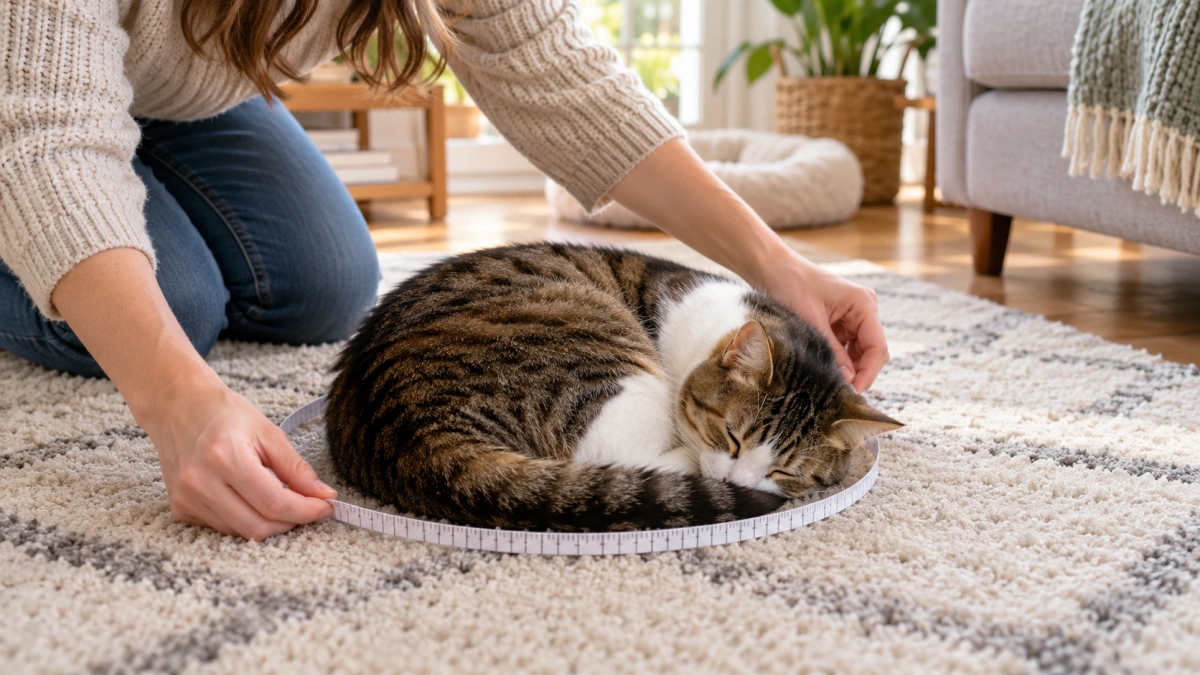
Measure your cat in the sleeping position that best matches the type of bed you are considering.
For a Donut Bed
Wait until your cat is naturally curled into its normal sleeping circle.
Estimate the widest space occupied by the curled body.
Then choose an interior sleeping area that gives the cat additional room to reposition without forcing the body firmly against the surrounding rim.
For a Flat Round Bed
If your cat sometimes stretches rather than curling tightly, measure the longer sleeping position as well.
A round bed may need to be considerably larger to accommodate a stretched cat than a tightly curled one.
Can a Donut Cat Bed Be Too Small?
Yes.
A donut bed should feel surrounded without forcing the cat into an unnaturally tight position.
Possible signs that the bed is too small include:
- The cat cannot turn comfortably
- Most of the body rests on top of the rim
- The rim presses tightly against the body
- The cat repeatedly chooses the floor beside the bed instead
- The cat cannot change sleeping position
Do not intentionally undersize the bed simply to create a more enclosed feeling.
Can a Donut Cat Bed Be Too Large?
A larger bed is not necessarily a problem, but it changes how the design functions.
A very oversized donut may feel more like a large round mattress than a compact nest because the cat no longer has easy contact with the surrounding rim.
Some cats will prefer that extra room.
Others specifically seek the close raised edge.
Again, observe how your cat normally uses cushions and furniture before deciding.
Why Rim Construction Matters
The raised rim is one of the defining features of a donut bed.
If the rim quickly collapses flat, the bed may lose much of the shape that made it different from a standard cushion.
Look for a rim that:
- Feels evenly filled
- Returns toward its original shape
- Supports the cat’s head without immediately flattening
- Does not contain large empty sections
- Stays reasonably consistent after cleaning
Softness is still important, but an extremely loose rim may provide very little structure after repeated daily use.
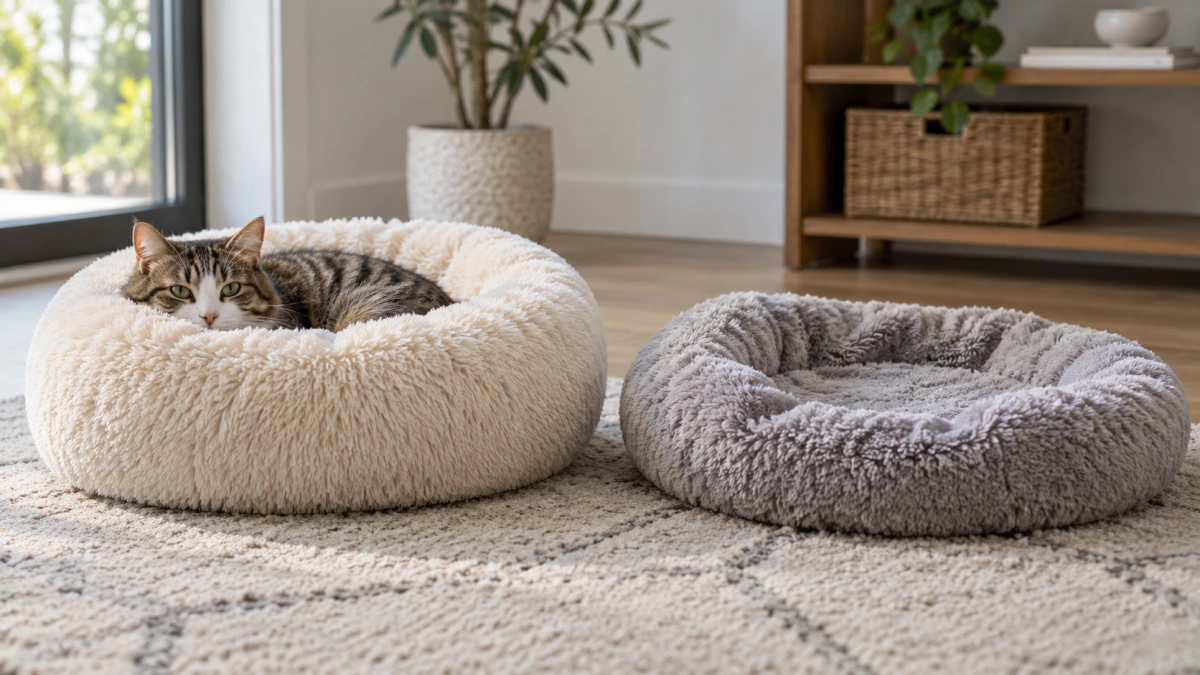
Check the Center Cushion Too
The raised rim receives a lot of attention, but the center of the bed supports most of the cat’s body.
A very thin central pad may compress until the cat is effectively resting against the floor.
Consider:
- Center cushion thickness
- Type of filling
- How easily it compresses
- Whether the filling shifts into lumps
- Whether the base remains flat
For heavier cats, a more structured center may be preferable to loose filling alone.
Are Donut Beds Orthopedic?
Not automatically.
The round shape and raised edge describe the design, not the quality or type of support underneath the cat.
A donut bed filled entirely with loose polyester fiber behaves differently from one with a foam base.
If support is a priority, evaluate the actual center construction instead of relying on words such as “orthopedic” in the product title.
Donut Cat Beds for Large Cats
Large cats require particular attention to the interior diameter.
A product may be labeled Large while still providing a relatively small central sleeping area because the outer rim takes up so much space.
Check:
- Interior diameter
- Rim thickness
- Center support
- Overall bed stability
- Whether the cat can turn around
If your cat regularly finds standard pet beds too small, see our cat beds for large cats guide for more detailed sizing considerations.
Donut Cat Beds for Senior Cats
Some older cats enjoy having a soft rim to lean against, but entry height and center stability become increasingly important.
For a senior cat, consider:
- A lower or compressible entry section
- A stable center cushion
- A nonslip base
- Enough interior room to reposition
- A washable surface
A very deep, extremely soft bed may require more effort to move through than a shallower supportive one.
If your cat suddenly stops entering a favorite bed, becomes reluctant to jump, appears stiff, or changes sleeping behavior significantly, discuss the change with your veterinarian rather than assuming the bed is the only issue.
Round Beds vs Cave Beds
A donut bed surrounds the cat from the sides but remains open above.
A cave bed adds an overhead cover and creates a more enclosed sleeping compartment.
A donut bed may suit a cat that likes:
- Raised edges
- Open visibility
- Curling in a compact nest
A cave bed may suit a cat that actively:
- Burrows beneath blankets
- Seeks hidden spaces
- Sleeps under furniture
- Prefers overhead cover
If your cat prefers full enclosure, choose a covered style rather than assuming a deeper donut bed will provide the same experience.
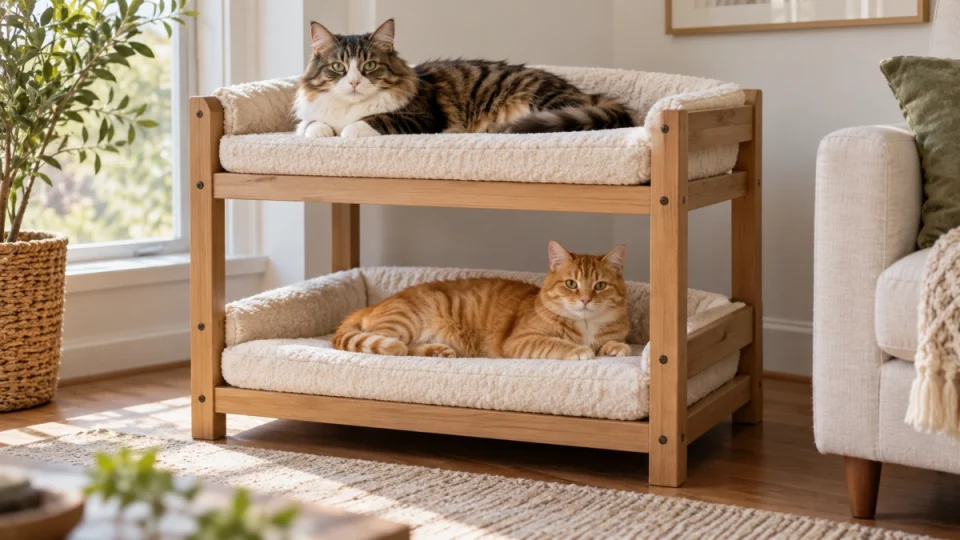
Round Beds vs Cat Bunk Beds
The two styles solve very different needs.
A donut bed focuses on the shape of the individual sleeping surface. A cat bunk bed focuses on providing multiple sleeping levels.
You can even combine the concepts by placing a correctly sized round cushion on a sufficiently large bunk platform, provided the cushion remains stable and does not reduce the safe usable area.
Plush and Faux-Fur Donut Beds
Many donut beds use long plush or faux-fur fabric to create a soft sleeping surface.
This may appeal to cats that already choose:
- Fleece blankets
- Soft throws
- Plush furniture
- Thick bedding
However, long fibers can trap fur and debris and may mat after repeated washing.
Check the care instructions before choosing a heavily textured surface.
Do Donut Beds Keep Cats Warm?
A curled sleeping position, padded raised sides, and plush fabrics can all reduce exposure around the body and may feel warmer than a flat open mat.
That can be appealing in cooler rooms.
However, a heavily padded bed may be less attractive to a cat that seeks tile, sinks, or other cooler surfaces.
Provide more than one resting option so your cat can choose according to room temperature and individual preference.
Cleaning and Washability
Round plush beds can collect considerable fur, dander, dust, and debris inside the central depression and along the rim.
Useful cleaning features include:
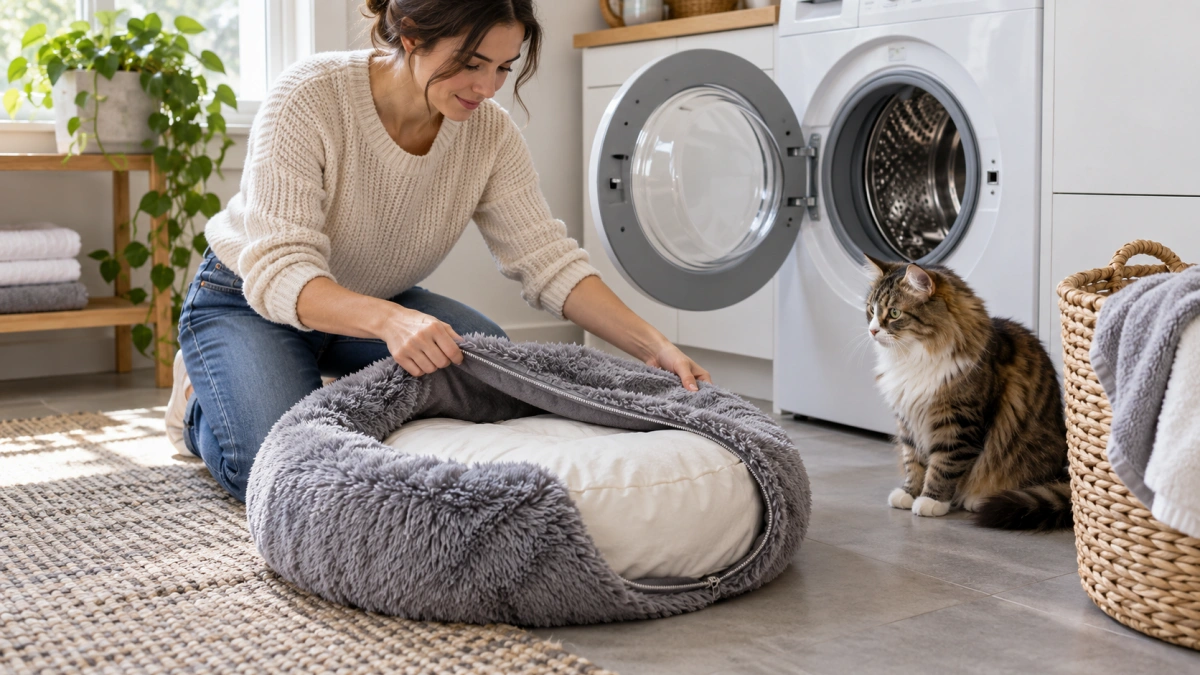
- A removable outer cover
- Machine-washable fabric
- Separate cushion inserts
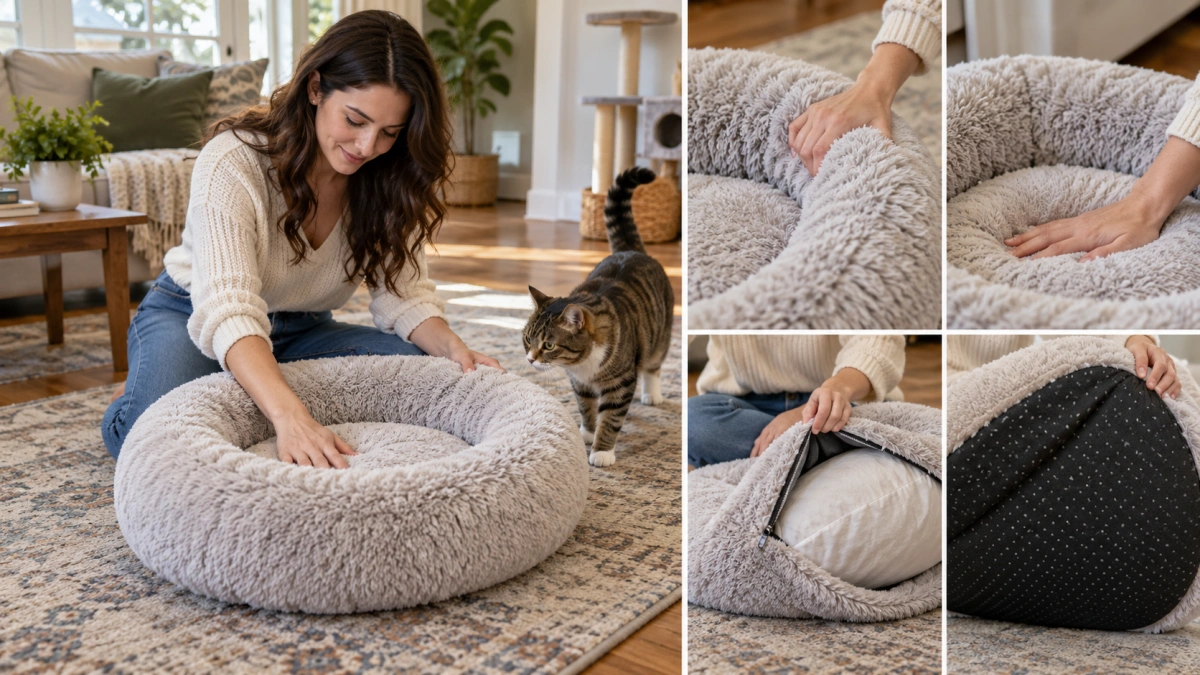
- A zipper large enough for easy removal
- Materials that dry completely
Check carefully whether the manufacturer’s “machine washable” claim applies to the entire bed or only the removable cover.
Large filled donut beds can become extremely bulky and heavy when wet, which may make whole-bed washing impractical in a household machine.
Why a Nonslip Base Helps
Round beds are often lightweight, especially when filled mainly with polyester fiber.
On tile, laminate, or hardwood flooring, the bed may slide while the cat steps in, turns, kneads, or pushes against the rim.
A nonslip base or secure nonslip mat underneath can help keep the sleeping spot stable.
Also make sure the floor underneath remains dry and clean so the bed does not move unexpectedly.
Can Two Cats Share a Donut Bed?
They can if the bed is genuinely large enough and both cats voluntarily prefer sleeping together.
However, buying one oversized donut for two cats is not the same as providing two individual sleeping choices.
Even cats that frequently cuddle may sometimes want separate beds.
In multi-cat homes, provide multiple resting locations so one cat does not have to share whenever another cat occupies the preferred bed.
Where Should You Put a Donut Cat Bed?
Start with a location your cat already chooses for sleeping.
Good options may include:
- A quiet corner
- Beside a sofa
- A bedroom resting area
- A warm but not excessively hot location
- A low-traffic part of the room
Do not assume the bed itself will make an undesirable location attractive.
A correctly sized bed placed in the middle of a noisy walkway may still go unused.
How to Introduce a New Round Bed
Place the bed in a familiar resting area and give your cat time to investigate.
You can add a familiar blanket or small piece of bedding if it does not make the surface unstable.
Avoid repeatedly placing the cat into the center.
Cats often accept new sleeping surfaces on their own schedule, and some will simply prefer another shape.
Common Round and Donut Cat Bed Buying Mistakes
- Buying by body weight alone
- Using the exterior diameter as the sleeping diameter
- Ignoring the thickness of the raised rim
- Choosing a round bed for a cat that always stretches out
- Assuming every fluffy bed is supportive
- Ignoring center cushion thickness
- Choosing a very high edge for a senior cat
- Ignoring whether the rim quickly collapses
- Buying a bed that cannot be realistically washed
- Ignoring a slippery bottom
- Assuming “calming” claims guarantee a behavioral effect
Are Donut Beds Really Calming?
Some products describe donut beds as calming beds because the raised rim and soft materials create a compact resting space.
Your cat may find that shape comfortable, but the product should not be treated as a treatment for anxiety, fear, or persistent behavioral problems.
Comfort preference varies between cats.
Choose the bed because its size, shape, material, and construction match your cat’s sleeping behavior rather than because of an unsupported promise that one bed style will change behavior.
Round and Donut Cat Bed Buying Checklist
- Does my cat normally sleep curled up?
- What is my cat’s curled sleeping diameter?
- What is the bed’s actual interior diameter?
- How thick is the raised rim?
- Can my cat turn around comfortably?
- Does the center provide enough support?
- Does the rim return to shape after use?
- Is the entry practical for my cat?
- Does the bottom resist sliding?
- Is the cover removable?
- Can the bed be machine washed?
- Will the material dry thoroughly?
- Does the bed match my cat’s normal sleeping style?
Final Thoughts
Round and donut cat beds can be an excellent match for cats that naturally curl into compact sleeping positions or enjoy leaning against a soft raised edge.
The most important sizing detail is the usable center, not the outside diameter. A thick rim can make a bed look much larger than the actual space available to the cat.
Also consider center support, rim construction, entry height, washability, floor grip, and your cat’s preferred sleeping surface.
If your cat regularly stretches out instead of curling, an open rectangular mattress may be a better choice. The best bed shape is the one that follows how your cat already chooses to sleep.