By
By 
Finding a dog bed for a Great Dane is different from buying one for an average-sized dog. Adult Great Danes can weigh well over 100 pounds and need enough sleeping space for their long body, legs, shoulders, and hips.
That means the word “large” on a product label tells you very little. A bed can look enormous in a product photo but still be too short, too narrow, or too soft once a full-grown Great Dane lies on it.
The best dog beds for Great Danes provide enough usable space for the dog’s normal sleeping position, stable support that does not collapse to the floor, practical access, durable construction, and a cover you can realistically clean.
You can explore our complete Dog Beds topic hub for more guides about bed sizes, materials, cleaning, support, and different sleeping styles.
What Makes a Good Dog Bed for a Great Dane?
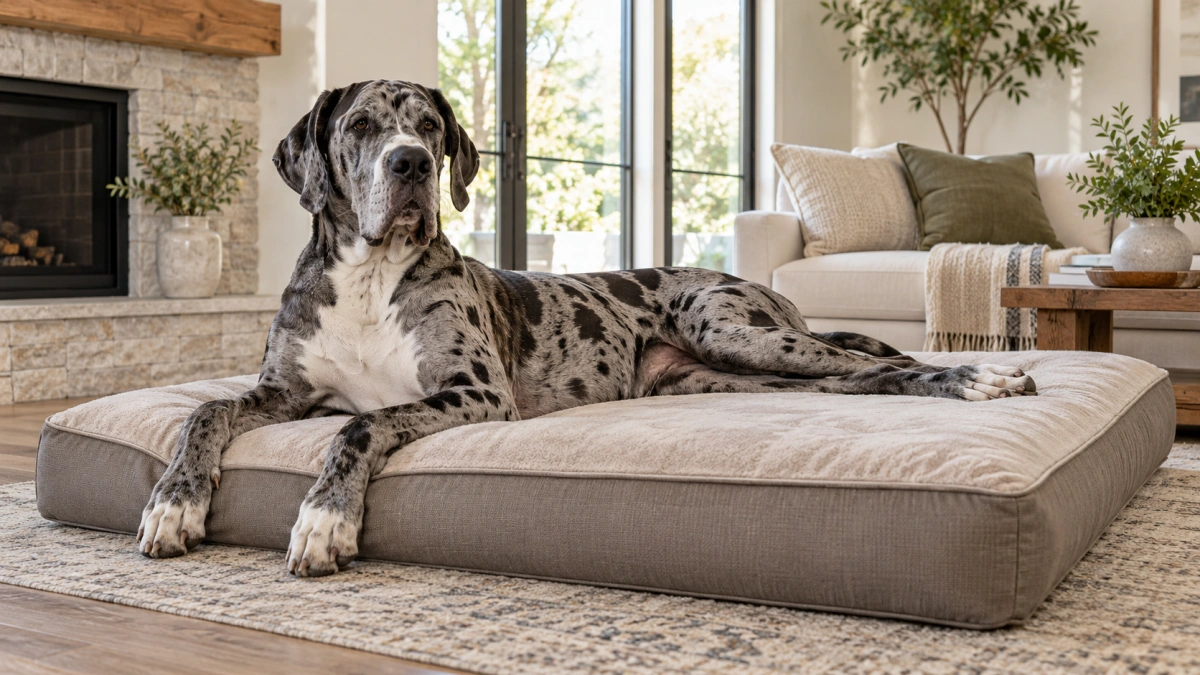
Great Danes are giant dogs, so their bed needs to solve several problems at the same time.
The most important factors are:
- Enough usable sleeping area
- Support that does not bottom out
- A stable base
- Durable cover material
- Easy entry and exit
- A removable washable cover
- Protection for the inner mattress
The right balance depends on your individual dog. A young Dane that sleeps fully stretched out may need a different shape from a senior that prefers leaning against a bolster.
Why Great Dane Bed Size Matters So Much
Great Danes are among the largest commonly kept companion dogs. Adult males may reach approximately 140 to 175 pounds, while females are commonly around 110 to 140 pounds.
Their height and long frame create another sizing challenge: weight alone does not tell you how much floor space the dog actually uses while sleeping.
A bed that supports the dog’s weight but leaves the head, hips, or legs hanging off the edge is still too small for many sleeping positions.
What Size Dog Bed Does a Great Dane Need?
There is no single dimension that fits every Great Dane.
Many beds marketed for giant breeds are approximately 48 inches long or larger, while especially large or fully stretched adult Danes may need substantially more space.
Instead of starting with a Small, Large, XL, or XXL label, start with your dog.
| Factor | What to Check |
|---|---|
| Sleeping length | Can the dog stretch without hanging off? |
| Sleeping width | Is there room for shoulders and legs? |
| Interior dimensions | How much space is actually usable? |
| Bolsters | How much sleeping area do they remove? |
| Dog’s growth | Is the dog still a puppy? |
Actual dimensions matter more than the manufacturer’s size name because sizing labels are not standardized between brands.
How to Measure Your Great Dane for a Bed
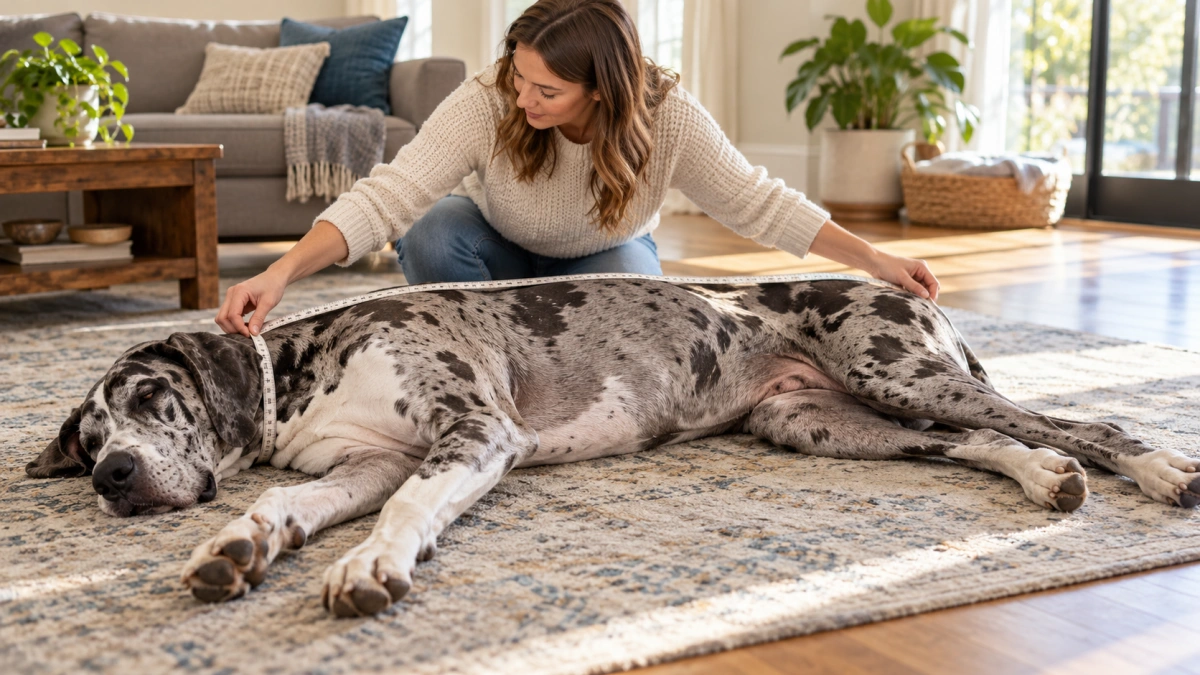
The easiest approach is to measure your dog while it is resting in the position that uses the most space.
Measure the Sleeping Length
Wait until your Great Dane is lying naturally on its side or stretching out.
Measure the amount of floor space used from the front of the body to the rear of the sleeping position. Include the legs if your dog normally extends them while sleeping.
Then choose a bed that provides additional room for repositioning rather than matching the measurement exactly.
Measure the Sleeping Width
Look at how far the body, chest, shoulders, and legs extend across the floor.
A Great Dane that sleeps on its side may use much more width than you expect from looking at the dog while standing.
Use Interior Dimensions for Bolster Beds
If you are considering a bed with raised sides, do not use the outside dimensions as the sleeping dimensions.
Thick bolsters can remove several inches from each side of the usable surface.
Support Matters More Than Softness
A thick-looking bed is not necessarily a supportive bed.
What matters is how the filling behaves after a heavy dog lies on it.
If the material compresses until your Great Dane’s hips, shoulders, or elbows are effectively resting against the hard floor, the bed is not providing much cushioning regardless of how plush the top looks.
Look for a sleeping surface that:
- Supports the dog’s body evenly
- Does not collapse completely under weight
- Returns toward its normal shape after use
- Does not develop deep permanent depressions quickly
- Provides stable footing when the dog gets up
Foam thickness is useful information, but thickness should not be considered by itself. Foam construction, density, firmness, layering, and the dog’s weight all affect how supportive the final bed feels.
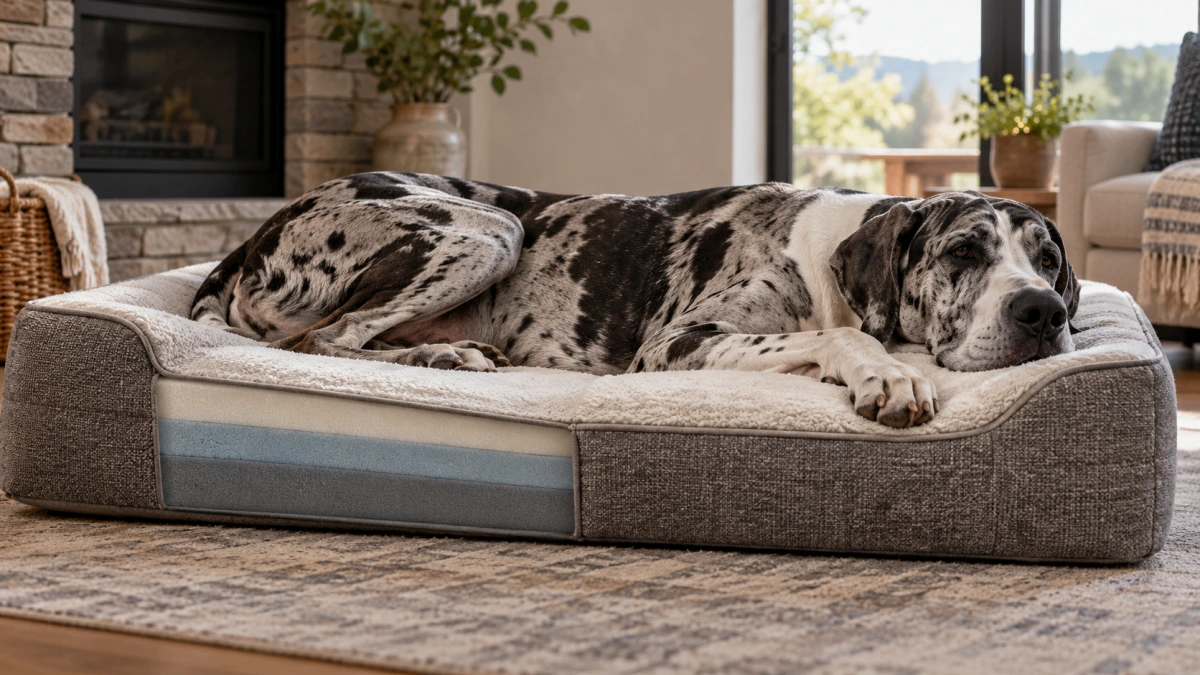
Are Orthopedic Dog Beds Good for Great Danes?
Orthopedic-style beds are popular for giant breeds because they generally use a more structured foam sleeping surface rather than loose fiber filling alone.
For a Great Dane, the useful feature is not the word “orthopedic” itself. The important question is whether the mattress provides stable cushioning across the dog’s full body without quickly flattening.
When comparing orthopedic beds, look at:
- Overall mattress construction
- How firmly it supports heavy dogs
- Whether the foam returns to shape
- Usable sleeping dimensions
- Ease of getting on and off
- Whether the cover can be removed
Be cautious with vague orthopedic claims that provide no useful information about the mattress construction.
Mattress Beds vs Bolster Beds for Great Danes
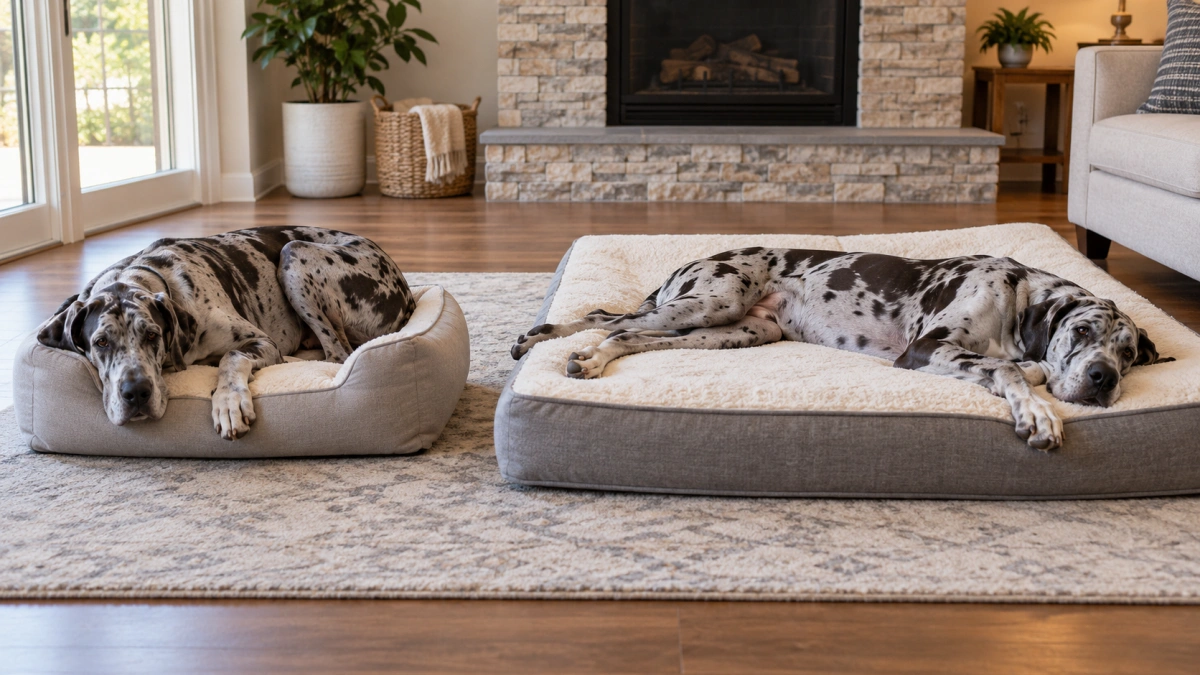
Both designs can work, but they use space differently.
Mattress-Style Beds
A flat mattress bed usually provides the maximum amount of usable sleeping area for its exterior dimensions.
This style can work especially well for Great Danes that:
- Stretch their full body out
- Change sleeping positions frequently
- Prefer easy access from every direction
- Need as much usable surface area as possible
Bolster Beds
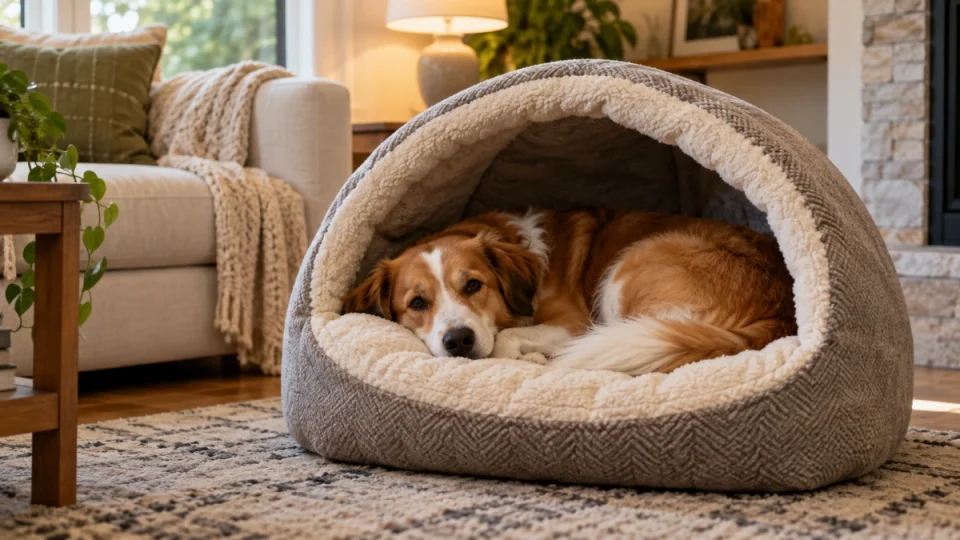
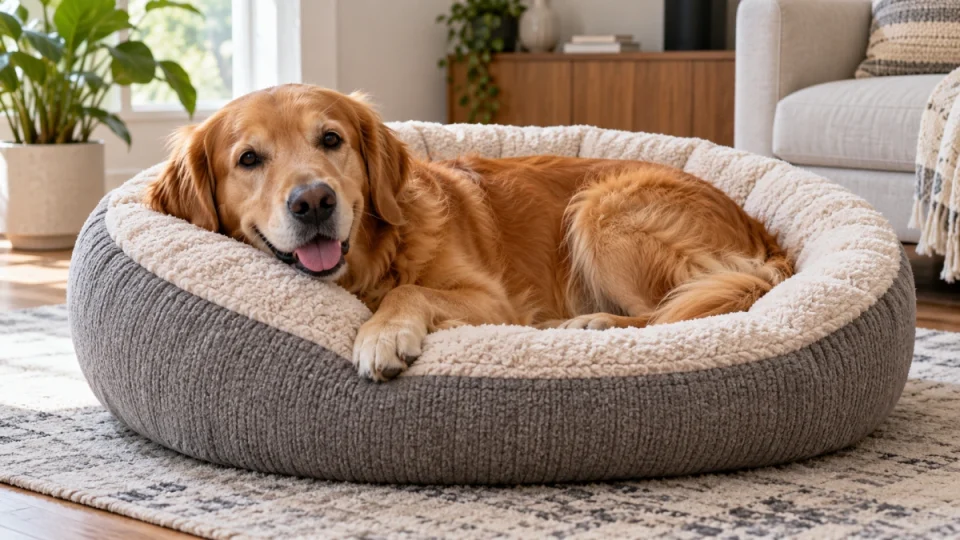
Bolster beds have raised sides that can provide a place for the dog to rest its head or lean against.
They may suit Danes that regularly sleep against furniture, pillows, walls, or the edge of another bed.
The tradeoff is usable space. A bed measuring 50 inches across the outside may provide a substantially smaller flat sleeping area once thick bolsters are included.
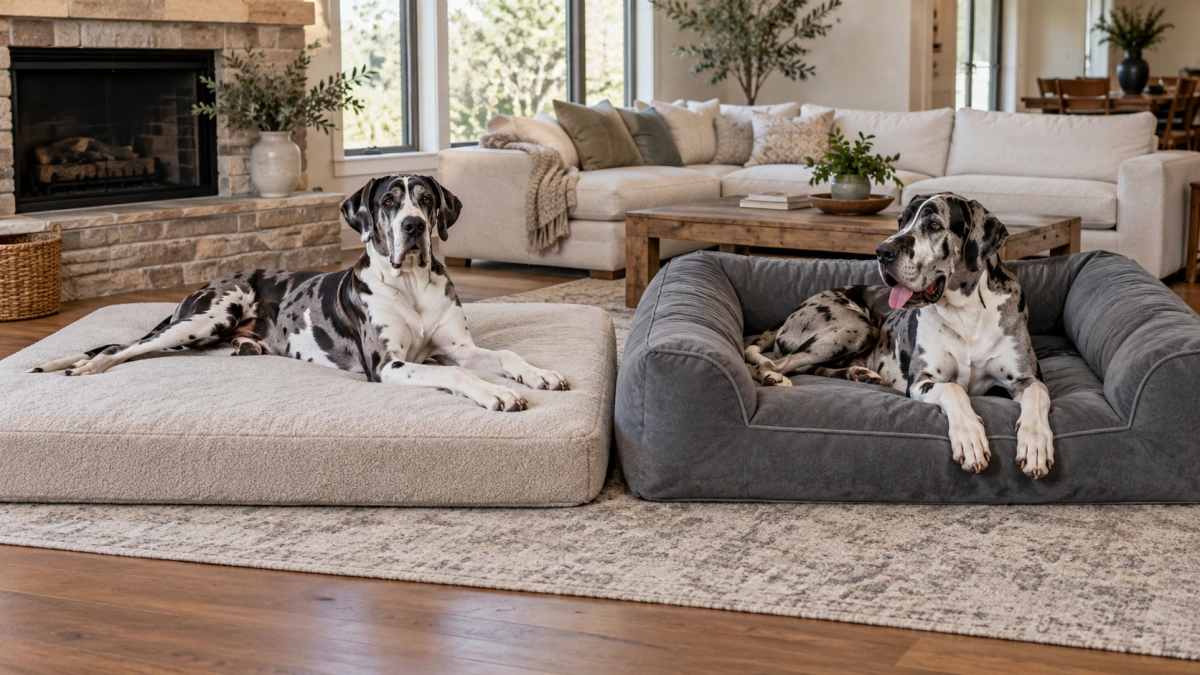
Are Elevated Beds Suitable for Great Danes?
An elevated bed supports the dog on a tensioned fabric surface above the floor.
Potential advantages include:
- Airflow underneath the dog
- Easy cleaning beneath the bed
- Less fabric and stuffing for some chewers to grab
- Practical indoor or outdoor use
However, an elevated cot does not feel the same as a cushioned foam mattress.
For a Great Dane, check the manufacturer’s actual weight capacity, frame stability, sleeping dimensions, fabric tension, and height above the floor.
A tall elevated design may also be less convenient for an older dog that prefers a very low entry.
Dog Beds for Senior Great Danes
As a Great Dane gets older, ease of access can become just as important as cushioning.
A senior-friendly design generally benefits from:
- A stable supportive sleeping surface
- A low or unobstructed entry
- Enough room to reposition
- A nonslip base
- A cover that stays relatively smooth
Avoid assuming that the softest possible bed is automatically the easiest for an older dog to use.
A surface that sinks deeply can make getting back onto the feet more difficult for some dogs. A supportive surface should provide cushioning while still feeling stable under the body.
If your dog develops persistent stiffness, pain, difficulty rising, limping, or a sudden change in sleeping behavior, the bed itself should not be treated as a substitute for veterinary care.
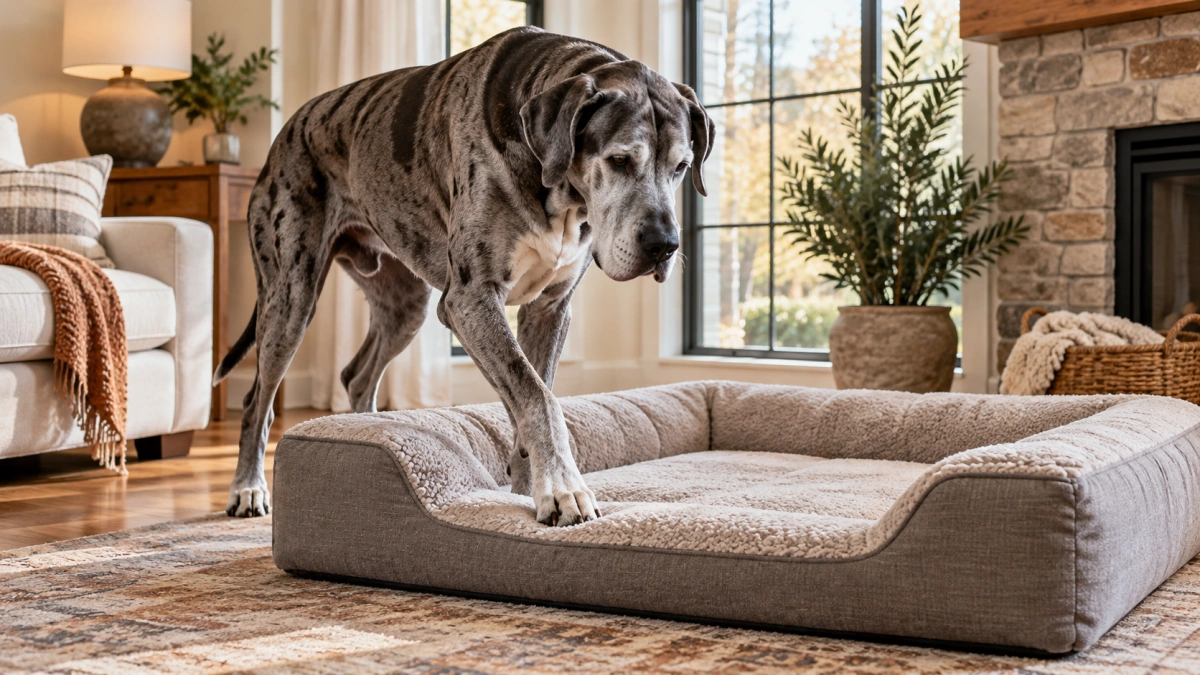
Dog Beds for Great Dane Puppies
A Great Dane puppy creates a different buying problem: rapid growth.
A bed that fits comfortably today may become too small much sooner than expected.
You generally have two practical approaches:
- Buy for the dog’s expected adult sleeping space
- Use a less expensive temporary bed and replace it as the puppy grows
Also consider chewing behavior. An expensive foam mattress may not be a practical first choice if your puppy regularly tears, digs, or chews bedding.
Inspect beds frequently and remove damaged material that could be swallowed.
Durability Matters More With a Giant Dog
A Great Dane puts more physical stress on a bed simply because of its body size and weight.
Repeated lying down, turning, digging, stepping, and getting up can stress seams, zippers, covers, and foam much faster than light use from a small dog.
Useful durability features include:
- Strong seams
- Protected or concealed zippers
- Replaceable outer covers
- Dense upholstery-style fabrics
- A stable nonslip bottom
- Replaceable mattress components
However, no soft fabric bed should automatically be considered chew-proof.
If your Great Dane deliberately destroys bedding, focus on managing that behavior and choose a construction appropriate for the dog’s habits rather than relying on marketing terms such as “indestructible.”
Washability and Waterproof Protection
Cleaning becomes particularly important when the bed itself is enormous.
A complete Great Dane bed may be far too bulky to fit inside a typical household washing machine.
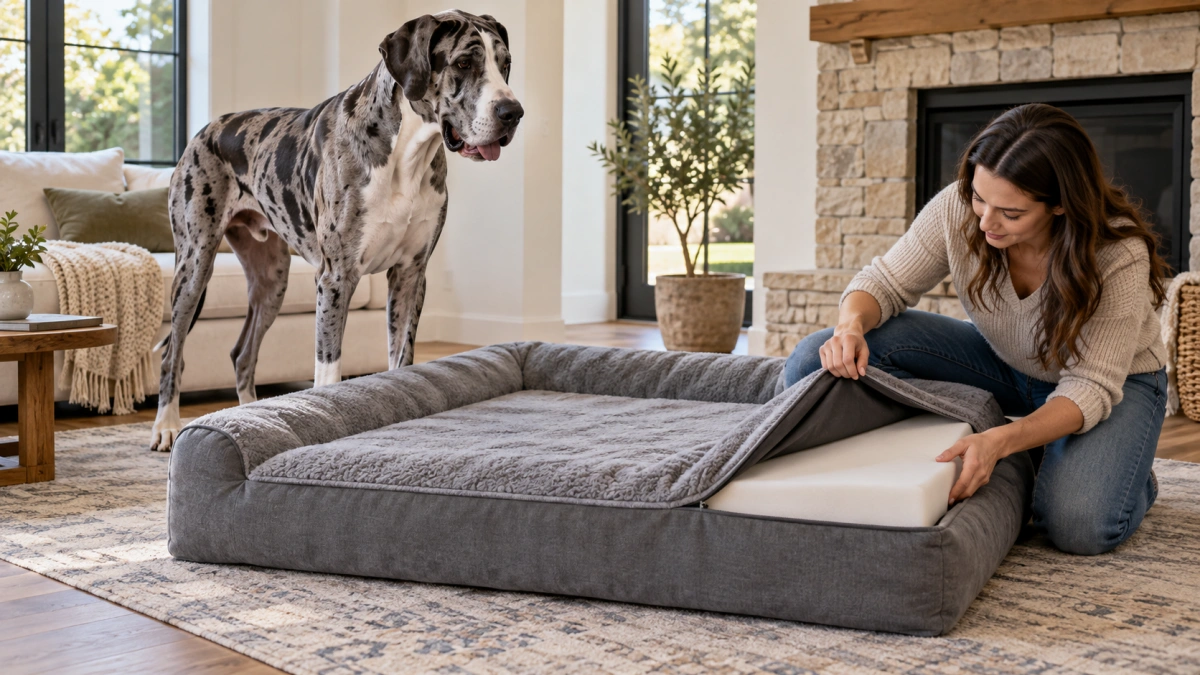
That makes a removable cover especially useful.
Look for:
- A fully removable outer cover
- A zipper opening large enough to remove the mattress easily
- A machine-washable cover
- A protective inner liner
- Replacement covers sold separately when possible
A waterproof or moisture-resistant inner liner can help protect the foam from accidents, drool, damp fur, and cleaning moisture.
Also check the care instructions before purchasing. “Washable” may refer only to the outer cover rather than the entire bed.
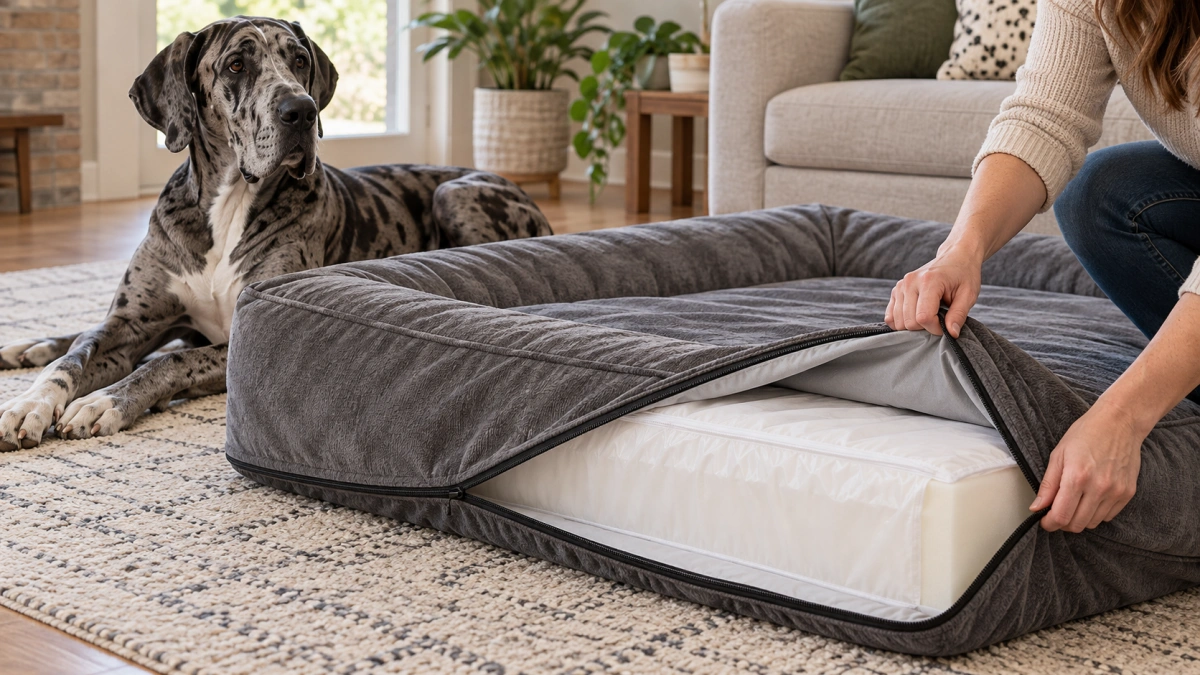
Choose a Bed Based on Your Great Dane’s Sleeping Style
| Sleeping Habit | Bed Style to Consider |
|---|---|
| Full-body stretching | Large mattress-style bed |
| Leans head against edges | Roomy bolster bed |
| Frequently changes position | Open rectangular mattress |
| Gets warm easily | Breathable or elevated design |
| Needs easy access | Low-profile mattress |
| Hard on soft beds | More durable reinforced design |
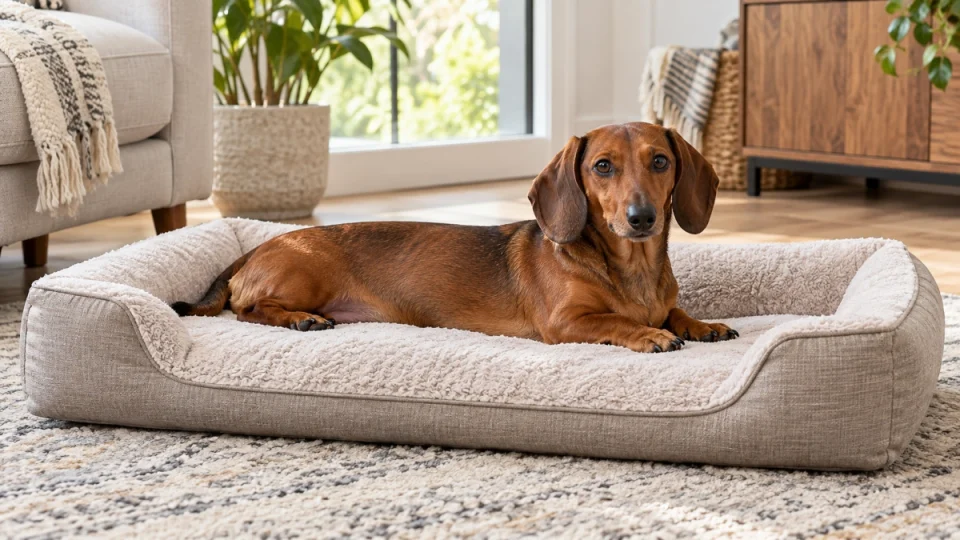
Breed size changes the priorities considerably. For example, our guide to dog beds for Dachshunds focuses much more heavily on low entry height and a long, low body shape, while Great Dane beds require far more attention to usable area and support under a giant frame.
Should You Use a Human Mattress for a Great Dane?
Some Great Dane owners use crib, toddler, twin, or other human mattresses because they offer a large flat sleeping area and standard bedding can make cleaning easier.
This approach can work in some homes, but it still requires the same evaluation as a dog bed.
Check:
- Whether the mattress is the right size
- Whether it is supportive enough
- Whether the height is easy for the dog to access
- Whether it has a waterproof protector
- Whether the mattress can be kept clean
- Whether the room has enough floor space
A human mattress is not automatically better simply because it is larger.
How Much Floor Space Does a Great Dane Bed Need?
A genuinely large Great Dane bed occupies significant room.
Before ordering one, measure the intended location as carefully as you measure your dog.
Allow space for:
- The full exterior bed dimensions
- The dog to approach the bed
- Legs extending beyond the edge occasionally
- Removing the cover for cleaning
- Opening doors and walking through the room
Do not downsize the bed simply because the preferred corner of the room is too small. A different location is usually better than forcing a giant dog onto an undersized sleeping surface.
Common Great Dane Dog Bed Buying Mistakes
- Buying by Large, XL, or XXL label alone
- Ignoring actual dimensions
- Using exterior bolster dimensions as sleeping dimensions
- Choosing a bed only because it looks thick
- Ignoring whether the foam bottoms out
- Buying for a puppy’s current size only
- Ignoring entry height for a senior dog
- Choosing a cover that cannot be removed
- Assuming soft automatically means supportive
- Assuming any bed is chew-proof
- Forgetting how much room a giant bed takes up
When Should You Replace a Great Dane’s Bed?
Inspect the bed regularly rather than waiting until it is completely unusable.
Replacement may be appropriate when:
- The sleeping surface no longer returns to shape
- The dog sinks through to the hard floor
- Deep permanent depressions have formed
- The cover or seams are badly damaged
- The inner foam has become wet or contaminated
- The puppy has clearly outgrown the usable area
Some beds allow you to replace the cover or mattress insert separately, which can extend the useful life of the overall bed.
Great Dane Dog Bed Buying Checklist
- Did I measure my Great Dane while sleeping?
- Can my dog fully stretch out?
- What are the actual bed dimensions?
- What are the usable interior dimensions?
- Does the mattress stay supportive under weight?
- Is the sleeping surface stable?
- Is the entrance low enough?
- Does the bed match my dog’s sleeping style?
- Is the cover removable?
- Is the cover machine washable?
- Is the inner mattress protected?
- Are replacement covers available?
- Will the bed fit comfortably in my home?
Final Thoughts
The best dog bed for a Great Dane is not determined by a brand name or an XXL label. It is the bed that gives your individual dog enough usable sleeping space while providing stable cushioning under a very large body.
Start by measuring your Great Dane in its normal sleeping position. Then compare actual dimensions, mattress support, entry height, cover durability, washability, and moisture protection.
For many Great Danes, a large open orthopedic-style mattress provides a practical combination of space and support. A roomy bolster can work well for dogs that like to lean against an edge, while an elevated bed may suit dogs that prioritize airflow or need a different type of durable sleeping surface.
Most importantly, choose for the dog in front of you rather than relying on a generic breed label. Great Danes vary in body size, sleeping habits, age, and bedding preferences, and the best bed is one that accommodates those real-world differences.