By
By 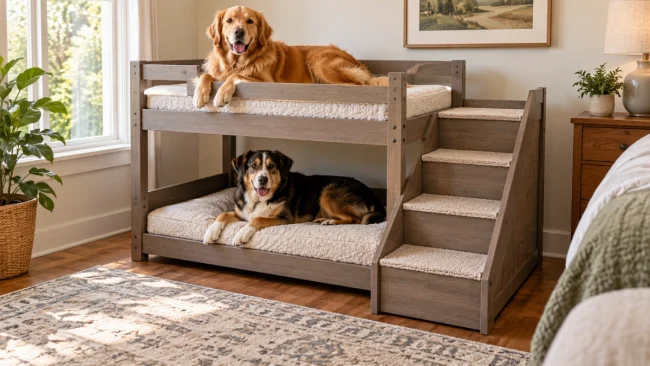
Dog bunk beds can give two or more dogs separate sleeping spaces without requiring you to place multiple beds side by side. By using vertical space, they can be especially useful in bedrooms, apartments, and multi-dog homes where floor space is limited.
But a dog bunk bed is only useful when every level actually works for the dog using it. Before choosing one, you should look beyond the overall furniture dimensions and check the usable sleeping area, published weight limits, stair or ramp access, upper-level edges, lower-bunk headroom, and frame stability.
For larger dogs, these details become even more important. A product described as “large” or “XL” does not automatically provide enough room or support for your dog.
If you are comparing other sleeping styles as well, our Dog Beds hub covers different bed designs, materials, sizes, and access features.
What Is a Dog Bunk Bed?
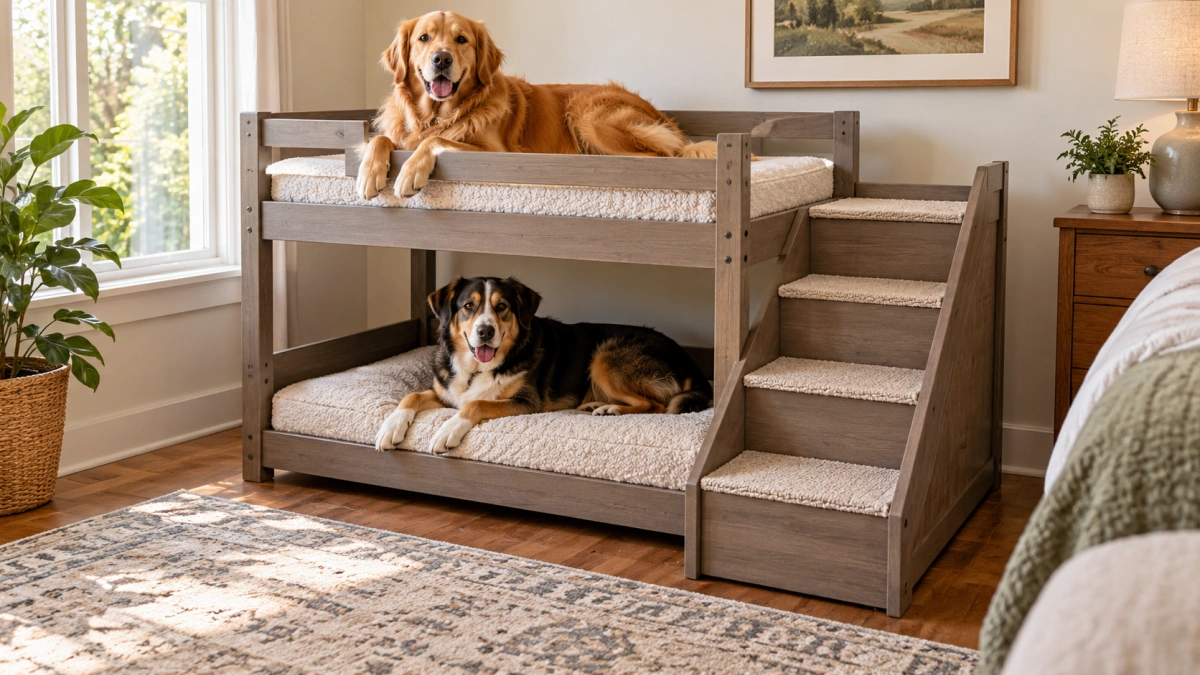
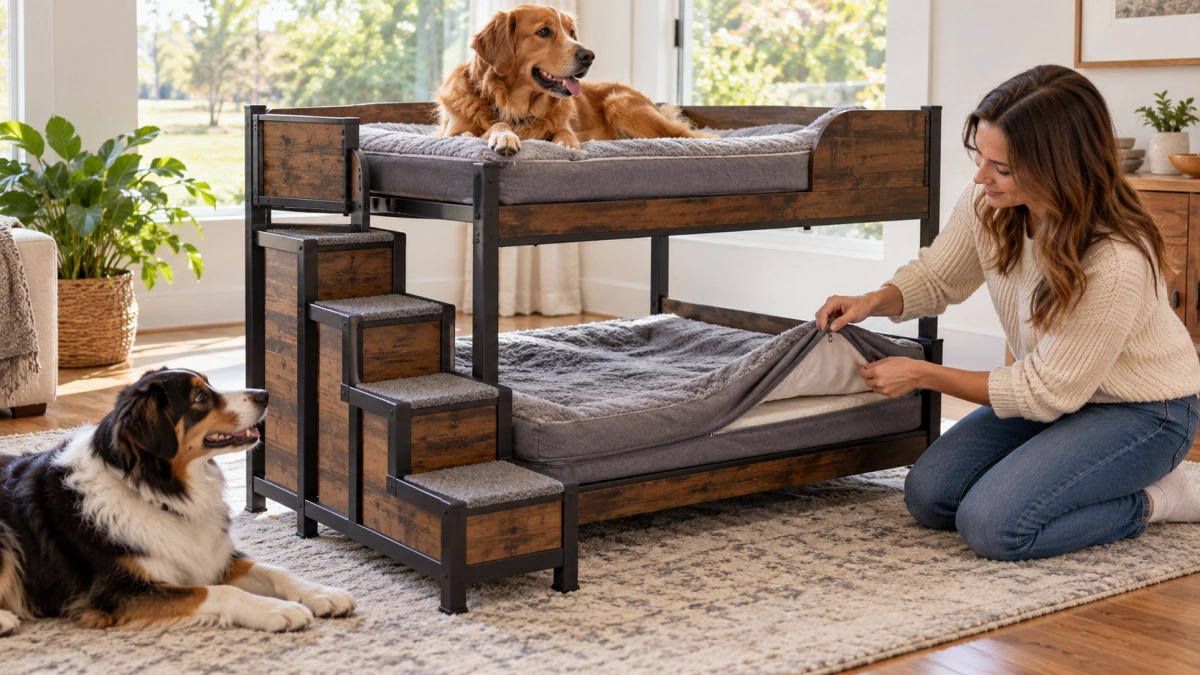
A true dog bunk bed provides two or more usable sleeping levels within one frame. Most designs have an upper platform and a lower sleeping area, with stairs, steps, or a ramp providing access to the upper level.
The goal is not simply to raise one dog bed off the floor. A real bunk design should give each dog its own usable resting space.
That usually means checking:
- A separate sleeping surface on each level
- Enough room for each dog to lie down and turn around
- Independent access to the upper and lower areas
- A stable frame that does not shift during normal use
- Safe access to the elevated platform
If the lower section is only storage space or an open frame, the product functions more like an elevated dog bed than a true multi-dog bunk bed.
Is a Dog Bunk Bed Right for Your Home?
A bunk bed can be a smart choice when you have more than one dog and want to reduce the amount of floor space occupied by separate beds.
It may work well if:
- You have two dogs that are comfortable resting near each other
- Your room has limited open floor space
- One or both dogs are comfortable using stairs or a ramp
- You want defined sleeping spaces instead of overlapping floor beds
- You have enough room around the structure for safe entry and cleaning
A bunk bed may be less practical if your dogs frequently compete over resting spots, dislike elevated surfaces, or need sleeping areas in completely different parts of your home.
The right question is not simply, “Can two dogs fit on this bunk bed?” It is whether both dogs can use their assigned sleeping spaces comfortably and independently.
Dog Bunk Bed vs Elevated Dog Bed
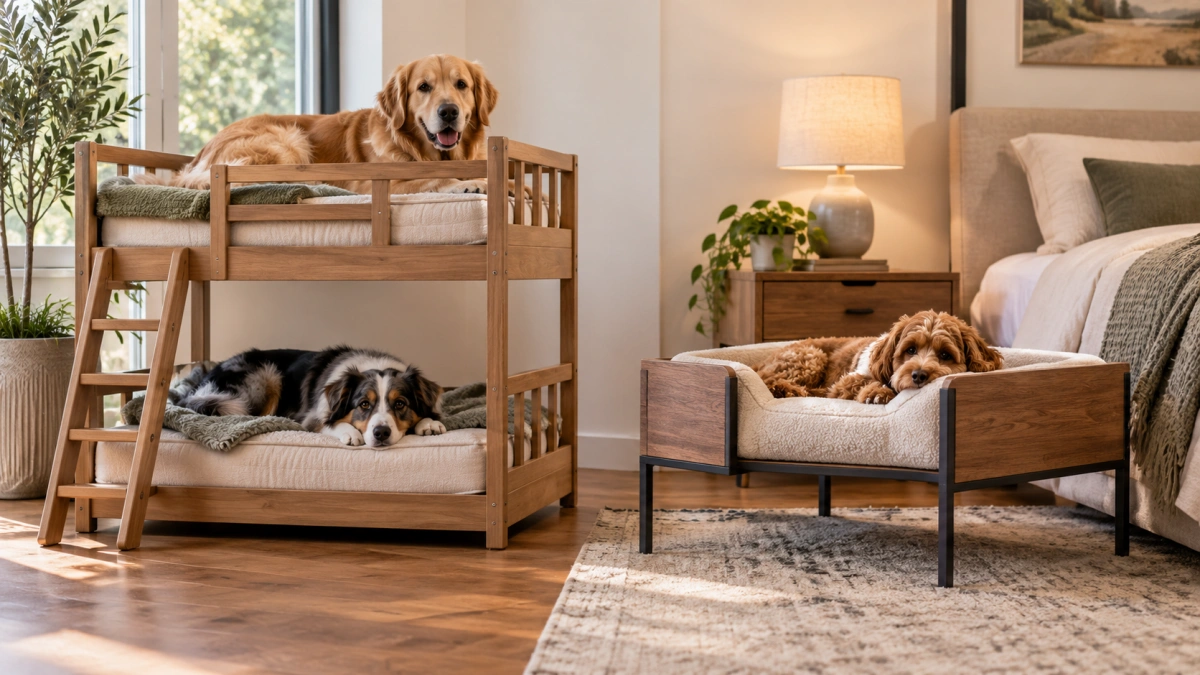
Dog bunk bed search results often include several types of elevated pet furniture, so understanding the difference can help you avoid buying the wrong design.
| Design | Usable Sleeping Levels | Typical Use |
|---|---|---|
| Dog bunk bed | Two or more | Separate resting areas for multiple dogs |
| Elevated dog bed | One | Keeps one sleeping surface above the floor |
| Bedside dog bed | Usually one | Lets your dog rest near the height of your bed |
| Multi-level pet furniture | Varies | May combine beds, platforms, stairs, or storage |
Before buying, look at the usable dimensions of every level rather than judging the product from its overall height or appearance.
When Do Dog Bunk Beds Actually Save Space?
The main advantage of a bunk bed is vertical sleeping space, but you should measure its complete footprint rather than just the main frame.
A bunk bed may also need room for:
- Stairs extending from one side
- A ramp extending into the room
- Your dog to turn before climbing
- Doors or drawers to open
- You to reach both mattresses for cleaning
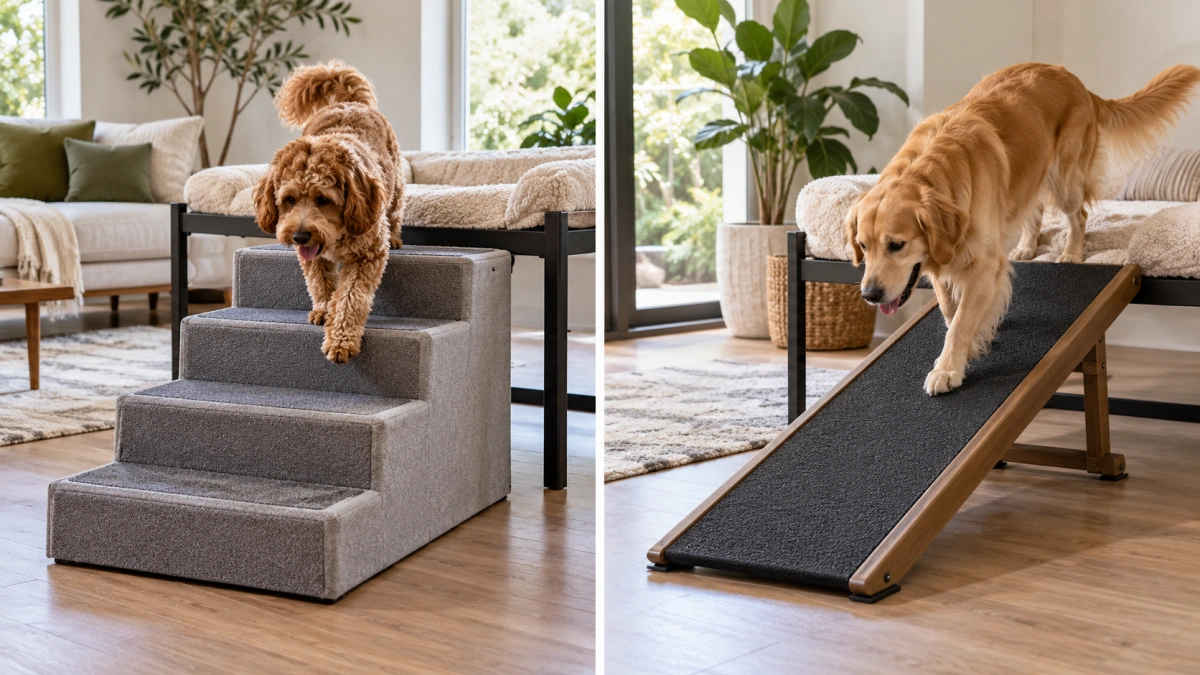
A compact stair design may take up less room than a long ramp. On the other hand, a ramp may be easier for some dogs to use even though it requires more floor length.
Before ordering, mark the complete footprint on your floor with removable tape. This gives you a better idea of how much walking space the furniture will actually use.
Measure Your Dogs Before Choosing a Bunk Bed
Do not choose a dog bunk bed only by breed label or body weight. Your dog’s actual sleeping dimensions matter too.
Watch how your dog normally sleeps. Some dogs curl tightly into a small area, while others stretch their legs far beyond their body length.
When comparing bunk dimensions, check whether your dog can:
- Lie on its side comfortably
- Turn around without hitting the frame
- Stretch without hanging over the platform edge
- Enter without squeezing through a narrow opening
Measure each dog separately if two dogs will share the bunk furniture. The dog using the upper level may require a different amount of space from the dog using the lower level.
How Much Sleeping Space Does Each Bunk Need?
Treat every bunk as a separate dog bed.
Instead of looking only at the furniture’s outside dimensions, find the usable mattress length and width for each level.
For example, a large frame may still have a smaller lower sleeping area because stairs, support posts, or storage compartments take up internal space.
You should also consider how much room remains after adding the mattress. A very thick mattress can reduce both upper guard height and lower-bunk headroom.
Dog Bunk Beds for Large Dogs
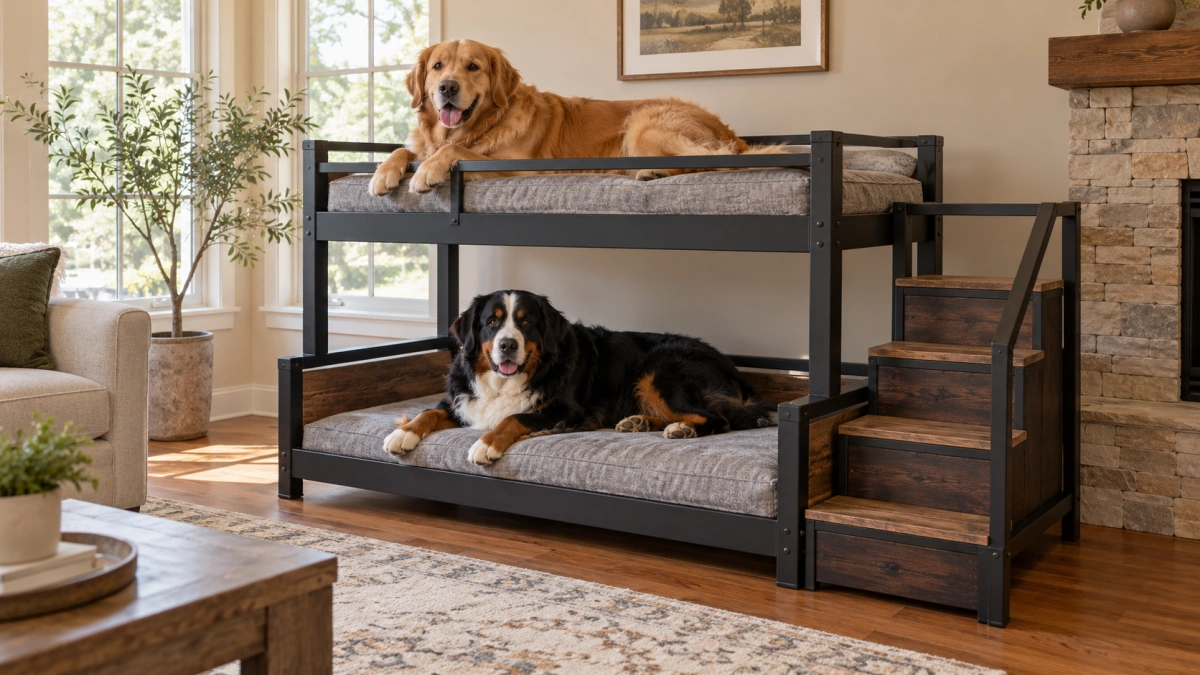
Dog bunk beds for large dogs require more attention to dimensions and structural specifications because a larger dog needs more sleeping area and places more load on the frame.
Before choosing a large dog bunk bed, check:
- Upper mattress length and width
- Lower mattress length and width
- Published weight capacity for the elevated level
- Overall frame stability
- Stair width
- Step depth
- Upper-edge protection
- Lower-bunk headroom
Terms such as “large,” “big dog,” and “XL” can mean different things between products. Use actual measurements whenever possible.
You should also check whether the published weight rating applies to the entire furniture piece or specifically to the upper platform.
Dog Bunk Beds With Stairs
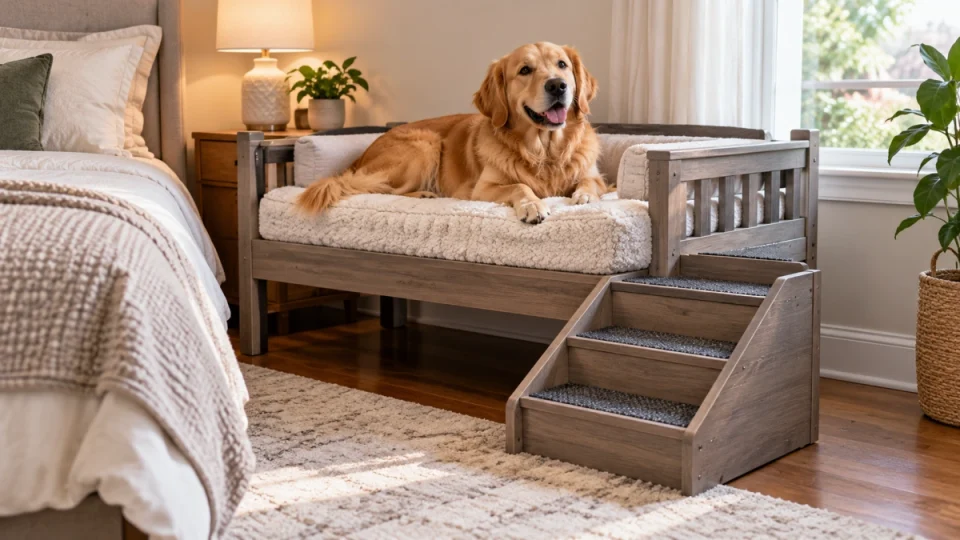
Stairs are a common way to reach the upper bunk because they can fit into a relatively compact area beside the frame.
When evaluating stairs, look at more than the number of steps.
Check:
- Step width
- Tread depth
- Surface traction
- Stair angle
- Attachment to the main frame
- The transition from the final step to the sleeping platform
Your dog should be able to place its paws securely on each step without slipping or twisting around a narrow corner.
If you are actually looking for a single elevated sleeping area with built-in access rather than a two-level bunk system, our guide to dog beds with steps covers that design in more detail.
Dog Bunk Beds With Ramps
A ramp replaces individual steps with one continuous inclined surface.
This can make the movement pattern simpler for some dogs, but a useful ramp still needs the right width, traction, and angle.
Before choosing a ramp design, check:
- How far the ramp extends into your room
- Whether the surface is non-slip
- Whether the ramp moves when your dog uses it
- Whether the incline looks manageable for your dog
- Whether there is enough landing space at the top
A very short ramp may save space but create a steep incline. A longer ramp can create a gentler path while using more floor area.
Stairs vs Ramp: Which Makes More Sense?
| Feature | Stairs | Ramp |
|---|---|---|
| Typical footprint | Shorter | Longer |
| Movement pattern | Repeated stepping | Continuous incline |
| Traction | Needed on each tread | Needed across the ramp surface |
| Space requirement | Often more compact | Requires more floor length |
| Best choice | Depends on your dog | Depends on your dog |
There is no universal winner. Your dog’s confidence, size, movement, and previous experience with steps or ramps all matter.
You should also consider your room. A theoretically comfortable ramp is not useful if it blocks a doorway or forces people to step around it constantly.
Top Bunk Safety: Weight Limits and Guard Edges
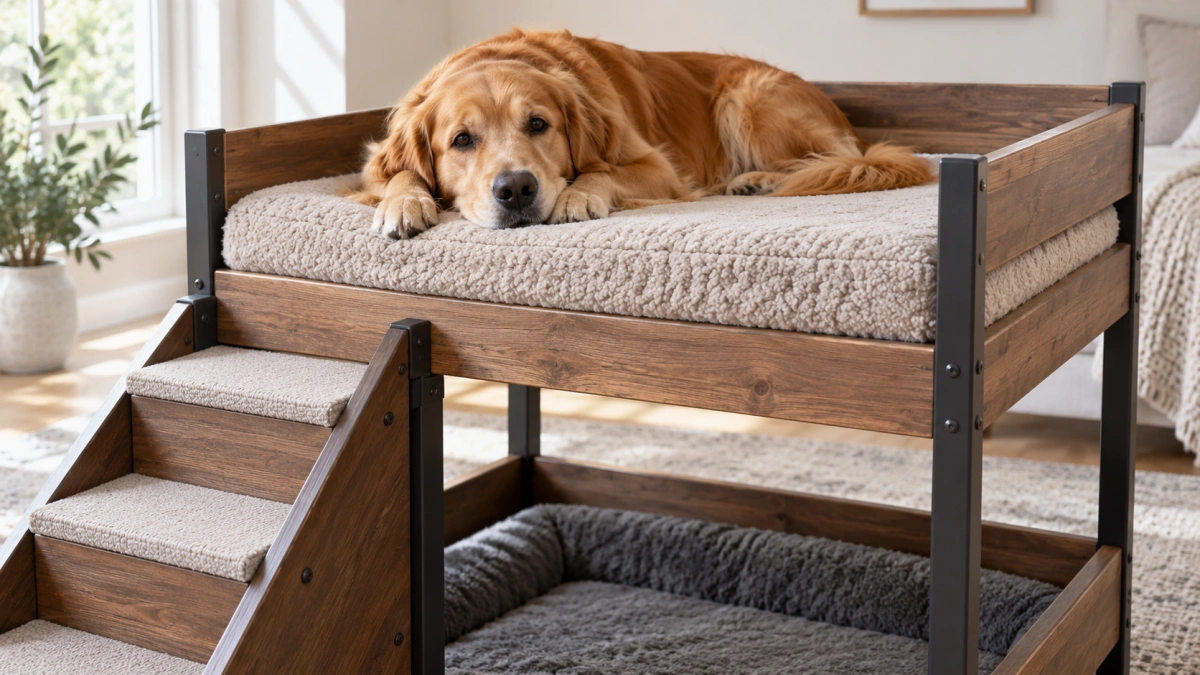
The top bunk deserves more attention than a floor-level bed because your dog is sleeping above the ground.
Check the upper level for:
- A clearly stated weight capacity
- A stable platform
- No obvious frame wobble
- Raised sides or protective edges
- A mattress that stays in position
- Enough room to turn around
- A secure entry point from the stairs or ramp
Do not estimate load capacity from how thick the wood or metal frame looks. Follow the manufacturer’s stated limits when they are available.
Raised edges can help define the sleeping area, but they should still leave enough usable room for your dog.
Check Lower-Bunk Headroom
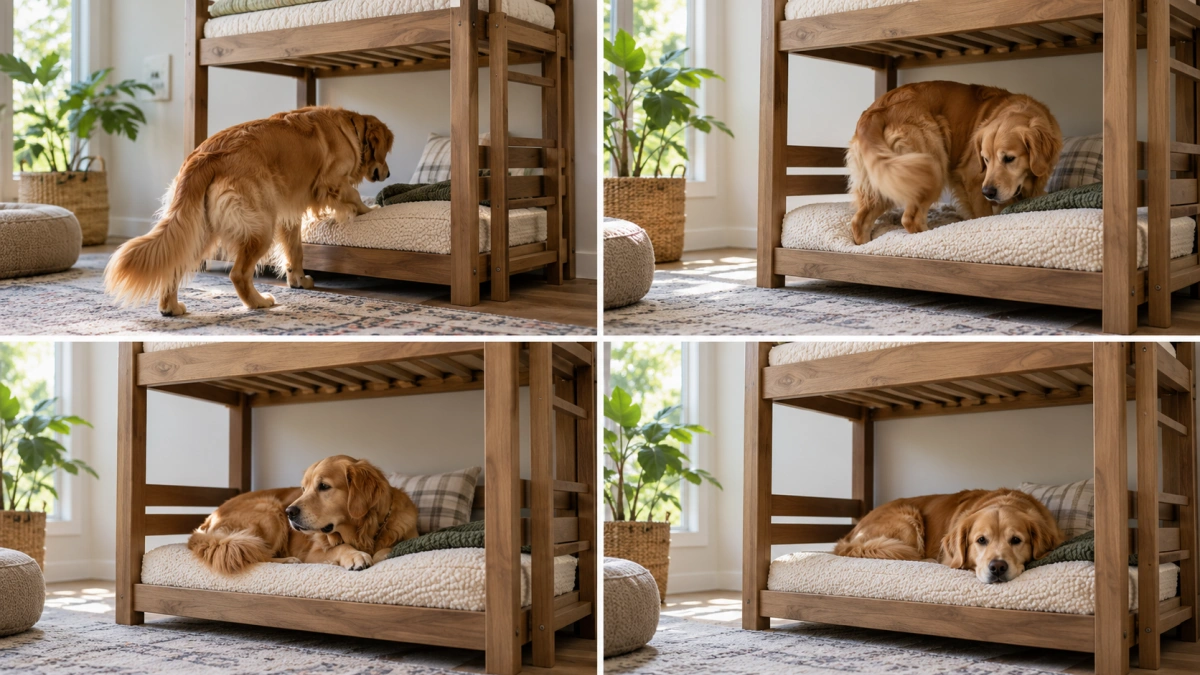
Lower-bunk space is easy to overlook because product photos usually emphasize the overall design rather than the internal clearance.
Measure or check the distance from the lower mattress surface to the bottom of the upper platform.
Then remember that mattress thickness reduces the available headroom.
Your dog should be able to:
- Enter without ducking excessively
- Turn around comfortably
- Lie down without feeling enclosed
- Stand or rise without repeatedly contacting the structure above
This is particularly important when the lower bunk will be used by the larger of your two dogs.
Which Dog Should Sleep on the Top Bunk?
You do not necessarily need to assign the top bunk based on which dog is smaller or younger. Watch which level each dog chooses naturally.
The dog using the upper bunk should be comfortable with:
- Climbing the provided access route
- Turning on the elevated platform
- Resting near the edge without trying to jump down
- Returning to the floor using the intended stairs or ramp
If one dog repeatedly chooses the lower bunk while the other confidently uses the upper level, allowing that preference can make the arrangement easier.
The bunk should give your dogs options rather than force one dog into an elevated sleeping position it does not enjoy.
Are Dog Bunk Beds Good for Multi-Dog Homes?
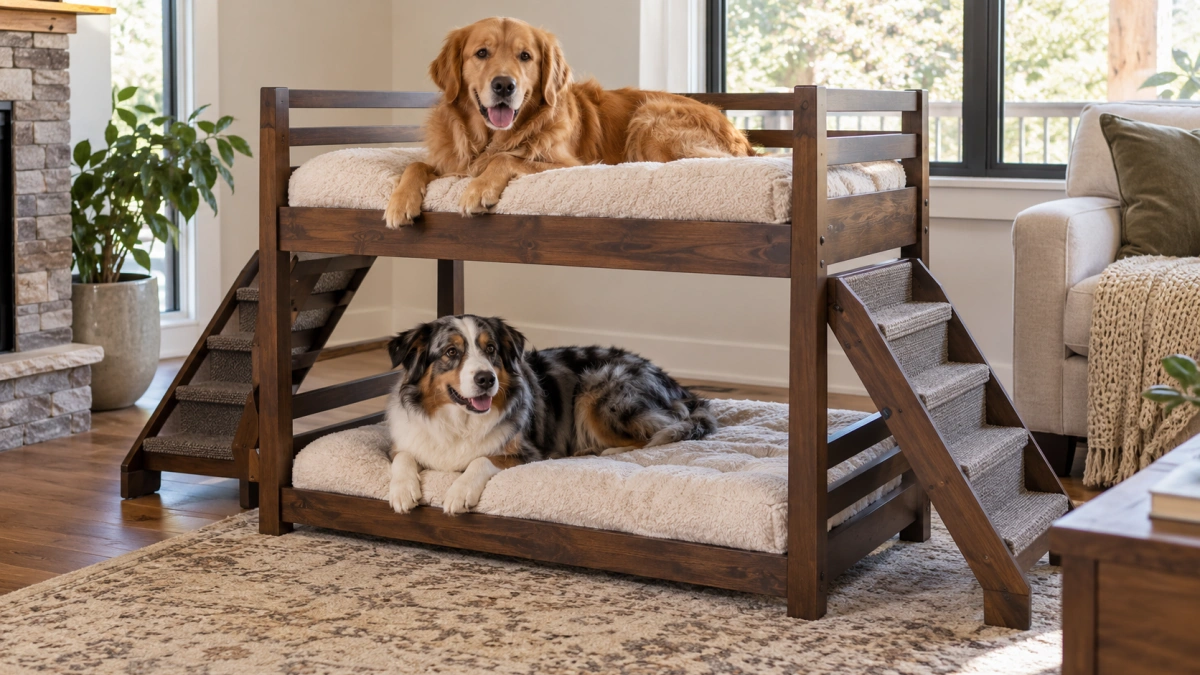
A dog bunk bed can work well when your dogs already feel comfortable resting near one another.
Ideally, both dogs should be able to:
- Reach their sleeping spaces independently
- Leave without passing through the other dog’s bed
- Rest without being crowded
- Choose different levels without conflict
Pay attention to the access route. If the lower dog regularly lies directly across the stairs, the dog above may have trouble leaving.
Likewise, if both dogs constantly compete for the same upper or lower level, two separate beds may work better than a bunk structure.
Helping Your Dogs Get Used to a New Bunk Bed
Your dogs may not immediately understand how you expect them to use a new piece of furniture.
Start by allowing them to investigate the lower area and access route without forcing them onto the upper platform.
You can make the transition easier by:
- Placing familiar bedding on each level
- Keeping the access route clear
- Allowing each dog to explore at its own pace
- Rewarding calm use of the stairs or ramp
- Avoiding physically placing a nervous dog on the upper bunk
If your dog consistently avoids the top level, the lower bunk may simply be the better sleeping space for that dog.
Where Should You Place a Dog Bunk Bed?
Placement affects both comfort and safety.
Choose an area where the bunk bed:
- Does not block a doorway
- Leaves a clear route around the stairs or ramp
- Sits on a stable floor surface
- Can be reached easily for cleaning
- Does not require your dogs to cross a busy walkway to enter
Avoid squeezing the furniture into a corner so tightly that you cannot remove the lower mattress or clean around the frame.
If the upper bunk is near another piece of furniture, check whether your dog could attempt to jump between surfaces instead of using the intended access route.
What About Triple Dog Bunk Beds?
Triple dog bunk beds extend the same space-saving idea to three levels, but additional height creates additional design considerations.
Check:
- The total height of the structure
- The published capacity for every level
- How each dog reaches its sleeping platform
- Whether upper levels have adequate protective edges
- Whether the frame remains stable when multiple dogs move at once
- Whether every sleeping area has enough usable space
A three-level design should not be chosen simply because it fits more dogs into a smaller footprint.
As furniture becomes taller, access, structural stability, and fall prevention become increasingly important.
If you are considering a custom or DIY triple bunk design, make structural strength and secure connections part of the design from the beginning rather than treating them as finishing details.
Mattresses, Covers and Cleaning
The frame may be the most noticeable part of a dog bunk bed, but your dogs actually sleep on the mattresses.
Check whether each level includes:
- A removable cushion or mattress
- A removable washable cover
- A secure mattress fit
- Enough cushioning for your dog’s preference
- Replacement covers or cushions when available
Bunk furniture can also create extra places for hair and debris to collect.
Common areas include:
- Stair corners
- Under the lower bunk
- Guard rails
- Frame joints
- The area where the ramp meets the floor
Before buying, think about whether you can reach these areas with your normal vacuum or cleaning tools.
When Should Your Dog Use the Lower Bunk Instead?
The top level is not the right sleeping space for every dog.
The lower bunk may be a better choice if your dog:
- Refuses to use the stairs or ramp
- Appears nervous at height
- Cannot turn comfortably on the upper platform
- Tries to jump directly from the top bunk
- Frequently loses footing on the access route
- Simply prefers resting closer to the floor
Do not force your dog to use the upper bunk simply because the furniture includes one.
If your dog suddenly becomes reluctant to climb stairs, jump, or move in ways it previously handled comfortably, consider discussing the change with your veterinarian.
Dog Bunk Bed Buying Checklist
Before choosing a dog bunk bed for your home, work through this checklist:
- Measure the usable sleeping area on every level
- Check the upper-level published weight limit
- Measure lower-bunk headroom after accounting for mattress thickness
- Choose stairs or a ramp your dog can use confidently
- Check tread or ramp traction
- Look for a stable, wobble-resistant frame
- Check upper-level raised edges or guards
- Make sure mattresses stay securely in position
- Confirm each dog can enter and leave independently
- Measure the complete floor footprint, including stairs or ramps
- Check whether mattress covers are removable and washable
- Make sure you can reach the frame for routine cleaning
Final Thoughts
Dog bunk beds can be a practical option when you want to create separate sleeping areas for multiple dogs without filling your room with several floor beds.
The best choice is not necessarily the tallest, most decorative, or most compact design. Focus on how the furniture will actually work for your dogs.
Measure each sleeping level, check the published weight limits, compare stairs with ramps, inspect upper-level edges, confirm lower-bunk headroom, and make sure both dogs can enter and leave comfortably.
When the dimensions, access, and sleeping preferences all match your dogs, a bunk bed can turn vertical space into a practical part of your home’s pet sleeping setup.