By
By 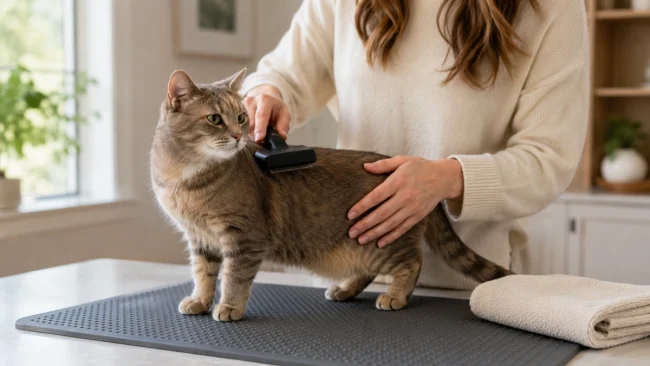
The safest cat grooming restraint is usually the least restraint that allows you to complete a short grooming task without frightening, hurting, or overpowering the cat. Before trying to hold a squirming cat more firmly, improve the environment, shorten the task, and pay attention to what the cat is telling you.
Many cats cooperate better when they can keep a natural position, stand on a non-slip surface, receive only light body support, and leave before frustration becomes intense.
This low-stress approach fits naturally into grooming a cat. For the complete home routine, including brushing, coat checks and handling preparation, see our cat grooming at home guide.
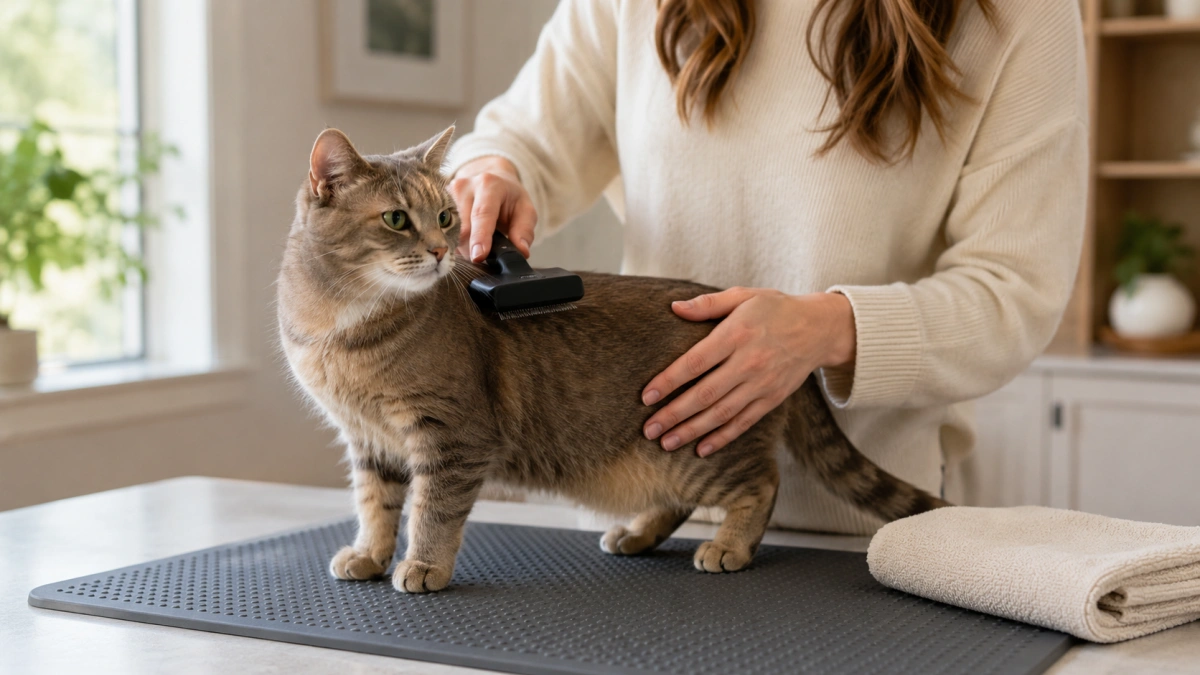
Start by Asking Why Your Cat Will Not Stay Still
Squirming is not a single behavior with a single solution.
Your cat may be excited, uncertain, afraid of the tool, uncomfortable with the body area being touched, frustrated by a long session, or reacting to pain.
If you treat every type of movement as a restraint problem, you may miss the real cause.
| What You Notice | Possible Reason | Better First Response |
|---|---|---|
| Cat walks away immediately | Low grooming tolerance | Shorten the session |
| Cat dislikes one tool | Tool sensation | Try a gentler tool |
| Cat reacts to one body area | Sensitivity or discomfort | Stop and reassess |
| Cat slips and keeps repositioning | Unstable surface | Add a non-slip mat |
| Cat tolerates a few strokes, then fights | Session is too long | Finish earlier |
| Previously calm cat suddenly resists | Possible discomfort or pain | Consider veterinary evaluation |
Improve the Grooming Setup Before Adding Restraint
A cat trying to balance on a slippery table is more likely to move, brace, or escape.
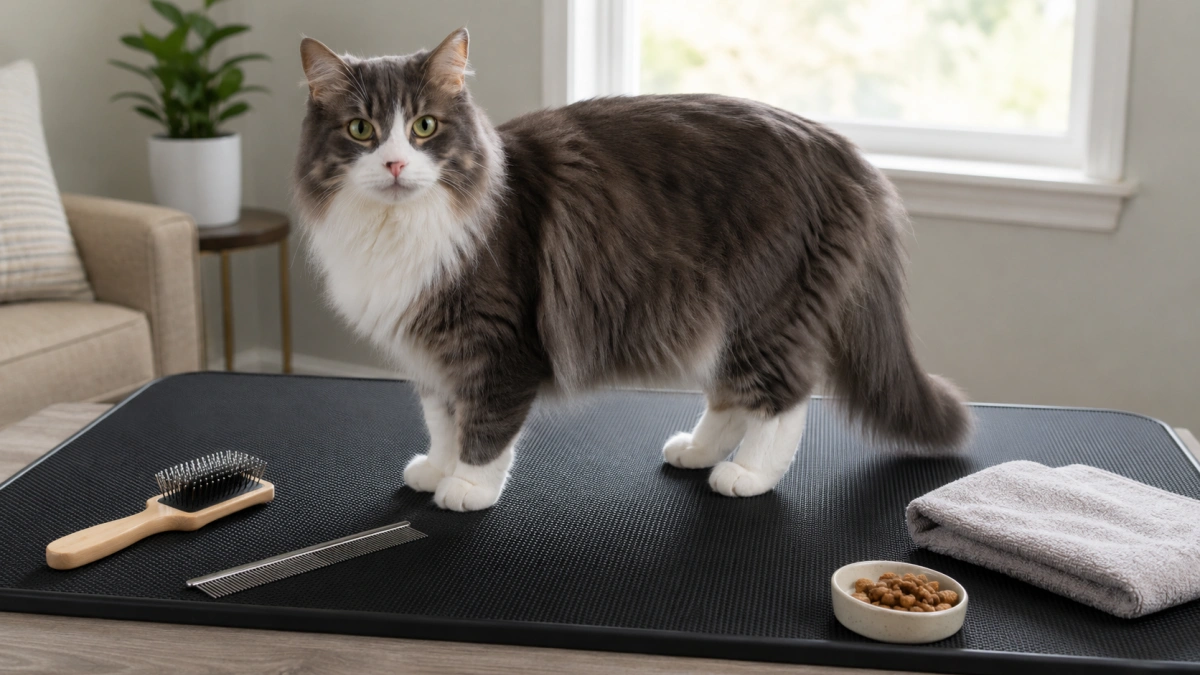
Use a stable low surface with good traction. A rubber-backed mat or securely positioned towel can give the paws something to grip.
Also reduce distractions.
- Choose a quiet room.
- Keep dogs and other cats away.
- Have all tools ready before bringing the cat over.
- Avoid repeatedly leaving and returning during the session.
- Keep the grooming area predictable.
Use the Minimum Amount of Physical Support
Many cats need some physical guidance during grooming, but guidance is different from immobilization.
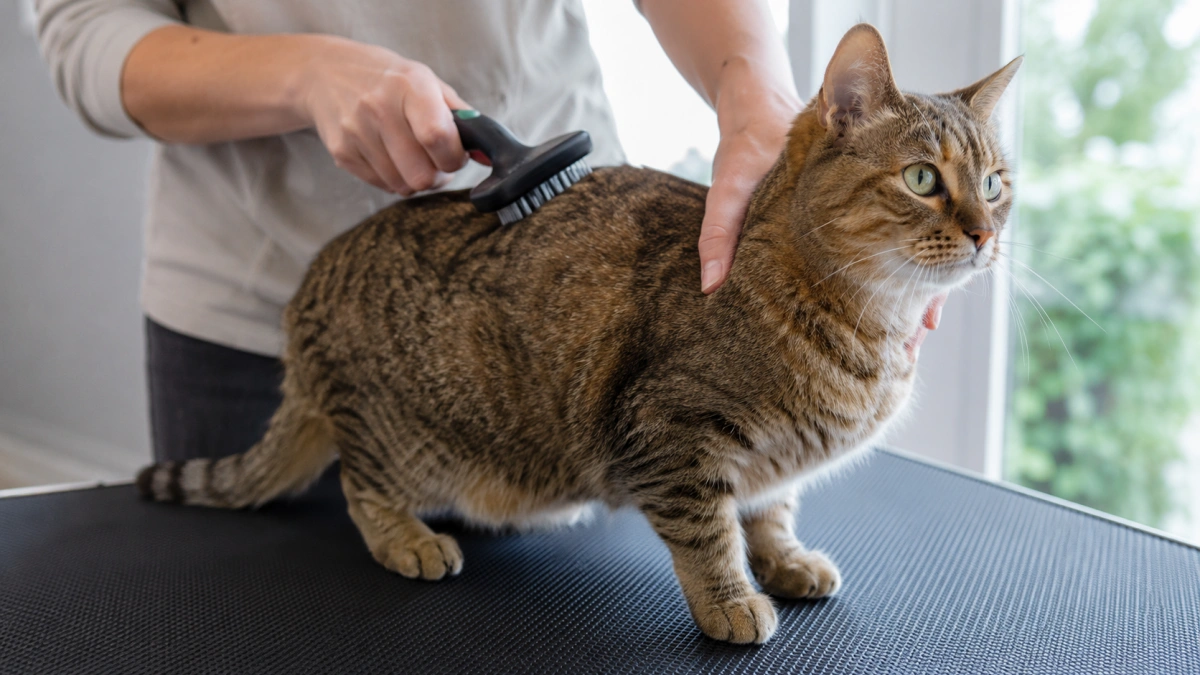
When your cat is standing or sitting comfortably, light contact around the shoulders or body may be enough to keep the cat oriented while you make a few grooming strokes.
Keep your hands relaxed and pay attention to whether the cat is becoming more settled or more determined to escape.
If you continuously need to increase pressure, the current technique is not working.
Let Your Cat Keep a Natural Position
You usually do not need to turn a cat onto its back to perform ordinary brushing, combing, or many nail-care tasks.
Cats often feel more secure when all four paws are supported and they retain some control over their body position.
Work around the position your cat already finds comfortable when possible instead of constantly repositioning the entire body.
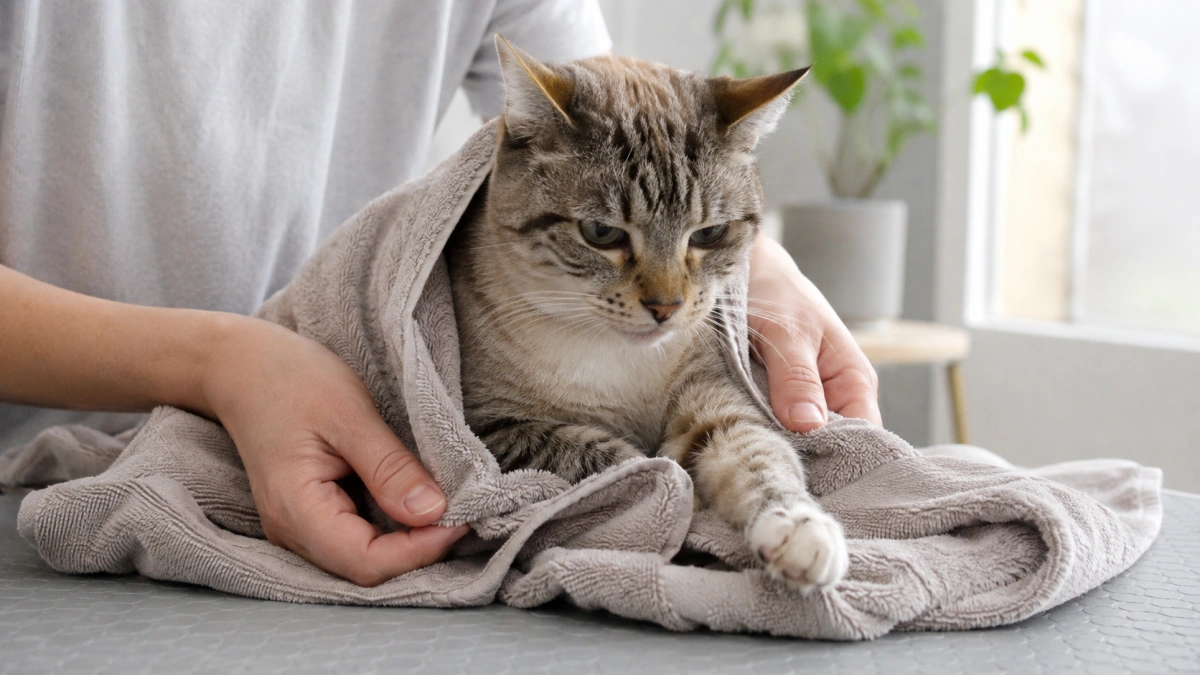
Can You Use a Towel for Cat Grooming?
A soft towel can be useful as a handling aid for some cats.
Its purpose is to provide traction, gentle containment, or a sense of partial cover—not to compress the cat tightly until movement becomes impossible.
For a short task, you may be able to loosely surround the body with a large towel while keeping the cat in a comfortable upright or side position.
If the cat begins fighting the towel itself, stop rather than wrapping progressively tighter.
Do You Need a Cat Grooming Harness or Restraint Device?
A restraint product is not automatically safer than your hands, a towel, or a better grooming setup.
A harness may help manage some cats in specific circumstances, but it should not be used to suspend a cat, force the body into an unnatural position, or continue grooming after the cat has become highly distressed.
Similarly, a grooming bag or other restrictive device should not become a way to overpower a cat that is telling you the session needs to stop.
The decision should be based on whether the tool reduces stress and improves safe control—not simply whether it prevents escape.
Learn the Early Signs That Your Cat Needs a Break
Do not wait for hissing, biting, or scratching before deciding the session has become too stressful.
Earlier signs can include:
- Repeated tail flicking
- Increasing body tension
- Ears rotating sideways or backward
- Turning repeatedly toward your grooming hand
- Trying to step away
- Skin twitching
- Suddenly refusing treats
- Becoming unusually still and rigid
A very still cat is not always a relaxed cat. Look at the whole body rather than assuming lack of movement equals cooperation.
Shorter Grooming Sessions Often Work Better Than Stronger Restraint
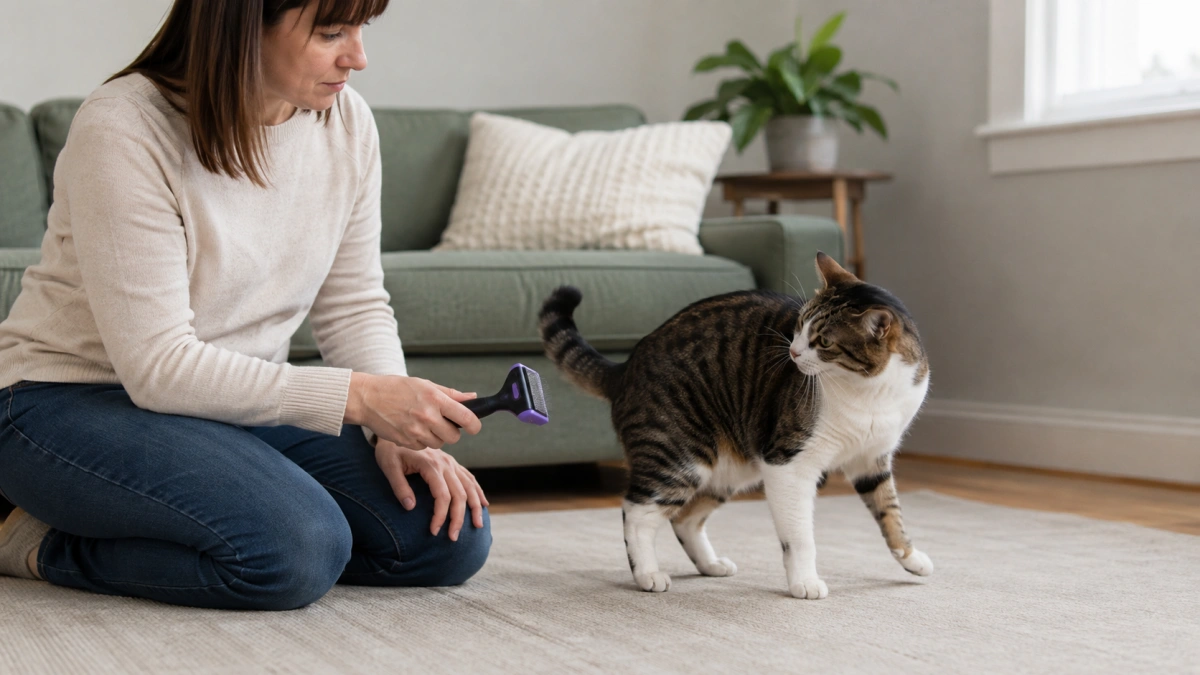
If your cat comfortably tolerates thirty seconds of grooming but becomes difficult after two minutes, the problem may simply be that the session is too long.
You do not need to complete the entire cat every time.
Brush the back today. Check the chest later. Handle one paw during another short session.
Splitting the grooming task into pieces can reduce the need for physical restraint altogether.
Use Positive Reinforcement Before Your Cat Is Already Upset
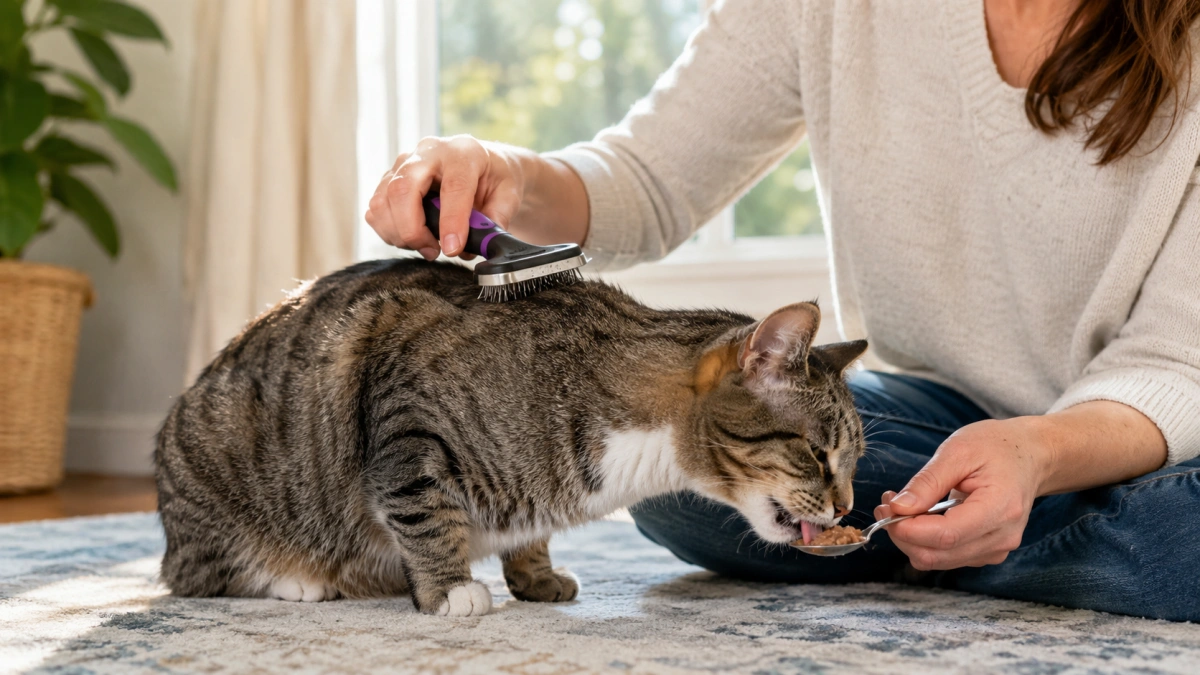
Treats work best when they are part of the grooming routine from the beginning, not only brought out after the cat has already become highly stressed.
You can build a simple sequence:
- Show the grooming tool.
- Give a small reward.
- Make one or two gentle grooming strokes.
- Reward calm behavior.
- End while the cat is still doing well.
Over time, this can make ordinary handling more predictable and less threatening.
What About Nail Trimming?
Nail trimming is one of the most common reasons owners look for stronger restraint.
Instead of trying to trim all claws in one session, practice the component behaviors separately.
- Touch a paw briefly.
- Reward.
- Hold the paw slightly longer another day.
- Press gently to expose one claw.
- Reward again.
- Trim one or two nails when your cat is comfortable.
One successful paw is better than a full nail trim that turns into a struggle.
When Can a Second Person Help?
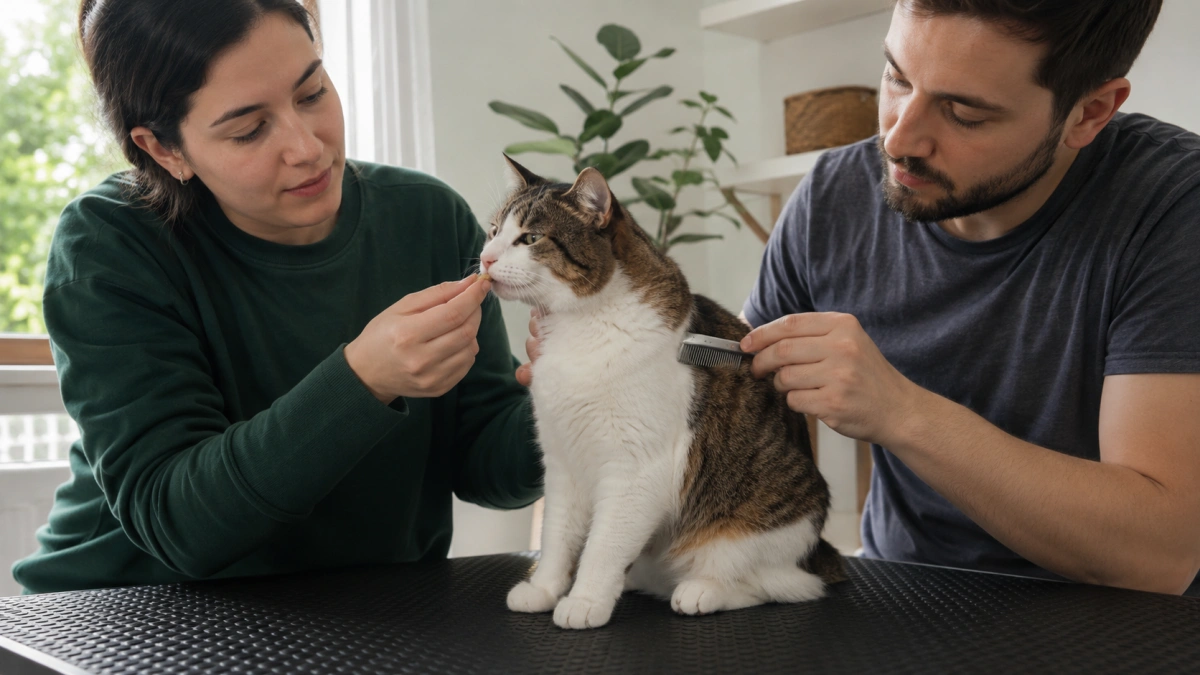
For some grooming tasks, a second calm person can be useful.
One person can provide light body support or offer a reward while the other focuses on the grooming tool.
This is different from having several people hold different parts of the cat down.
If two people still cannot perform the task without escalating force, stop rather than adding more restraint.
Should You Scruff a Cat for Grooming?
Routine home grooming should not depend on grabbing a cat by the loose skin at the back of the neck and using that as the primary restraint method.
Modern cat-friendly handling focuses on minimizing restraint and supporting the cat in comfortable positions whenever possible.
If a grooming task cannot be completed without escalating to forceful handling, the better question is whether the task should continue at home.
Do Not Suspend a Cat in a Grooming Restraint
A cat should not be left hanging from a harness, sling, collar, or other restraint in an attempt to make grooming easier.
The body should remain properly supported on a stable surface.
Any equipment that places pressure on the neck, interferes with normal breathing, or removes physical support should not be used as a home-grooming shortcut.
What If the Grooming Problem Is a Mat?
A cat that will not stay still while you are pulling on a tight mat may be reacting because the mat itself is painful.
Increasing restraint does not solve that problem.
If you are dealing with compact or skin-level mats, read our guide to grooming matted cat fur safely before attempting more handling.
When Stronger Restraint Is a Sign to Stop
Use this practical rule:
If every failed attempt leads you to search for a stronger way to hold the cat, the grooming plan needs to change.
Stop and reconsider the task when:
- Your cat is becoming progressively more frightened.
- You cannot keep hands or tools safely controlled.
- The grooming procedure appears painful.
- The cat is biting or repeatedly attempting to bite.
- Several restraint methods have already failed.
- You are considering increasingly restrictive equipment.
- You cannot complete the task without pinning or overpowering the cat.
When Should You Use a Professional Groomer?
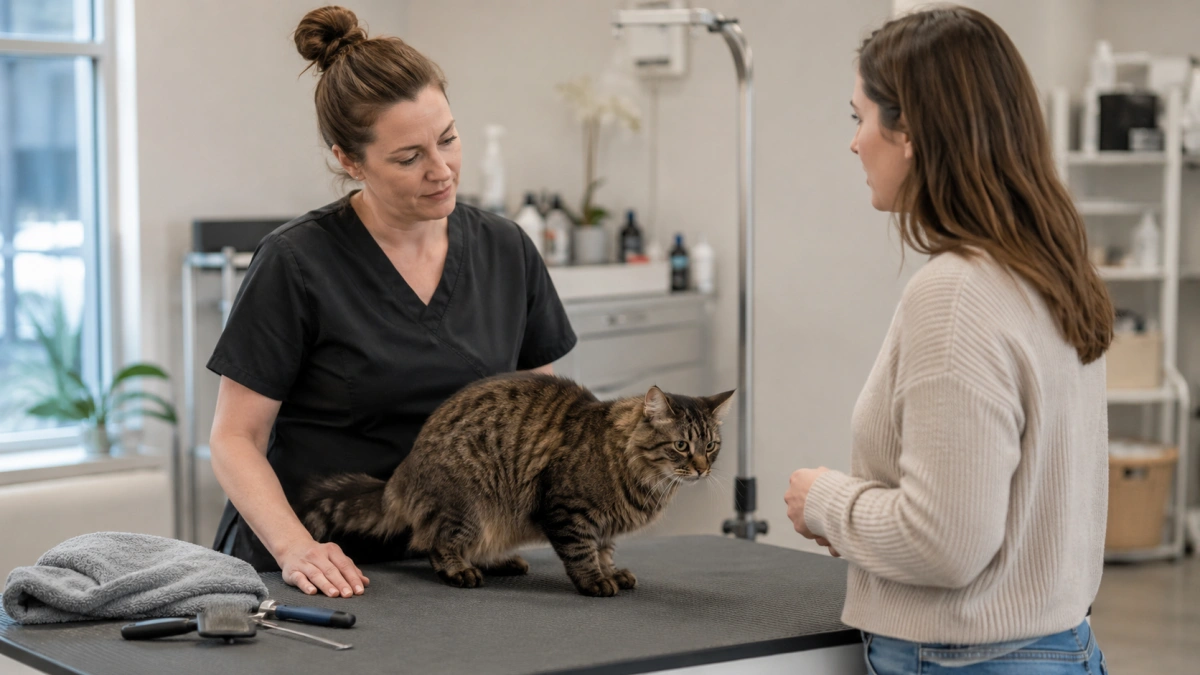
A feline-experienced groomer is useful when the grooming itself is necessary but the handling difficulty exceeds your home skills.
Examples include:
- Essential coat maintenance you cannot safely perform
- Sanitary trimming
- Difficult nail care
- Mat removal
- Clipping or haircuts
- Cats that require experienced handling
When Should You Talk to a Veterinarian?
A sudden change in grooming tolerance can be important.
Contact your veterinarian when:
- A previously cooperative cat suddenly resists touch.
- One body area seems painful.
- Your cat’s mobility has changed.
- Normal self-grooming has decreased significantly.
- A required grooming procedure may need medical support.
- You are considering medication to make grooming possible.
Do not give sedating or calming medication for grooming unless your veterinarian has prescribed it for your individual cat and given you instructions for its use.
A Low-Stress Cat Grooming Restraint Checklist
| Before Adding More Restraint | Check This First |
|---|---|
| Cat keeps moving | Is the surface slippery? |
| Cat walks away | Is the session too long? |
| Cat dislikes the brush | Would a softer tool work? |
| Cat reacts to one area | Could the area be uncomfortable? |
| Cat fights towel wrapping | Reduce containment instead of tightening |
| Two people still cannot manage safely | Stop and use professional help |
| You think medication is needed | Talk to your veterinarian |
Final Thoughts
Cat grooming restraint should be about supporting cooperation, not defeating resistance.
Start with traction, a quiet environment, a natural body position, short sessions, light physical support, and rewards. Use a towel only as gentle containment when it genuinely makes the cat more comfortable.
If each attempt requires stronger restraint than the last, stop escalating. A shorter grooming plan, professional feline groomer, or veterinary guidance is safer than turning routine grooming into a physical struggle.