By
By 
Donut dog beds are round beds with a raised padded ring surrounding a recessed center sleeping area. Their shape is especially popular with dogs that like to curl up, lean against an edge, or sleep in a more enclosed circular space.
But the biggest sizing mistake is easy to make: the outside diameter of a donut bed is not the same as the space your dog can actually sleep in. A thick raised rim can take up a large part of the total width, leaving a much smaller center area than the product dimensions may suggest.
Before choosing a donut or round dog bed, look at your dog’s sleeping position, the inner sleeping area, rim thickness, center cushion construction, cover design, and how much floor space the bed will use in your home.
You can also explore our complete Dog Beds hub for more guides about dog bed shapes, sizing, materials, and comfort features.
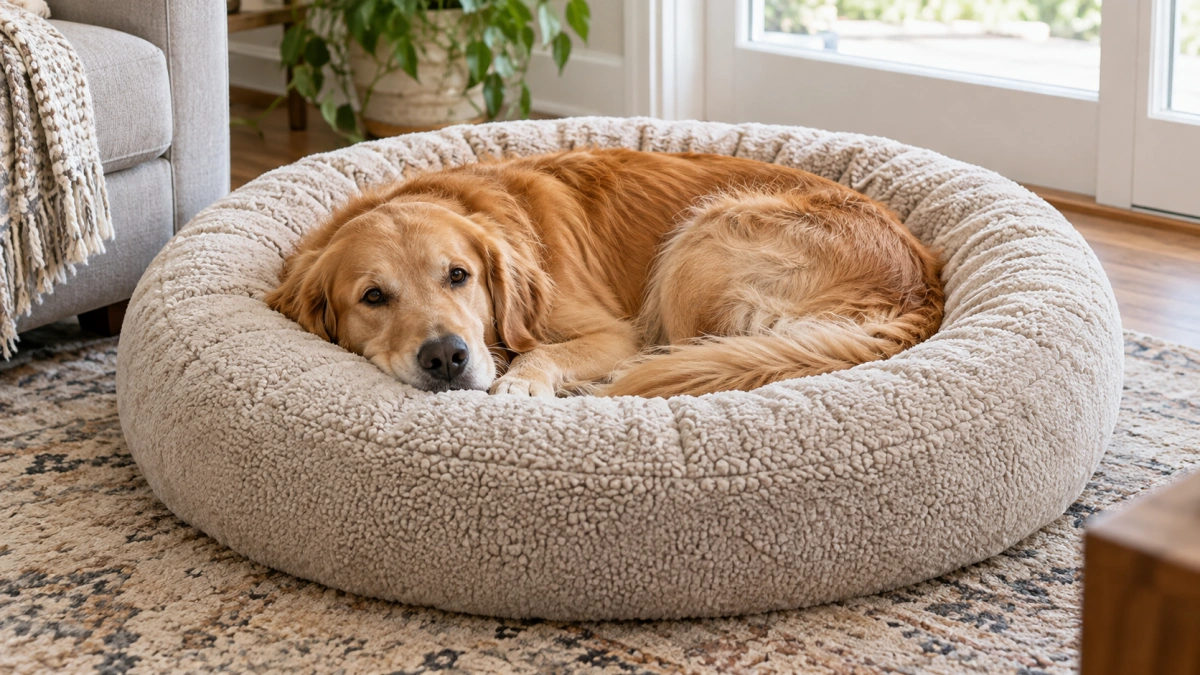
What Is a Donut Dog Bed?
A donut dog bed usually combines three features:
- A round or circular outer shape
- A continuous raised padded rim
- A softer or recessed sleeping area in the center
The raised ring gives your dog something to rest against, while the center creates a defined sleeping area.
Some donut beds are extremely fluffy and soft, while others use a more structured foam base with a padded rim. The shape may look similar, but the internal construction can be very different.
That is why you should not judge a donut bed only by how plush the outer ring looks.
Are Round Dog Beds and Donut Beds the Same?
Not exactly.
“Round dog bed” describes the overall shape. A round bed can be a simple circular cushion, a flat pillow bed, a bolster bed, or a donut-style bed.
A donut bed is more specific because it usually has a raised ring surrounding the center.
| Bed Type | Main Shape | Raised Rim | Sleeping Area |
|---|---|---|---|
| Round pillow bed | Circular | Usually none | Open across most of the bed |
| Round bolster bed | Circular | Partial or full | Center surrounded by padded sides |
| Donut dog bed | Circular | Usually continuous | Recessed center area |
Most donut beds are round, but not every round dog bed is a donut bed.
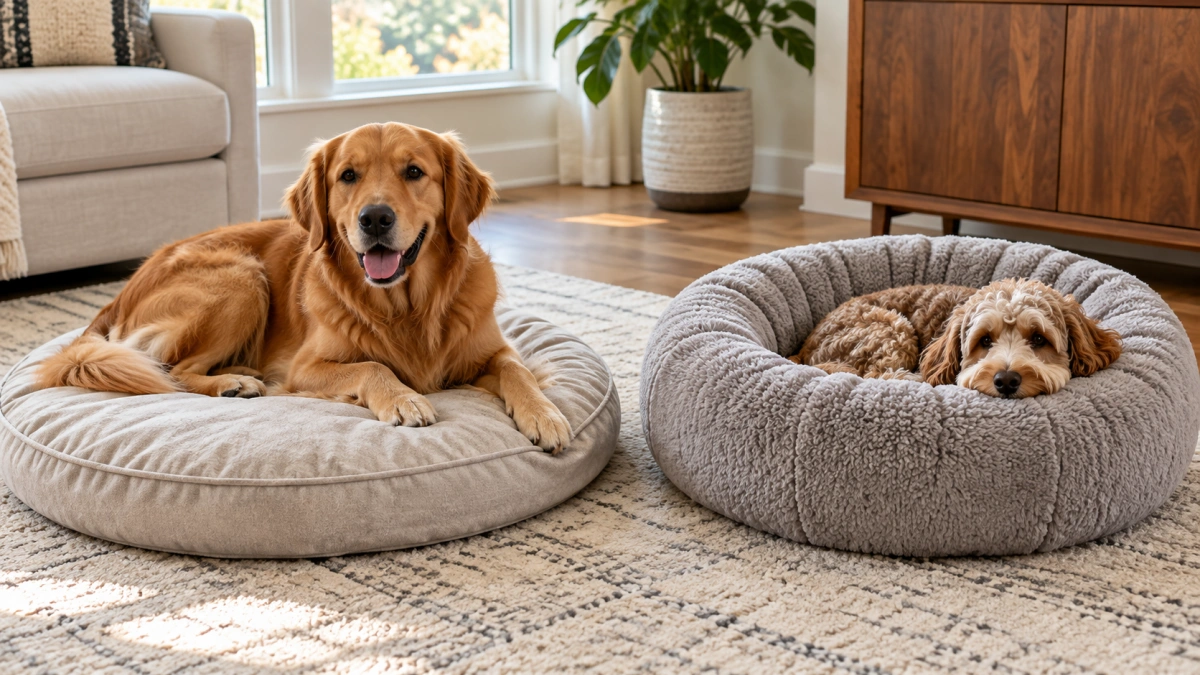
Match the Shape to Your Dog’s Sleeping Position
Your dog’s normal sleeping position is one of the best clues for deciding whether a donut bed makes sense.
A donut-style bed may suit your dog if it often:
- Curls into a compact position
- Rests its head against cushions
- Leans against the edge of a bed
- Prefers sleeping inside a defined boundary
A round bed may be less ideal if your dog usually stretches its legs fully in a straight line.
In that case, the circular center may limit usable length even if the outer bed looks large.
Watch how your dog sleeps on the floor or its current bed before deciding which shape to buy.
Why Outer Diameter Can Be Misleading
The outer diameter is usually the most visible size listed for a donut bed, but it does not tell you how much room your dog actually gets.
The raised ring takes up part of the total diameter.
For example:
- A thick rim reduces the center sleeping area
- A taller rim may also be wider at the base
- A deep recessed center can feel smaller than the outside measurements suggest
When comparing two beds with the same outer diameter, the one with a thinner ring may provide noticeably more usable sleeping space.
This is why inner dimensions matter so much with donut and round bolster beds.
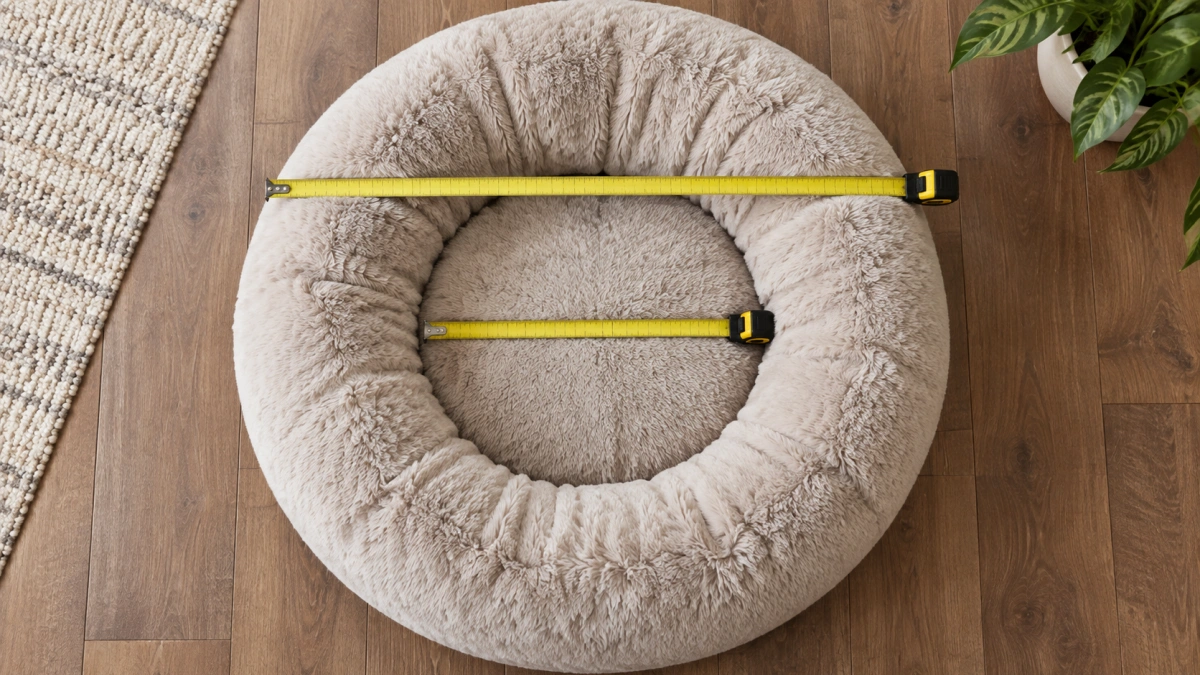
How to Measure Your Dog for a Donut Bed
Instead of choosing a size only from your dog’s weight, start by watching how much space your dog uses when naturally curled.
A practical process is:
- Wait until your dog is resting naturally.
- Look at the space occupied in its normal curled position.
- Measure the approximate length and width of that sleeping area.
- Compare those measurements with the bed’s inner sleeping dimensions.
- Leave enough room for your dog to turn and change position.
If your dog sometimes stretches out as well as curls up, choose more interior space rather than sizing only for the tightest curled position.
Do not assume that a manufacturer’s Small, Medium, Large, or XL label will match the same dimensions used by another brand.
Donut Dog Beds for Large Dogs
Large donut dog beds can look enormous from the outside while still providing a surprisingly limited center area.
For a large dog, focus on:
- Inner sleeping diameter
- Center cushion width
- Rim thickness
- Rim height
- Base construction
- Total floor footprint
If your dog likes to stretch, an oversized outer diameter may still not be enough if most of that size comes from a thick padded ring.
You should also consider how much the center compresses under your dog’s weight. A very fluffy center may look deep before use but flatten considerably once your dog lies down.
For large dogs, usable interior area usually matters more than the marketing size name.
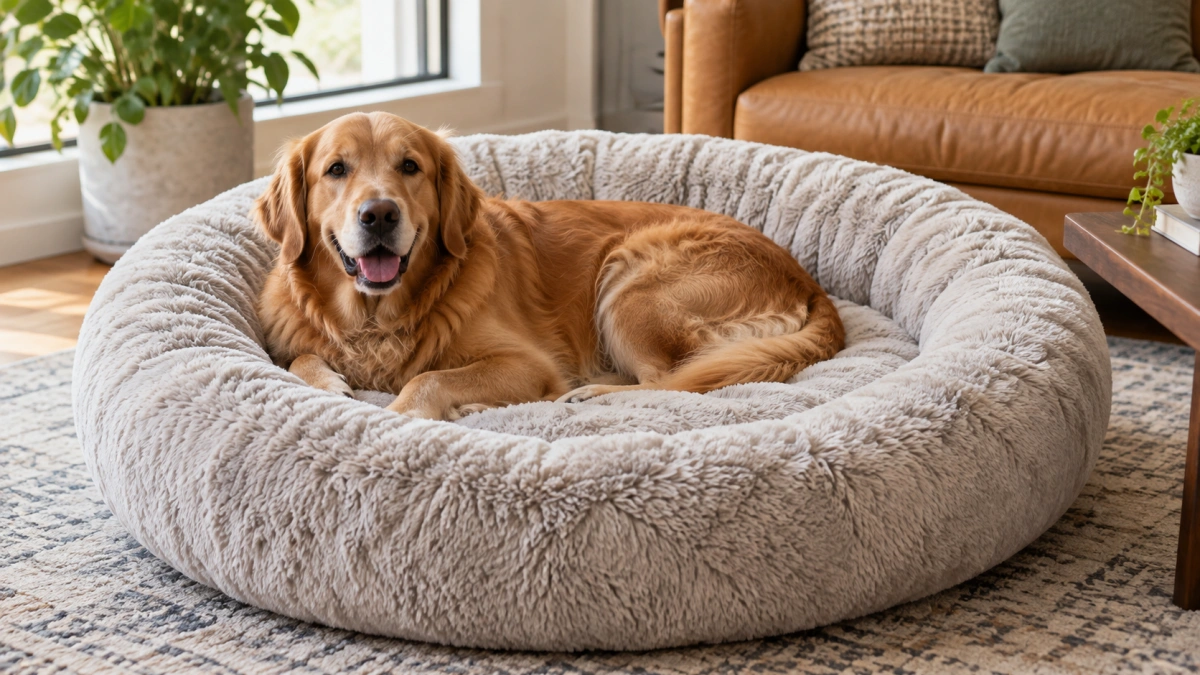
Donut Dog Beds for Small Dogs
A small dog does not automatically need the smallest donut bed available.
If the center is too tight, your dog may have little room to reposition or stretch its legs.
For a small dog, check whether the center allows it to:
- Curl comfortably
- Turn around easily
- Lie on its side
- Change position without constantly resting on the rim
A slightly larger donut bed can still feel cozy because the raised ring maintains the circular shape around your dog.
Choose based on the inner area, not simply because the packaging says the size is intended for small dogs.
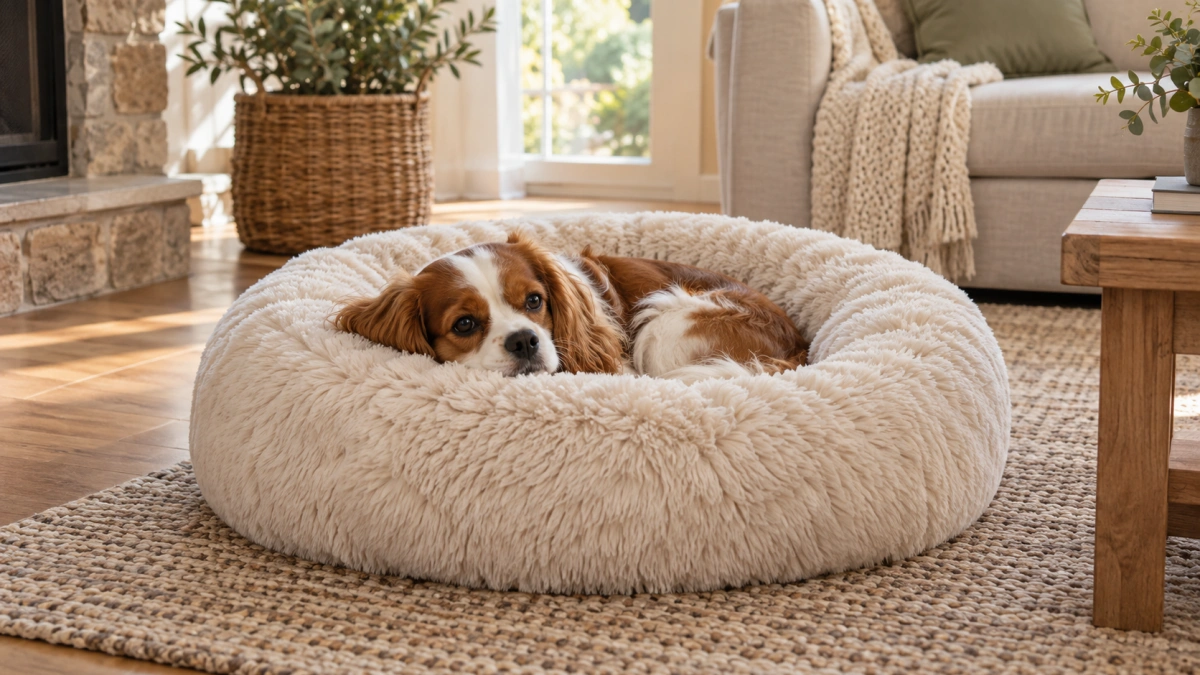
How High and Thick Should the Rim Be?
The padded ring is one of the defining features of a donut bed, but a larger rim is not always better.
A thicker or taller rim can provide more surface for your dog to lean against, but it also:
- Reduces the center sleeping area
- Raises the entry height
- Increases the overall footprint
- Adds more material that may need cleaning
Think about how your dog enters the bed.
If your dog steps easily over soft edges, a thicker rim may not be a problem. If your dog prefers a low entry, look for a shallower ring or lower-profile design.
Check the Center Cushion, Not Just the Rim
The rim gets most of the visual attention, but your dog spends most of its sleeping time on the center cushion.
Check:
- Center fill thickness
- Whether the center has a separate insert
- How much the cushion compresses
- Whether filling shifts toward the edges
- Whether the base stays evenly padded
A very fluffy outer ring does not tell you whether the center provides a comfortable sleeping surface.
Some donut beds use mostly fiber filling, while others combine a structured base with a padded outer ring. These designs may feel very different even when they look similar in photos.
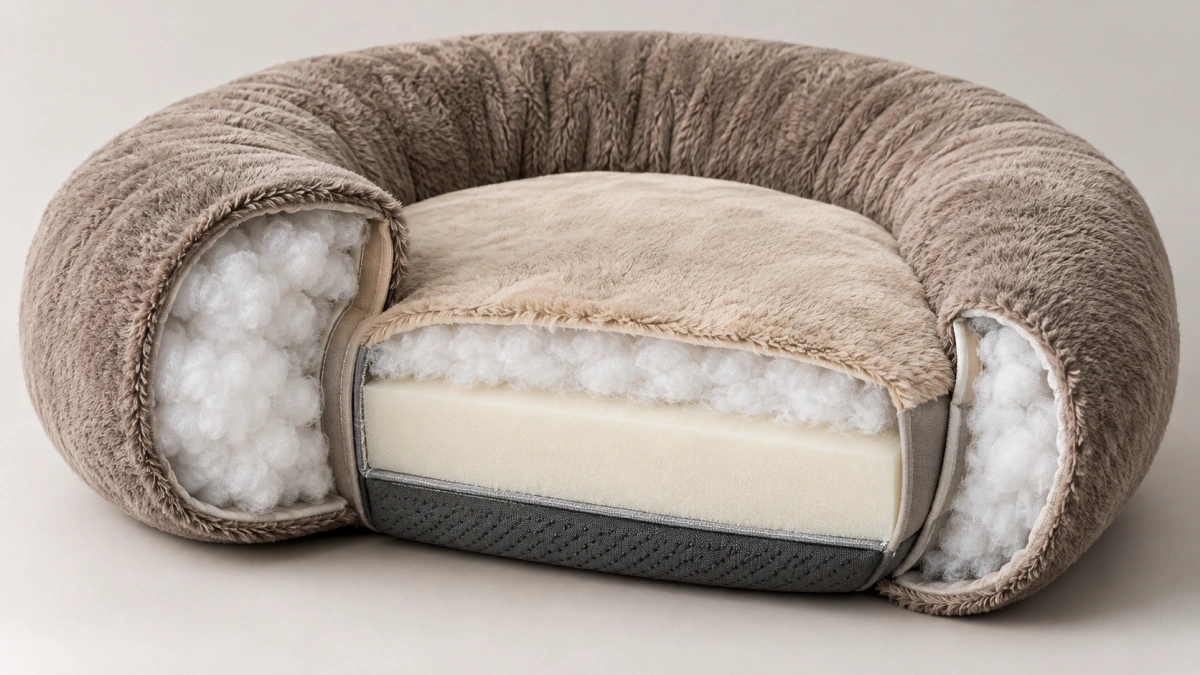
Softness vs Support in a Donut Bed
Softness and support are separate qualities.
A bed can feel extremely fluffy while still compressing close to the floor under your dog’s body.
When comparing donut beds, consider:
- How thick the center is before use
- How much it compresses under weight
- Whether the fill stays evenly distributed
- Whether there is a separate supportive base
- How easily the center regains its shape
This is especially important for larger dogs because their weight compresses soft fill more noticeably.
Do not assume that a deep-looking center automatically provides more support.
Will the Bed Hold Its Shape?
Donut beds can lose their original shape over time if the filling shifts or compresses repeatedly.
Features that may help with shape retention include:
- Separate center and rim inserts
- Internal filling compartments
- Structured foam sections
- Dense or evenly distributed fill
- Replaceable or refillable inserts
A bed with one large loose-filled cavity may require more frequent reshaping than a design that separates the center from the outer ring.
You should also check whether the bed can be refluffed or whether individual inserts can be replaced if one section wears faster than another.
Does Your Dog Sleep Hot?
Many donut beds use plush fabrics, faux fur, sherpa-style surfaces, and thick padded rings.
These materials can feel warm and cozy, but not every dog prefers that temperature.
If your dog frequently leaves a soft bed to lie on tile, wood, or another cool surface, pay attention to fabric and insulation rather than choosing the fluffiest option.
You may want to consider:
- Smoother cover fabrics
- Less dense plush material
- A lower-profile rim
- A more open round cushion
- Placement away from heating vents or direct sun
Your dog’s existing sleeping habits can tell you whether extra warmth is likely to be welcome.
Cleaning Round and Donut Dog Beds
Cleaning becomes especially important as donut beds get larger.
A small bed may fit into a washing machine as one piece, but an XL round bed may be too bulky to wash or dry conveniently.
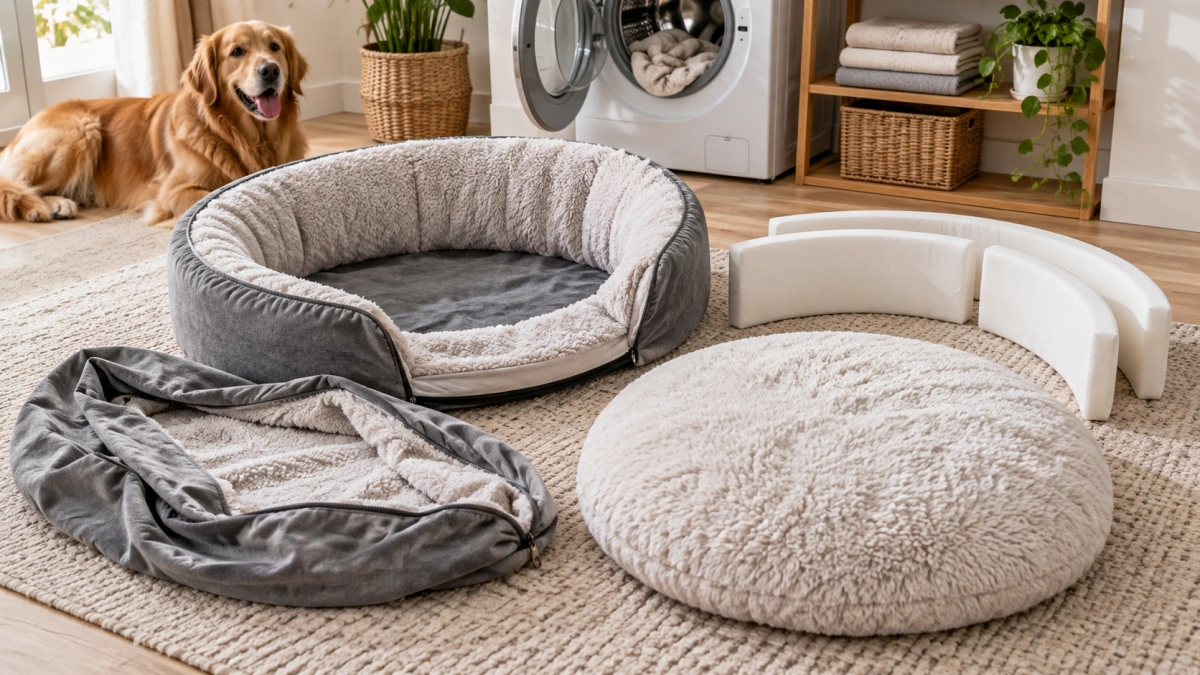
The easiest designs usually separate the bed into multiple components.
Look for:
- A removable outer cover
- A removable center insert
- Separate rim inserts
- Accessible zippers
- Clear washing and drying instructions
A product described as “machine washable” may still require washing the entire bulky bed, so check exactly which parts can be removed.
If you have a large dog or limited laundry capacity, removable components can make routine maintenance much easier.
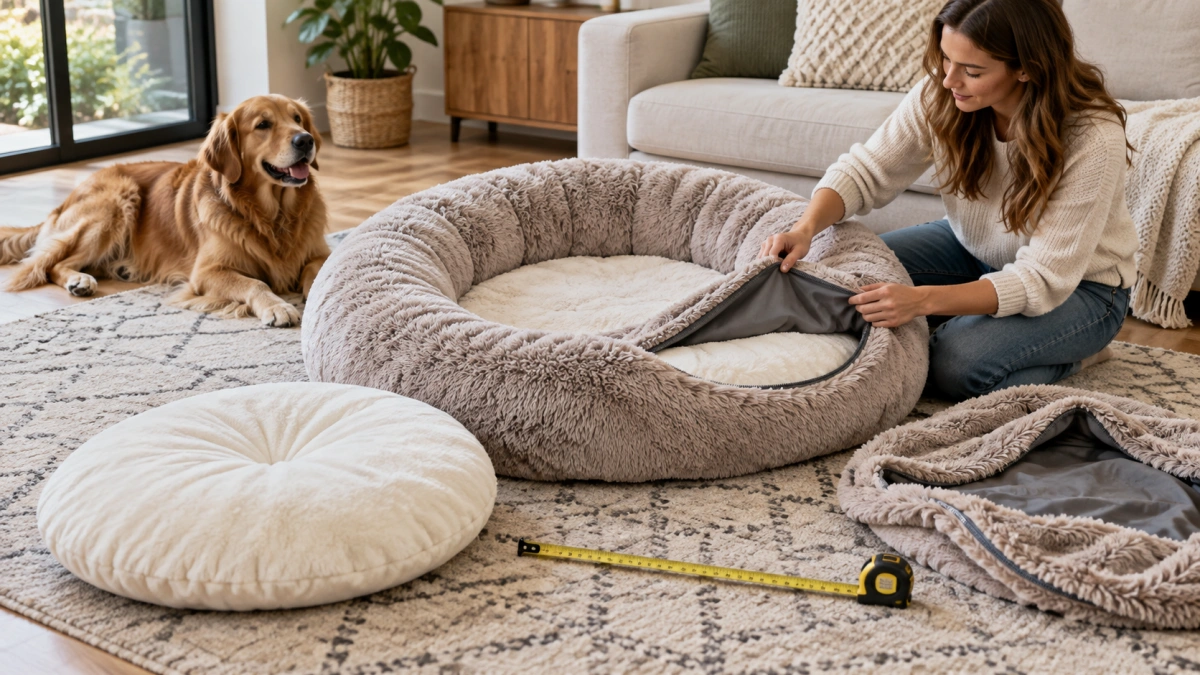
How Much Floor Space Does a Large Round Bed Need?
Round beds can use more room than they appear to in product photos.
A large circular bed needs enough floor area in every direction, not just along one wall.
Before buying, check:
- Total outer diameter
- Walking space around the bed
- Clearance from doors and furniture
- Whether you can remove the cover easily
- Whether the bed blocks a common walkway
You can outline the expected diameter on your floor with removable tape before ordering.
This is especially useful for oversized round beds because their footprint can be much larger than a rectangular bed placed against a wall.
Donut Beds vs Pillow and Bolster Beds
Donut beds, pillow beds, and bolster beds can all provide soft sleeping surfaces, but the shape and usable area are different.
| Bed Type | Main Design | Typical Sleeping Fit |
|---|---|---|
| Donut bed | Round center with continuous padded ring | Dogs that often curl or lean into a surrounding edge |
| Pillow bed | Open cushioned surface | Dogs that stretch or change positions frequently |
| Bolster bed | Flat center with raised sides | Dogs that like a headrest while keeping more open space |
If your dog prefers an open sleeping surface or raised support on only part of the bed, our guide to pillow and bolster dog beds explains those styles separately.
When a Donut Bed May Not Be the Best Choice
A donut bed may look comfortable but still be a poor fit for some dogs.
Another style may make more sense if your dog:
- Always sleeps fully stretched
- Frequently overheats on plush surfaces
- Dislikes stepping over raised edges
- Needs more open usable mattress space
- Consistently chooses flat floor-level surfaces
Your dog’s normal behavior should guide the decision more than the popularity of the bed style.
Donut and Round Dog Bed Buying Checklist
Before choosing a donut or round dog bed, check both your dog’s needs and the bed’s actual usable dimensions.
- Watch how your dog normally sleeps
- Check the inner sleeping area
- Do not rely only on outer diameter
- Compare rim thickness and height
- Make sure your dog can enter comfortably
- Check the center cushion construction
- Consider how much the center may compress
- Look for features that help the bed hold its shape
- Choose fabric based on your dog’s temperature preference
- Check whether the cover is removable
- See whether rim and center inserts can be removed separately
- Measure the full floor footprint in your home
Final Thoughts
Donut dog beds can work well for dogs that enjoy curling up inside a round sleeping area and resting against a padded rim.
The most important sizing detail is not the outer diameter. Focus on the inner sleeping space your dog will actually use.
Compare rim thickness, center cushion construction, compression, temperature, washability, and total floor footprint before deciding which size and style fits your dog and your home.
When the inner dimensions match your dog’s real sleeping position, a donut or round bed can provide a comfortable and practical everyday resting space.