By
By 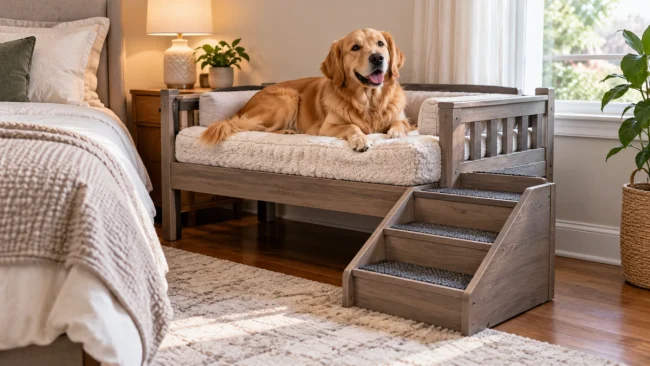
Dog beds with steps combine a raised sleeping platform with built-in access, giving your dog a dedicated way to reach the bed without jumping directly onto it.
They can be useful in bedrooms, living rooms, and other spaces where you want a raised dog bed to function as one complete furniture system. The main advantage is convenience: the sleeping surface and access route are designed together rather than relying on separate stairs placed beside the bed.
But built-in steps are only helpful when the dimensions, traction, stability, and sleeping platform all match your dog. Before choosing one, look closely at the height of the bed, the size of each step, the width of the staircase, the usable mattress area, and the amount of floor space the structure will occupy in your home.
You can also explore our Dog Beds hub for more guides about dog bed styles, sizes, materials, and access features.
What Are Dog Beds With Steps?
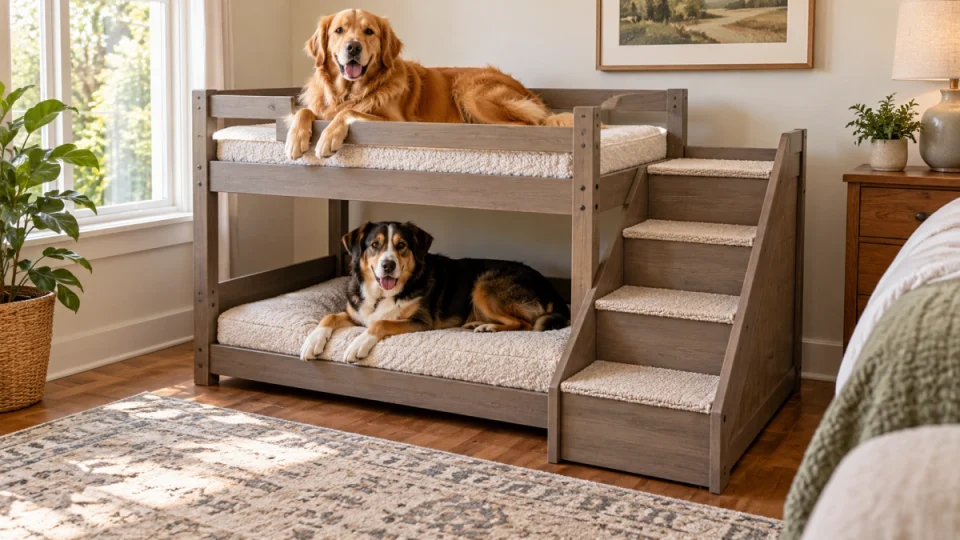
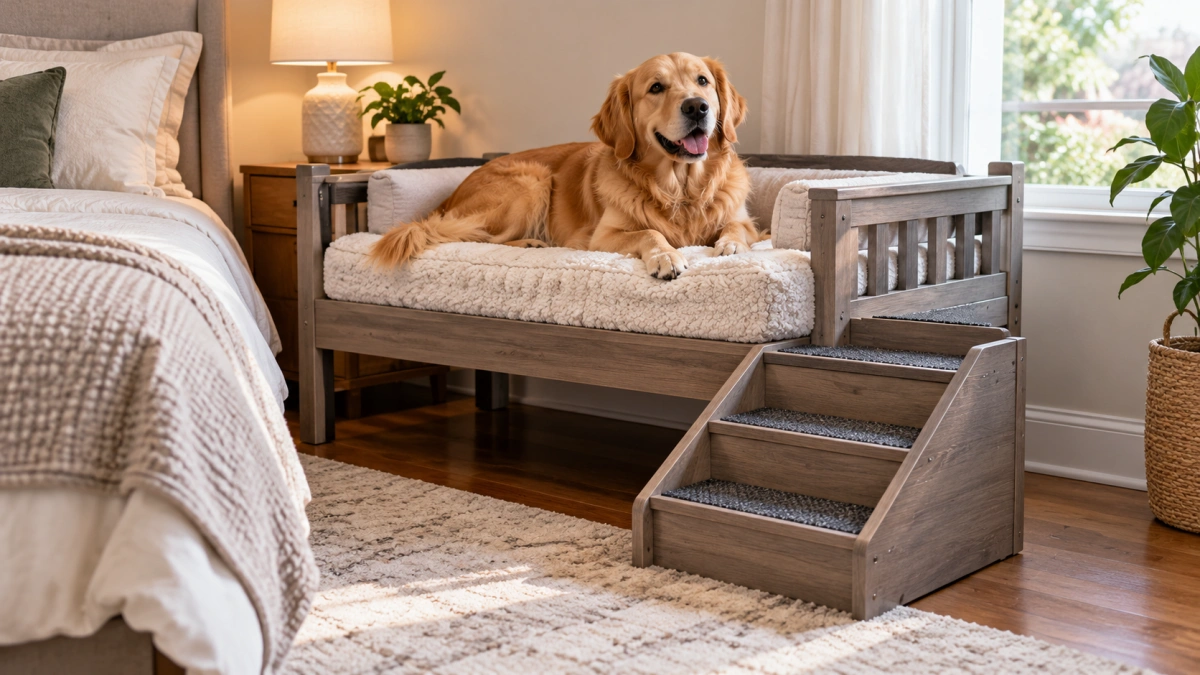
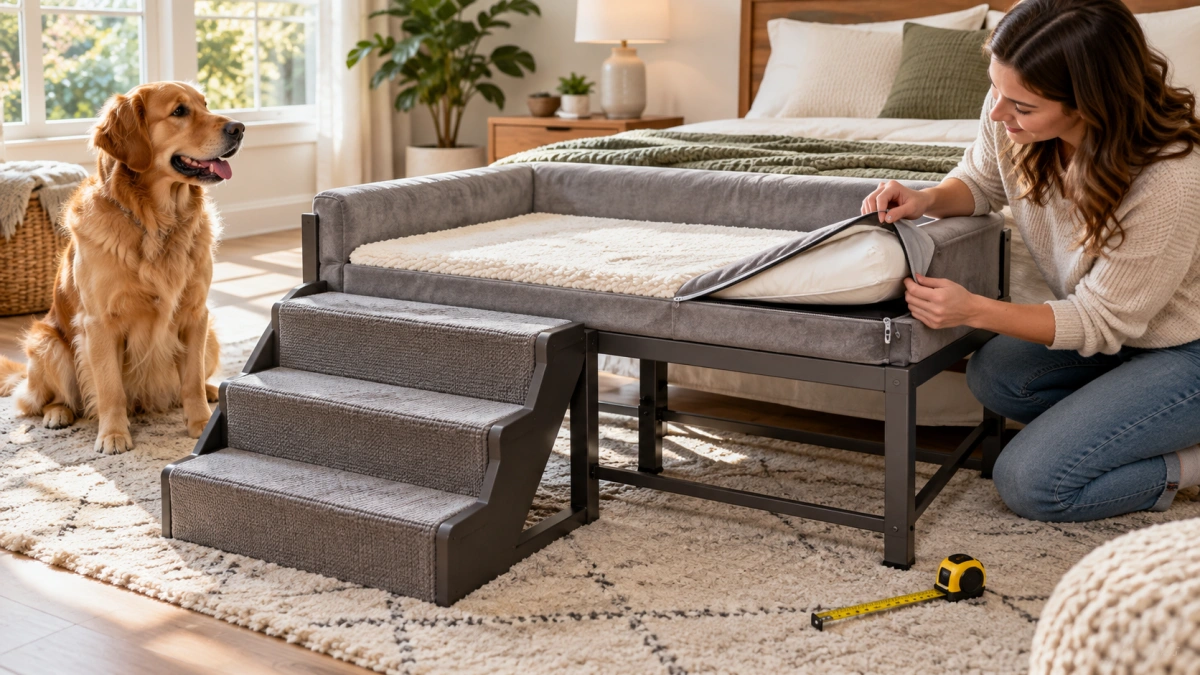
Dog beds with steps are elevated sleeping platforms with an integrated staircase or step system that helps your dog reach the mattress.
A typical design includes:
- A raised sleeping platform
- Two or more built-in steps
- A mattress or cushion on top
- A frame that supports both the bed and the access route
The steps may be positioned at the front or side of the bed, depending on the furniture design.
Most dog beds with steps provide one main sleeping surface. If you need multiple stacked sleeping areas for two or more dogs, our guide to dog bunk beds covers that type of furniture separately.
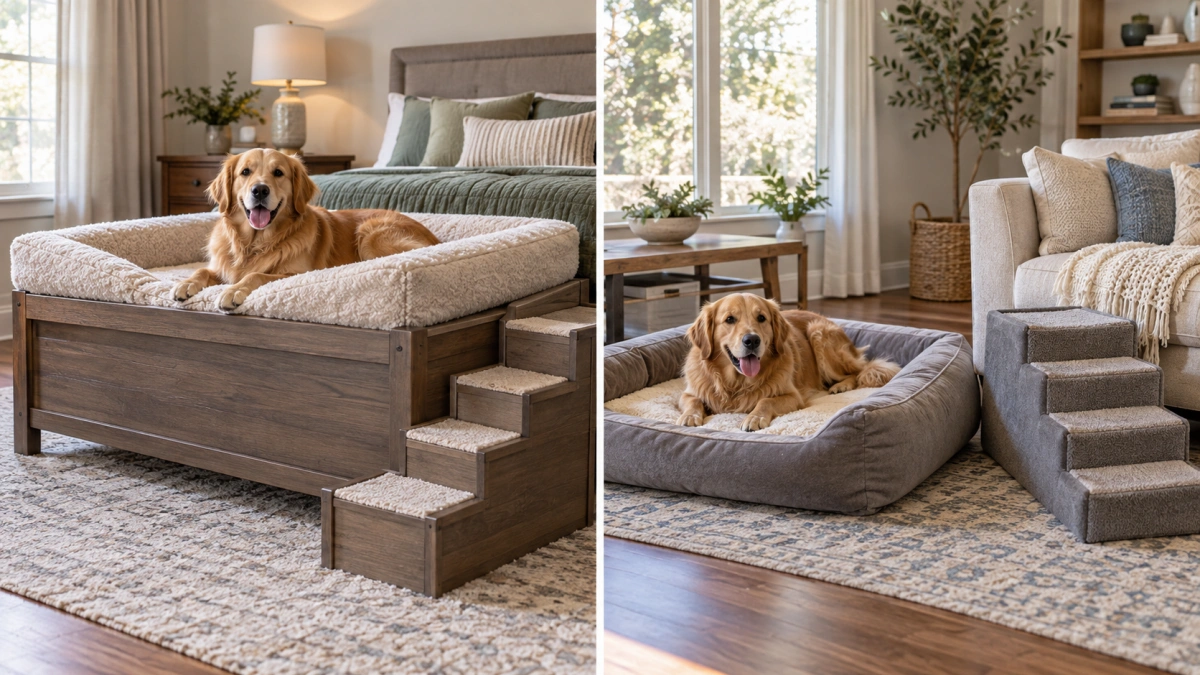
Built-In Steps vs Separate Pet Stairs
Built-in steps and freestanding pet stairs can serve similar purposes, but they are not the same setup.
| Feature | Built-In Steps | Separate Pet Stairs |
|---|---|---|
| Connection | Part of the dog bed frame | Separate piece of furniture |
| Alignment | Designed to match the bed height | Must be positioned manually |
| Movement | Usually moves with the bed | Can be repositioned independently |
| Typical use | Dedicated raised dog bed | Sofa, human bed, or existing pet bed |
Built-in steps can create a cleaner and more integrated layout, while separate stairs give you more flexibility if your dog needs access to several different pieces of furniture.
The better choice depends on whether you want a permanent sleeping setup or a movable access aid.
When Do Built-In Steps Actually Help?
Built-in steps can make the most sense when your dog’s sleeping platform is high enough that direct entry would otherwise require a jump.
They may be useful when:
- You have a raised or bedside dog bed
- Your dog is small compared with the platform height
- You want a defined access route instead of free jumping
- You prefer the stairs to remain aligned with the bed
- You do not want separate pet stairs moving around the room
They can also make the furniture easier to understand because your dog has one consistent route onto and off the bed.
However, built-in steps are not automatically the best choice for every dog. A floor-level bed may be simpler when elevation does not provide a meaningful benefit.
Measure the Bed Height and Sleeping Platform
Before looking at the stairs, make sure the actual sleeping platform fits your dog.
Check:
- Mattress length
- Mattress width
- Total platform height
- Usable sleeping area
- Published weight capacity
Your dog should be able to lie down, turn around, and change sleeping positions without being crowded by the frame or stair opening.
Also pay attention to whether the listed dimensions describe the whole furniture piece or only the mattress area. Built-in stairs can make the outside dimensions much larger than the actual sleeping surface.
Measure the Steps, Not Just the Bed
A dog bed may have an appropriate overall height while still using steps that are awkward for your dog.
Look at each step individually.
Important measurements include:
- Step rise
- Step depth
- Step width
- Total staircase width
- Top landing area
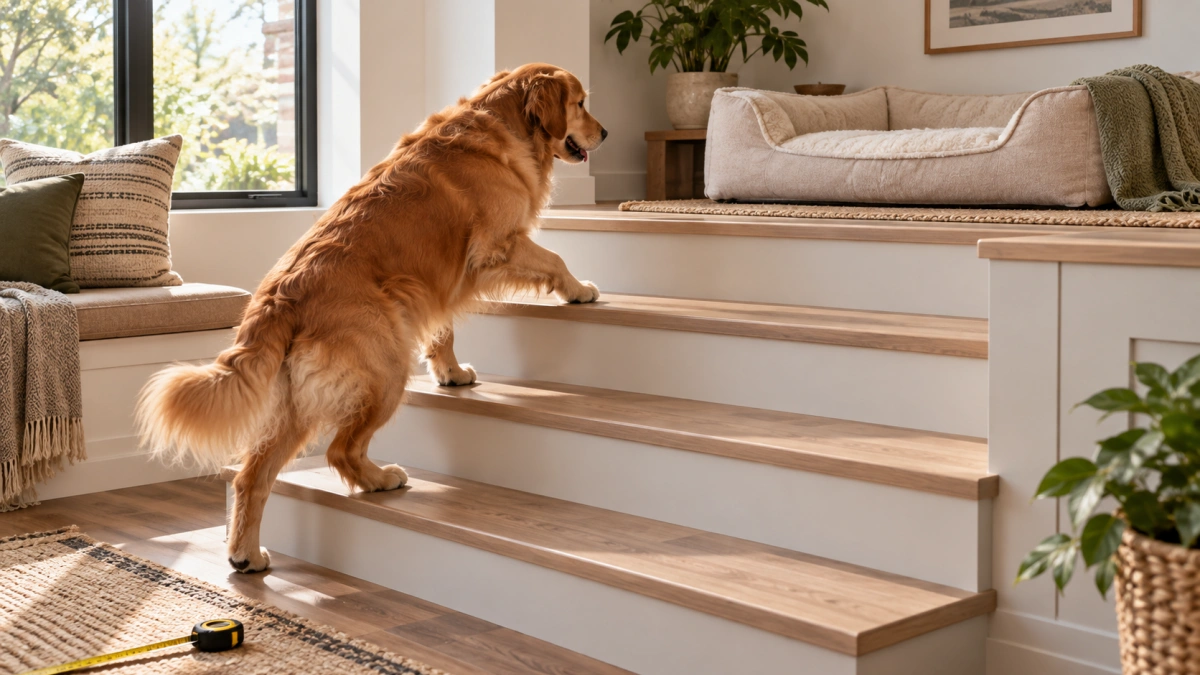
Your dog should have enough room to place its paws securely on each tread without needing to balance on a very narrow edge.
A staircase with several lower steps may feel very different from a shorter staircase with only two tall steps, even when both reach the same bed height.
Why Step Width and Depth Matter
Step dimensions affect how confidently your dog can use the staircase.
A step that is too narrow may not provide enough room for stable paw placement, while a very shallow tread can make downward movement feel less controlled.
When comparing designs, think about your dog’s body size and normal movement.
Ask:
- Can all four paws fit comfortably during the climb?
- Does your dog have enough room to reposition?
- Can your dog see and reach the next step clearly?
- Is the staircase wide enough that your dog does not feel close to the edge?
These practical details matter more than whether the staircase simply looks proportional in product photos.
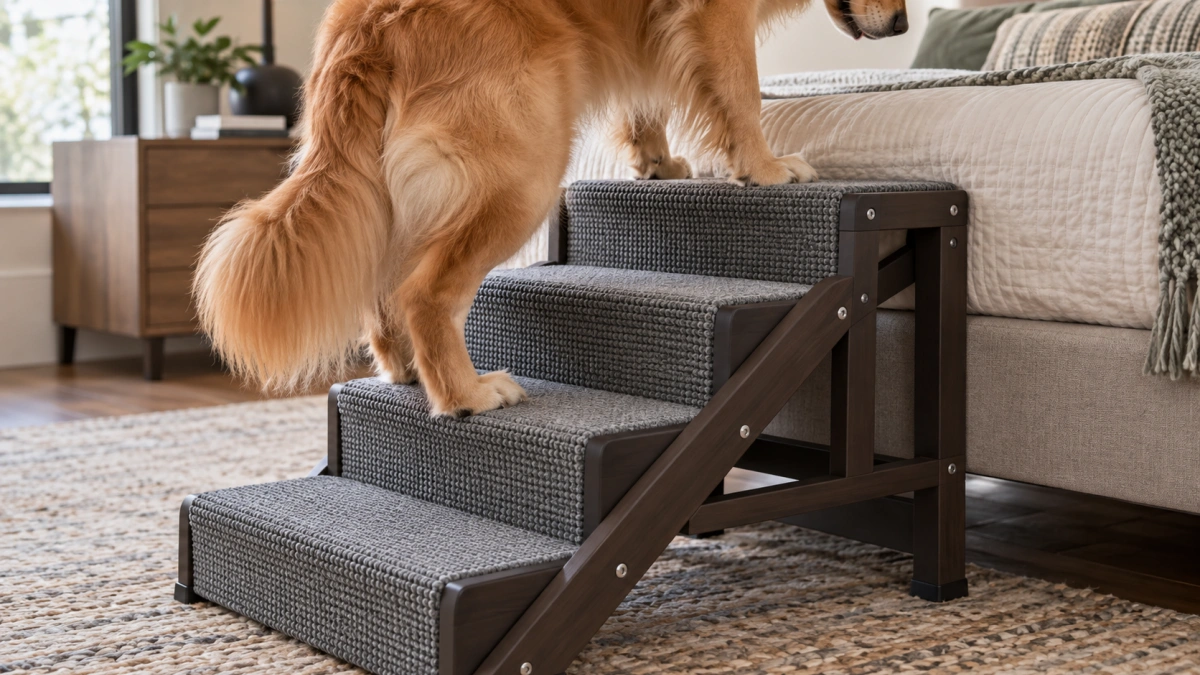
Look for Non-Slip Treads and Stable Construction
A staircase is only useful if your dog can maintain traction while using it.
Smooth wood, polished plastic, or loose fabric surfaces can make steps harder to use confidently.
Look for:
- Textured tread surfaces
- Securely attached carpeting or grip material
- A staircase that does not flex noticeably
- A stable connection between the steps and bed frame
- A base that remains steady on your flooring
If the entire bed shifts while your dog climbs, even well-sized steps may feel unreliable.
Dog Beds With Steps for Small Dogs
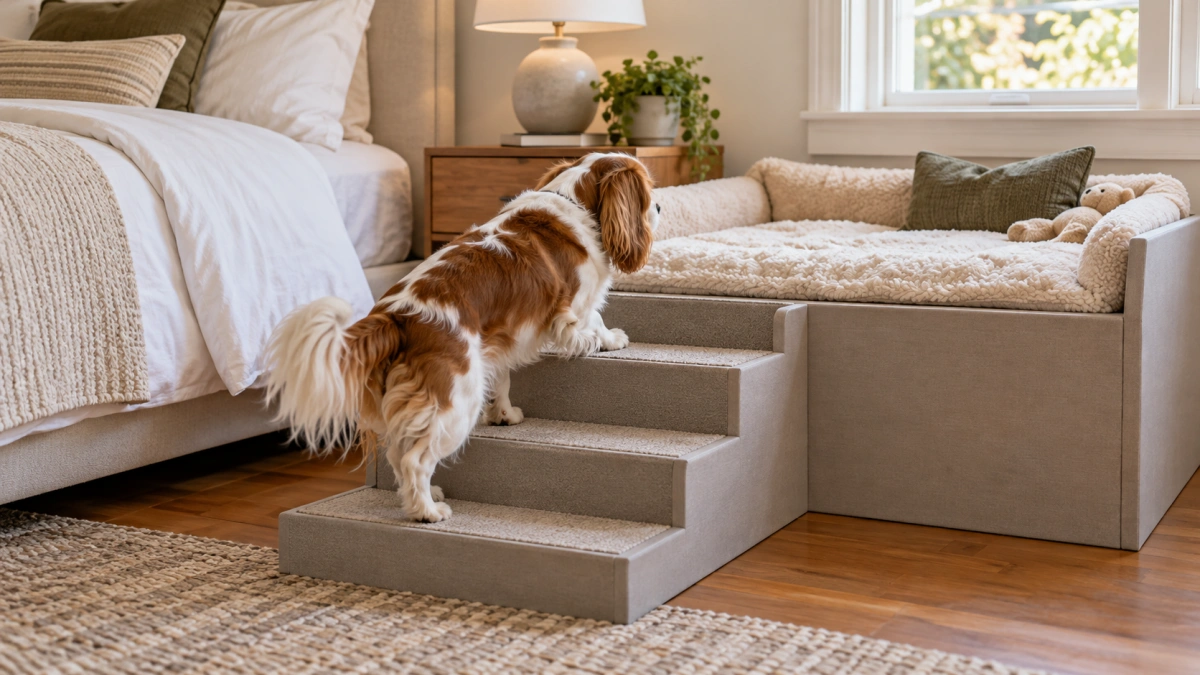
Small dogs may benefit from built-in steps when the sleeping platform sits well above their normal standing height.
For a smaller dog, check whether:
- The step rise is manageable
- The treads are deep enough for secure footing
- The staircase is not excessively steep
- The top landing provides enough room to transition onto the mattress
- The bed itself is not oversized for your room
A design made for a large dog may use steps that are too tall for a much smaller dog even if the sleeping surface itself is comfortable.
Bedside Dog Beds With Steps
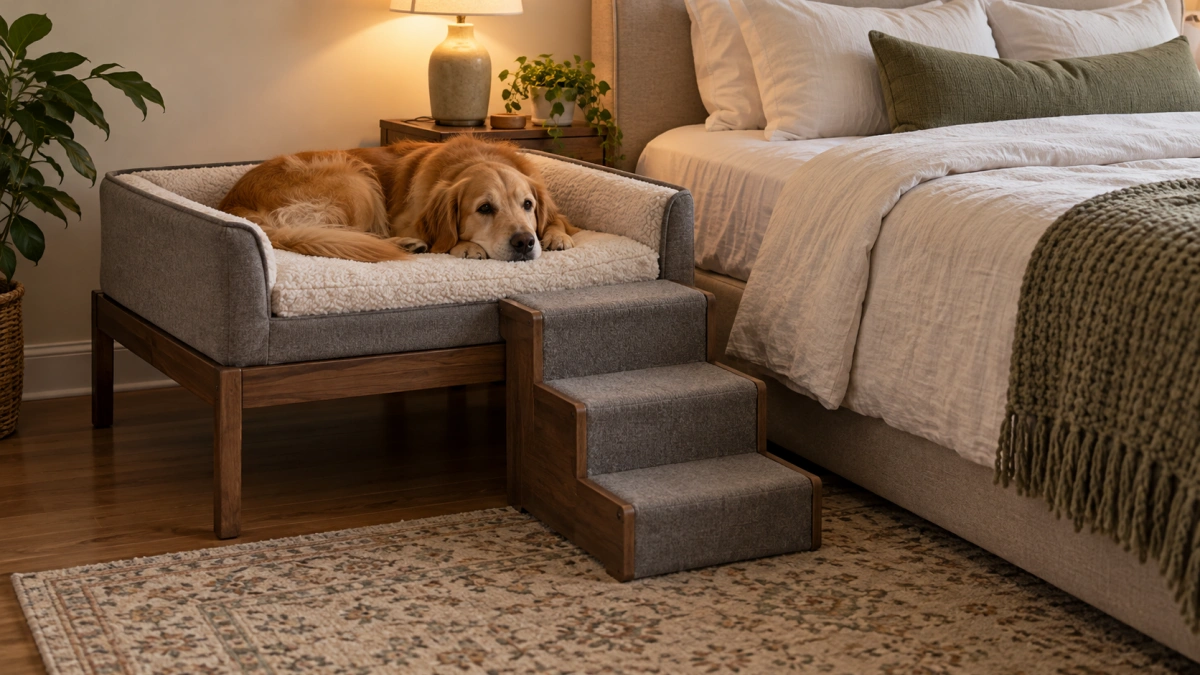
A bedside dog bed with steps places your dog’s sleeping area near the height of your own bed while keeping the pet on a separate sleeping platform.
This setup may appeal to you if you want your dog nearby at night without sharing the same mattress.
Before choosing a bedside design, measure:
- The height of your human bed
- The height of the dog bed platform
- The total width of the pet furniture
- The amount of aisle space remaining beside your bed
- The direction in which the stairs extend
Make sure the staircase does not block a doorway, closet, nightstand, or common walking path.
Built-In Steps vs a Ramp
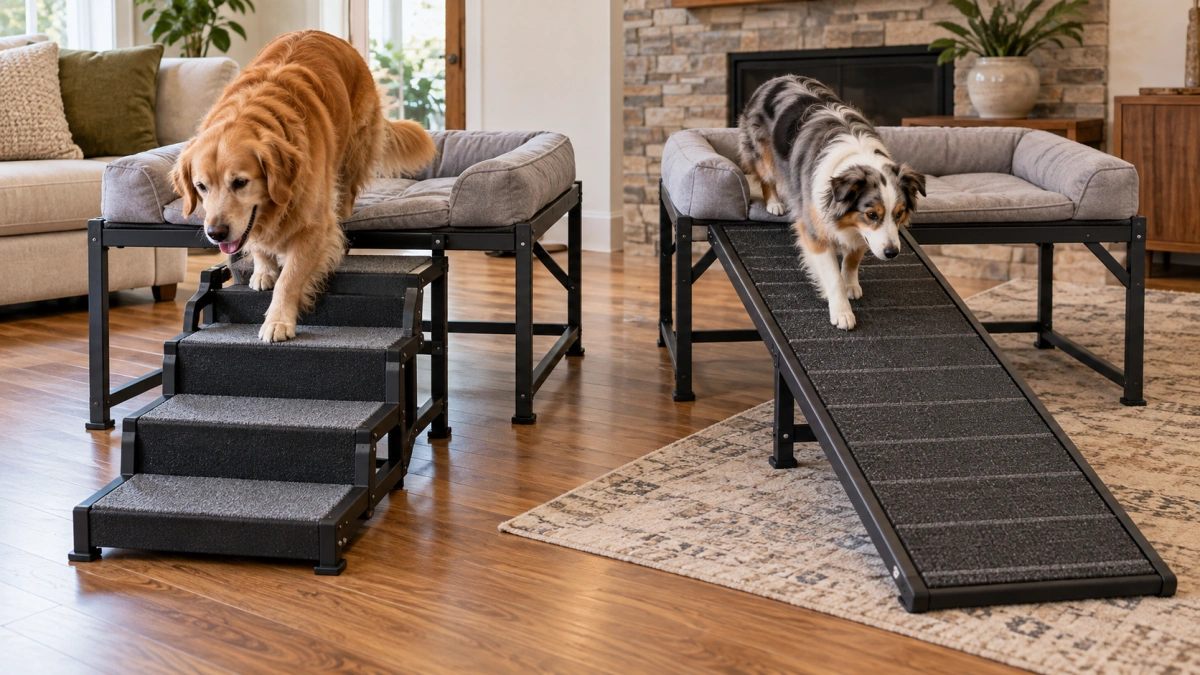
Steps are not the only way to reach an elevated dog bed. A ramp provides a continuous inclined path instead of separate treads.
| Feature | Built-In Steps | Ramp |
|---|---|---|
| Floor footprint | Usually shorter | Usually longer |
| Movement style | Repeated stepping | Continuous incline |
| Furniture integration | Often built into the bed | Often separate |
| Traction | Important on each tread | Important across the full surface |
| Best choice | Depends on your dog | Depends on your dog |
There is no single option that works best for every dog.
A compact staircase may fit your room better, while a ramp may feel more natural for a dog that does not like individual steps.
The best choice depends on your dog’s size, movement, confidence, and the amount of available floor space.
How Much Floor Space Will the Steps Use?
A raised dog bed with steps may use more room than the mattress dimensions suggest.
The total footprint includes:
- The bed frame
- The staircase
- Any landing area
- Space your dog needs to approach the first step
- Clearance for cleaning around the furniture
Before ordering, compare the complete assembled dimensions with the space available in your home.
You can also use removable tape on the floor to outline the expected footprint. This makes it easier to see whether the steps will interfere with normal walking routes.
Do Built-In Steps Reduce Sleeping Space?
They can, depending on how the furniture is designed.
Some staircases attach outside the sleeping platform, while others use part of the frame or mattress opening as the entrance point.
Check whether:
- The staircase reduces mattress width
- The top landing takes space from the sleeping area
- Rails or side panels limit how your dog can stretch
- Storage steps make the overall frame wider
A large exterior frame does not always mean a large usable mattress.
Compare both measurements before deciding whether the design gives your dog enough room.
Can Your Dog Use the Steps Independently?
Your dog should be able to climb onto and leave the bed without needing you to lift, guide, or reposition it every time.
Watch whether your dog can:
- Approach the stairs comfortably
- Place its paws securely on each tread
- Reach the mattress without jumping the final gap
- Turn around on the platform
- Walk back down without trying to leap from the side
If your dog repeatedly avoids the staircase or chooses to jump directly from the elevated platform, the design may not be a good match.
Helping Your Dog Learn to Use the Steps
Some dogs understand built-in steps immediately, while others need time to become comfortable with a new access route.
Start with the bed in its permanent location so the staircase does not keep changing position.
You can help by:
- Keeping the stairs free of clutter
- Allowing your dog to investigate without pressure
- Encouraging calm movement one step at a time
- Rewarding confident use
- Avoiding physically forcing a nervous dog up the staircase
Your dog should be allowed to choose the route comfortably rather than being placed onto an elevated bed it does not understand how to leave.
When a Floor-Level Dog Bed May Be Better
A raised bed with built-in steps adds complexity, height, and floor footprint. If your dog does not need an elevated sleeping surface, a simple floor-level bed may be more practical.
A floor bed can make more sense when:
- Your dog strongly prefers sleeping close to the floor
- Your room has very limited space
- The staircase blocks normal walking areas
- Your dog refuses to use steps
- You want the simplest possible cleaning setup
Do not choose an elevated design just because it looks more like furniture. The sleeping arrangement should work for your dog and your home.
If your dog suddenly becomes reluctant to climb steps, jump, or move in ways that were previously comfortable, consider discussing that change with your veterinarian rather than assuming the problem is simply the furniture.
Dog Bed With Steps Buying Checklist
Before choosing a dog bed with built-in steps, check the complete system rather than evaluating the staircase and mattress separately.
- Measure the usable mattress area
- Check the bed’s published weight capacity
- Measure the total platform height
- Compare individual step rise
- Check step depth and width
- Look for non-slip tread surfaces
- Confirm the staircase is securely attached
- Make sure the top landing is easy to enter
- Check whether the mattress stays securely in place
- Measure the complete assembled floor footprint
- Make sure your dog can use the steps independently
- Check whether covers and bedding are easy to remove and wash
Final Thoughts
Dog beds with steps can be useful when you want a raised sleeping area with a dedicated access route built directly into the furniture.
The most important details are not how stylish the staircase looks, but whether the bed and steps work together for your dog.
Measure the sleeping platform, compare the rise and depth of each step, look for good traction, check frame stability, and make sure the complete furniture footprint fits comfortably in your home.
When your dog can climb onto the bed, rest comfortably, and return to the floor without hesitation, built-in steps can turn an elevated dog bed into a more practical everyday setup.